Why has Roman concrete lasted so long?
Volcanic ash in the mix, plus lime lumps that seal cracks on their own, are thought to explain its long life.
1900years
Walk around Rome and you will see buildings almost 2,000 years old standing as if it were the most natural thing in the world. Many of them are held up by concrete made by the ancient Romans. The concrete around us today, by contrast, can crack and need repairs within a few decades if conditions are harsh.
So how is it that a modern material, backed by all our technology, loses to an ancient one on lifespan? Recent research has slowly been bringing the answer to light.
The key ingredient: volcanic ash from Naples
Roman concrete is known in Latin as opus caementicium. It was made by mixing lime, produced by burning limestone, with water and sand, then setting it together with chunks of crushed stone or broken brick. It is said to have been in widespread use by around 150 BC.
Plain lime mortar was common across the ancient world. What set the Romans apart was the volcanic ash they used in place of sand. This volcanic sand, dug near Pozzuoli outside Naples, is called pozzolana after the town. The architect Vitruvius wrote that when this powder is mixed with lime, it sets hard even under the sea. Silicon and aluminum in the ash react with the lime to form a bond as tough as stone.

The white specks weren’t a mistake
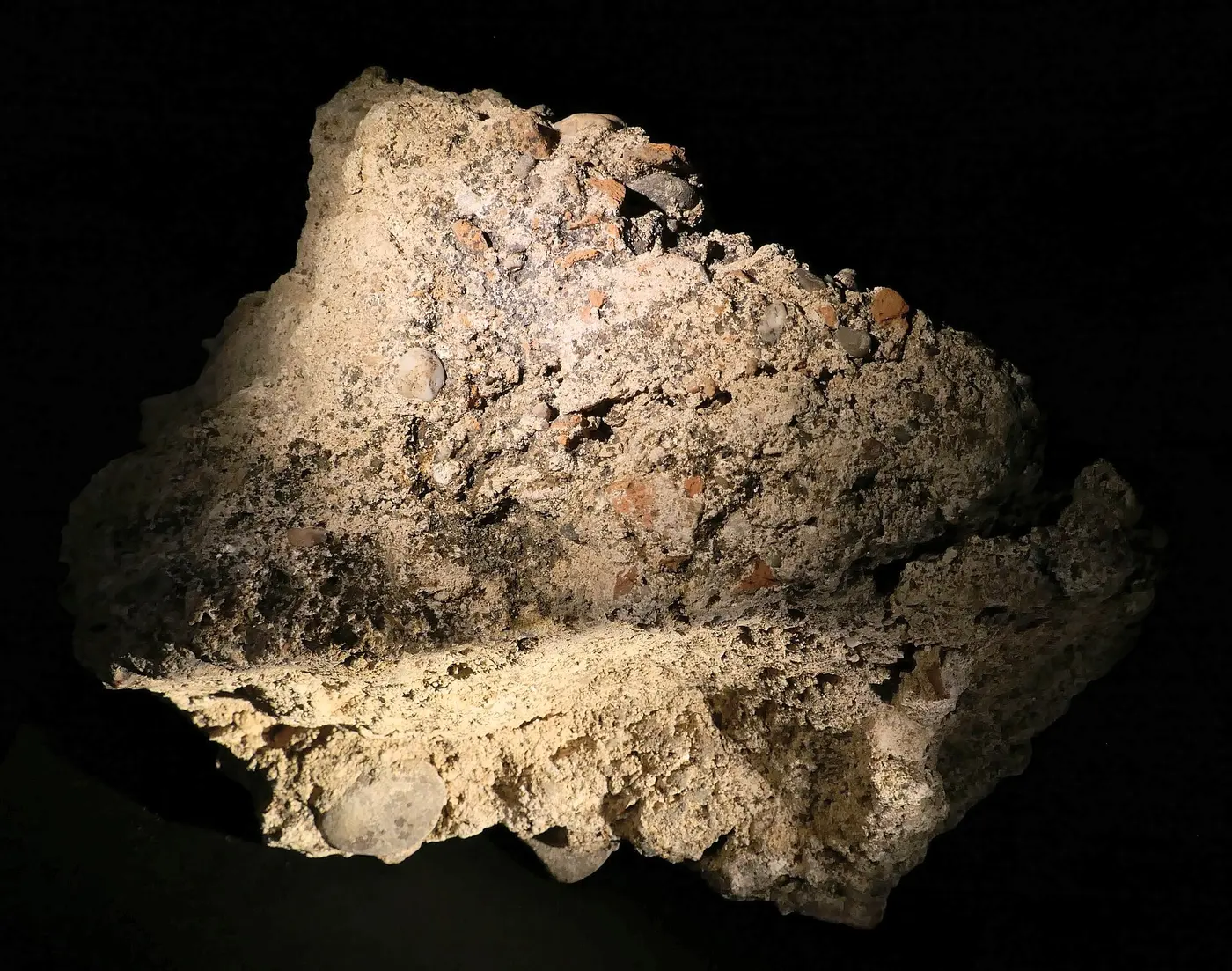
Break open a piece of Roman concrete and you will find tiny white specks, a few millimeters across, scattered through it. They are lumps of lime known as lime clasts. For a long time they were taken as a sign of sloppy work, proof that the material had not been mixed properly.
Then, in January 2023, a team led by Professor Admir Masic of the Massachusetts Institute of Technology (MIT) overturned that view in the journal Science Advances. The team concluded that the Romans used a method called “hot mixing,” adding quicklime directly, before it had been slaked with water, and kneading the mixture while it gave off intense heat. The white specks, they argued, were brittle lumps of lime formed in the process.
Those specks act as a repair crew. When a crack forms and water seeps in, calcium dissolves out of the specks. It then hardens again as calcium carbonate and fills the gap. When the team deliberately cracked samples made with quicklime and ran water through them, the cracks sealed completely within about two weeks. Samples made without quicklime did not heal.
Breakwaters that grow stronger in seawater
The Romans also used this concrete to build harbors and breakwaters out at sea. The naturalist Pliny wrote that concrete sunk in the sea becomes “a single stone mass, impregnable to the waves and every day stronger.”
That may sound like an exaggeration, but in 2017 Marie Jackson of the University of Utah and her colleagues published research that backs it up. As seawater seeps into the concrete, components of the volcanic ash dissolve, and crystals of minerals called aluminous tobermorite and phillipsite slowly grow. These crystals are thought to fill the gaps and interlock, binding the whole mass more tightly. Seawater is the great enemy of modern concrete, but Roman concrete turned it into an ally.
A giant dome with no steel
The high point of Roman concrete is the Pantheon in Rome. The present building was completed in the first half of the 2nd century, in the reign of the emperor Hadrian, and is said to have been dedicated around AD 126. Its dome is 43.3 meters (142 feet) across, and it is still the largest dome in the world made of concrete without steel reinforcement.
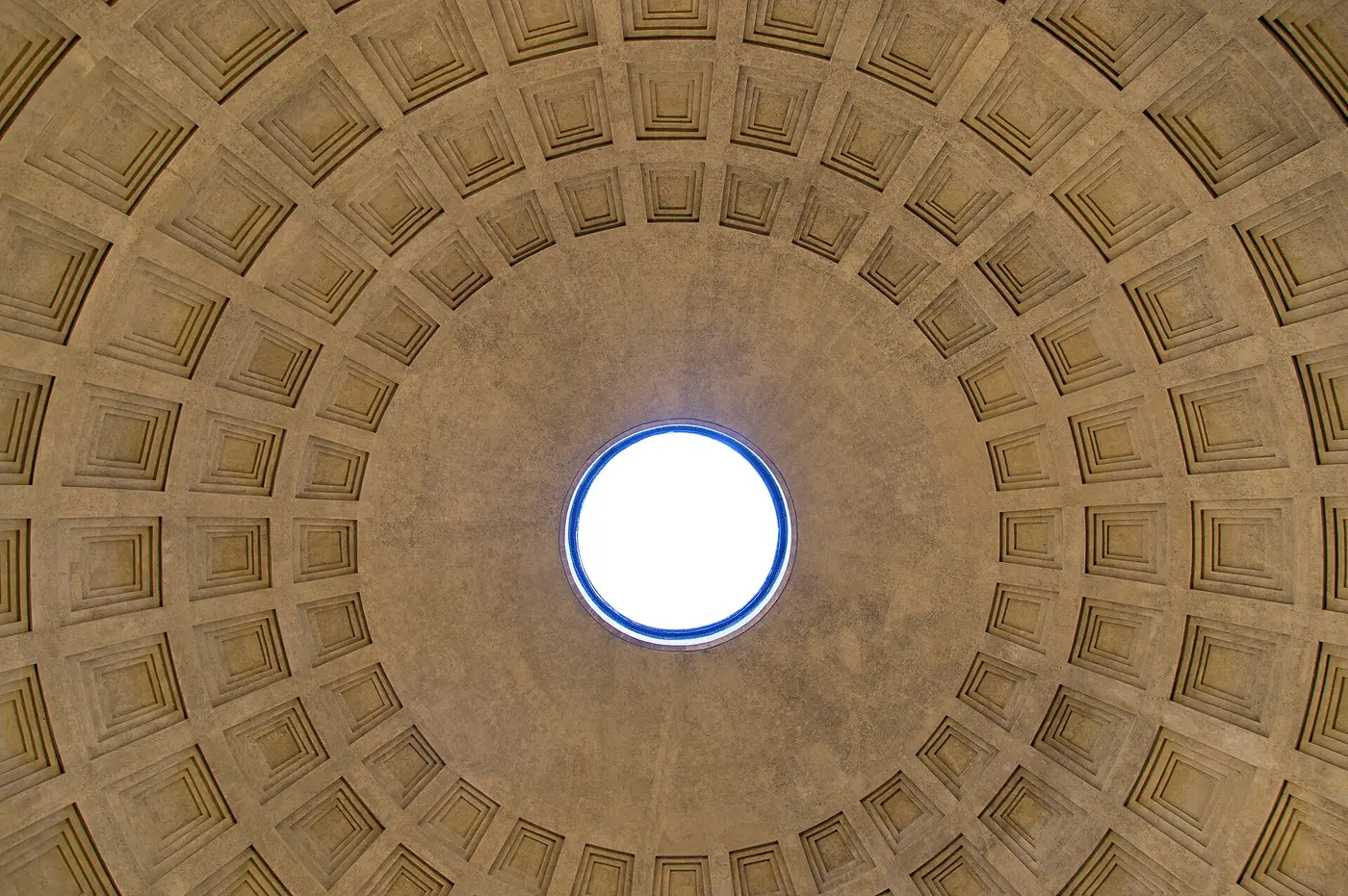

The dome thins from about 6.4 meters at its base to about 1.2 meters near the top. The aggregate changes too: heavy travertine low down, giving way to lighter tuff and pumice higher up. Lightening the upper part kept the dome from collapsing under its own weight.
In fact, when it comes to resisting crushing force alone, modern concrete is the stronger material. One reason modern buildings deteriorate faster is the steel inside them. When reinforcing bars rust, they swell and split the concrete from within. Roman buildings, which used no steel, had no such weakness. Of course, not all Roman concrete survived. It is worth remembering that what we see today are the buildings that were especially well made and lucky with their conditions.