What is the oldest money in Japan?
The late-7th-century Fuhonsen is now seen as the oldest copper coin, older than the long-favored Wadō kaichin.
708
Ask people in Japan what the country’s first money was, and many will answer “Wadō kaichin” (和同開珎). They learned it in history class, and some may even remember drilling its tricky characters for a test.
Today, though, many Japanese textbooks introduce a different coin as older than the Wadō kaichin. The turning point was an excavation carried out in Nara Prefecture at the very end of the 20th century.
The birth of the Wadō kaichin
The Wadō kaichin was first made in 708, shortly before the capital moved to Nara. According to the Shoku Nihongi, an official history compiled in the 8th century, copper was presented to the imperial court that year from Chichibu District in Musashi Province, around today’s city of Chichibu in Saitama Prefecture. Delighted, the court changed the era name to Wadō, “Japanese copper,” and soon had silver and copper coins minted.
The design followed the Kaiyuan Tongbao, the currency of Tang-dynasty China at the time: a round coin with a square hole in the middle. Its name can be read two ways, “Wadō kaichin” or “Wadō kaihō,” and opinions differ over the fourth character, 珎. Some read it as 珍 (chin, “rare, precious”); others take it as an abbreviation of 寳 (hō, “treasure”).
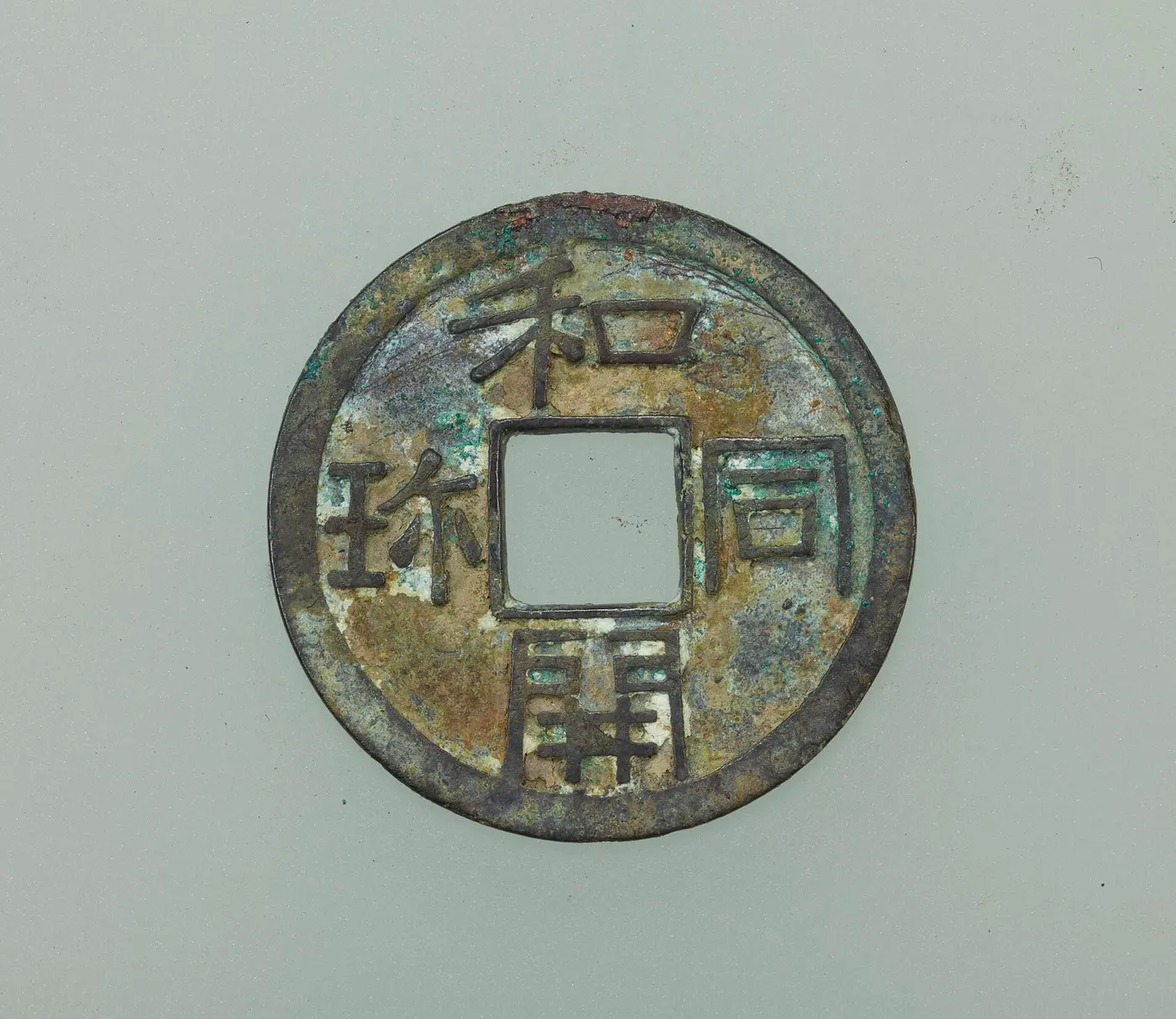

Coins, however, were unfamiliar to people at the time. Goods were normally traded for rice or cloth. So in 711 the court issued an edict granting court rank to anyone who saved up a certain amount of coin, to encourage their use.
Coins from Asuka Pond
The existence of a coin that might be older than the Wadō kaichin had actually been known since the Edo period (1603–1868). It was the Fuhonsen (富本銭), stamped on its face with the two characters 富本, fuhon. But few had been found, and they were thought to be good-luck charms or coins used in rituals rather than real money.
An announcement in 1999 changed that view dramatically. At the Asukaike site in the village of Asuka, Nara Prefecture, 33 Fuhonsen were found in the remains of a late-7th-century workshop. Large quantities of copper waste from casting coins, along with coin-shaped molds, also turned up, making it clear that Fuhonsen had been produced in bulk right there. Judging from the soil layers they came from and other evidence, the Fuhonsen came to be seen as having been made more than 20 years before the Wadō kaichin.
The Nihon Shoki, Japan’s oldest official chronicle, records that in 683, during the reign of Emperor Tenmu, an order was issued: “From now on, copper coins must be used. Do not use silver coins.” The “copper coins” mentioned here are widely thought likely to have been the Fuhonsen.
What “fuhon” means
The Fuhonsen measures about 2.4 centimeters across, nearly the same as the Wadō kaichin. The characters 富 and 本 sit above and below the square hole, and to its left and right is a pattern called shichiyōsei, “seven luminaries,” with seven dots arranged like the plates of a tortoise shell.
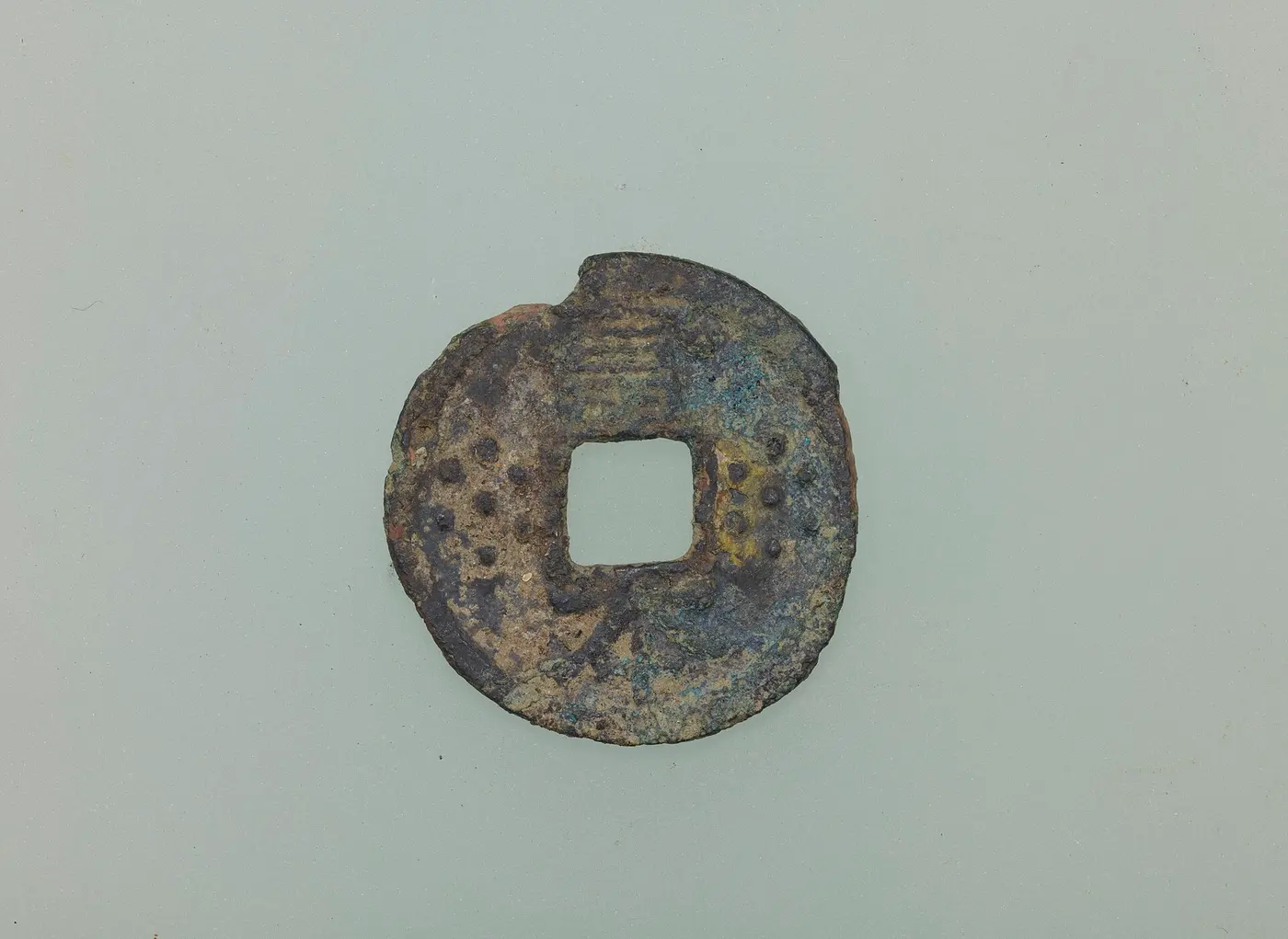

The word fuhon is thought to come from a passage in an ancient Chinese text: “The foundation (本) of enriching (富) the people lies in food and money.” In other words, food and currency are the basis of the people’s prosperity. The name conveys the ambition of a court that was busy building a nation.
Was it really used as money?
How widely the Fuhonsen actually circulated among ordinary people is still debated. Some see it as genuine currency that the state used for payments and the like. Others, noting that it has been found in only a limited number of places, suspect it also had a strong ritual character.
There is another wrinkle. In the 7th century, plain silver discs bearing no inscription, called mumon ginsen (無文銀銭), “uninscribed silver coins,” are also thought to have been in use. They may have been money valued by weight, and if you count them, the history of money in Japan goes back even further. The answer to “What was the oldest money?” still has room to change, depending on what you are willing to call money.