Why does the Leaning Tower of Pisa lean?
It was built on soft ground with a shallow foundation. It had already begun to tilt during construction, in 1178.
199years
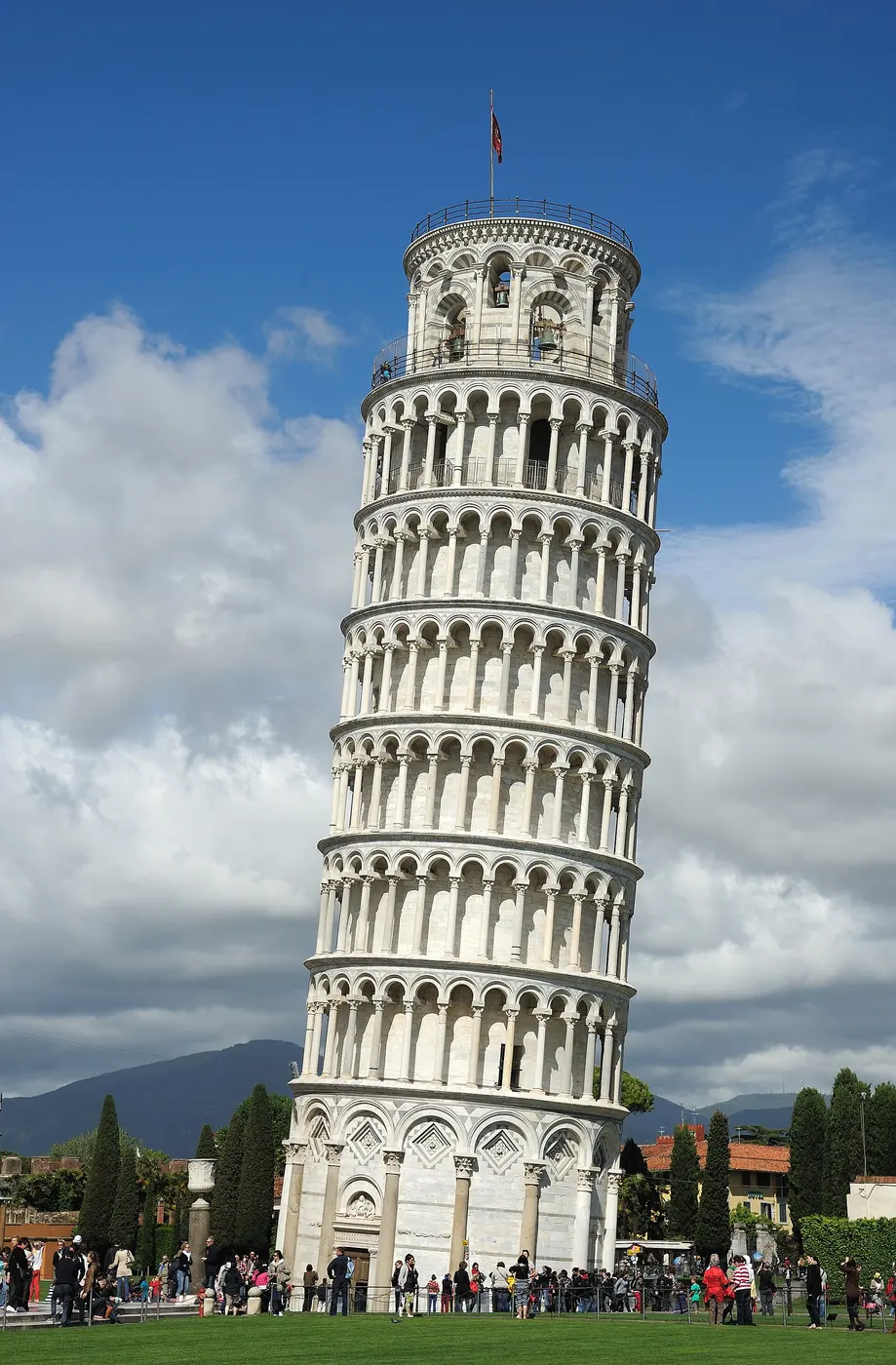
Pisa, a town in central Italy. In the cathedral square stands a white tower that almost everyone has seen in photos, tipped at an angle that makes it look ready to topple. Tourists posing as if propping it up with their hands have become a familiar sight.
The tower was never meant to lean. It started tilting while it was still being built.
Sinking before it was finished
The Leaning Tower of Pisa was built as the bell tower of the cathedral. Work began in August 1173. But in 1178, when only the lower floors had gone up, the tower began to sink.
The cause lay underfoot. The foundation was only about 3 meters deep, and the ground at Pisa is soft, built up from layers of clay and sand carried in by rivers and the sea. Unable to bear the tower’s weight evenly, the ground let one side sink deeper than the other.

Saved by war
Work then stopped for nearly a century. The Republic of Pisa was almost constantly at war with Genoa, Lucca, and Florence.
That interruption turned out to be a stroke of luck. While construction was on hold, the weight of the tower compacted the soil beneath it. Had the builders kept stacking stone without a break, it is thought the tower would almost certainly have fallen.
When work resumed in 1272, the engineers tried to disguise the tilt. They built the upper floors slightly taller on the leaning side. As a result the tower is not straight; look closely and you will see it curves slightly, like a banana. Construction was interrupted again along the way, and the bell chamber at the top was not finished until 1372, 199 years after work began.
Major surgery on the brink
Even after completion, the tower kept slowly leaning. By 1990 the tilt had reached about 5.5 degrees, and in January of that year the tower was closed to the public. The sudden collapse of a medieval tower in Pavia, elsewhere in Italy, the year before, which killed people, added to the sense of alarm.
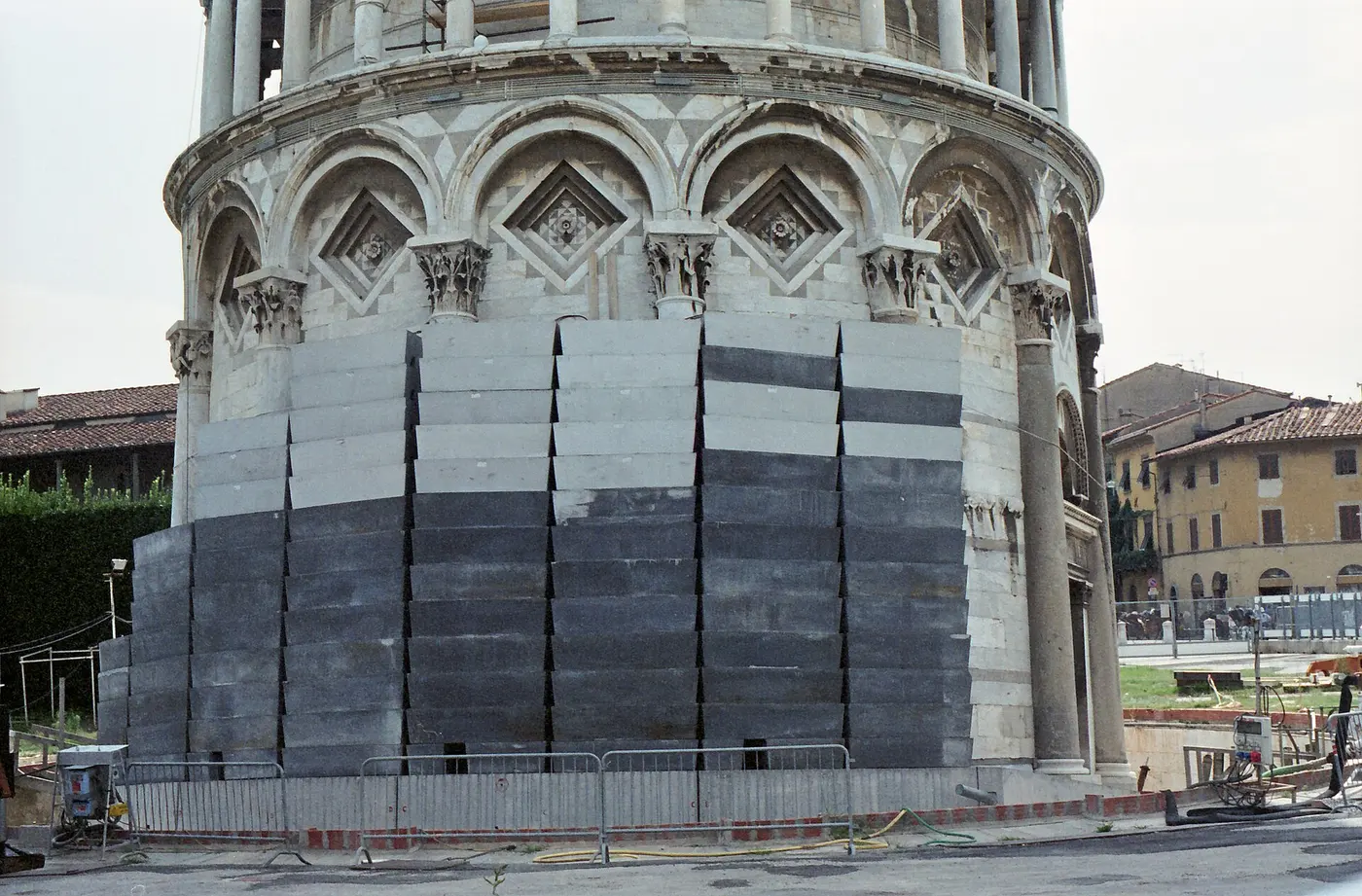

Starting in 1993, a total of 870 tonnes of lead weights were placed at the base of the tower, pulling it back slightly. The decisive step was removing soil, little by little, from beneath the north side, the raised side opposite the lean. About 38 cubic meters of soil came out. Letting the north side settle a little brought the tower upright by about 45 centimeters (18 inches), back to roughly where it had been in 1838.
The tower reopened in December 2001, its tilt now about 4 degrees. In 2008, it was reported that the lean had stopped progressing for the first time in the tower’s history. Nobody, however, considered straightening it completely. A Leaning Tower that doesn’t lean would hardly be the Leaning Tower of Pisa.
Did Galileo’s experiment really happen?
Many people think of Galileo Galilei’s falling-body experiment when they think of the tower. As the famous story goes, he dropped two balls of different weights from the top and showed that they hit the ground at the same time.
The main source for this story, however, is a biography written in 1654 by his pupil Vincenzo Viviani. Galileo’s own writings contain no record of an experiment at the tower. That is why many historians believe the story is a legend that grew out of a “thought experiment,” worked out in Galileo’s head, rather than a public demonstration that actually took place.
In fact, there is a solid record of a similar experiment elsewhere. In 1586 in Delft, in the Netherlands, the mathematician Simon Stevin and a colleague dropped two lead balls, one ten times heavier than the other, from a height of about 30 feet (about 9 meters), and reported that they reached the ground together.