Is it true that pure water doesn’t conduct electricity?
It barely does. Water conducts electricity thanks to the ions dissolved in it.
Don’t touch electrical appliances with wet hands in the bathroom. Most of us have been told that since childhood. Water and electricity are a dangerous combination; everyone knows that.
Yet in science class, we hear that pure water barely conducts electricity at all. What’s going on? The key lies in tiny, invisible particles dissolved in the water.
Ions carry the current
In a metal, electrons that can move about freely carry the electric current. In water, the current is carried by ions: atoms or molecules that have an electric charge.
Dissolve table salt in water, for example, and the sodium chloride splits into positive sodium ions and negative chloride ions. Apply a voltage, and the positive ions start moving toward the negative electrode and the negative ions toward the positive one, so a current flows. The idea that substances dissolving in water break apart into ions was put forward in the late 19th century by the Swedish chemist Svante Arrhenius, who received the Nobel Prize in Chemistry in 1903.


Tap water, river water and our own sweat all contain dissolved ions such as sodium, calcium and magnesium. That is why they conduct electricity.
Water without impurities is nearly an insulator
So what happens if you strip out the ions completely? Semiconductor factories and similar facilities use “ultrapure water,” from which impurities have been removed to the utmost limit. Its electrical conductivity is about 0.055 microsiemens per centimeter at 25°C. Typical drinking water measures about 200 to 800 microsiemens, so ultrapure water conducts only a few thousandths to a little over a ten-thousandth as well. Compared with seawater, it’s about one millionth.
Even so, its conductivity never quite reaches zero, because a tiny fraction of water molecules split apart on their own into hydrogen ions and hydroxide ions. In water at 25°C, that is roughly one molecule in every 550 million. These few ions provide ultrapure water’s faint path for electricity.
Pure water doesn’t stay pure
Ultrapure water’s resistance to electricity is very fragile, however. Simply exposing it to air lets carbon dioxide dissolve into it, creating ions that make it conduct more easily. Distilled water left out in the air can reportedly see its conductivity rise about 10 to 20 times.
Even the slightest trace of salt makes a clear difference. In the world of ultrapure water, salt at a level of just 0.1 parts per billion, or one part in 10 billion, is enough to change the reading.
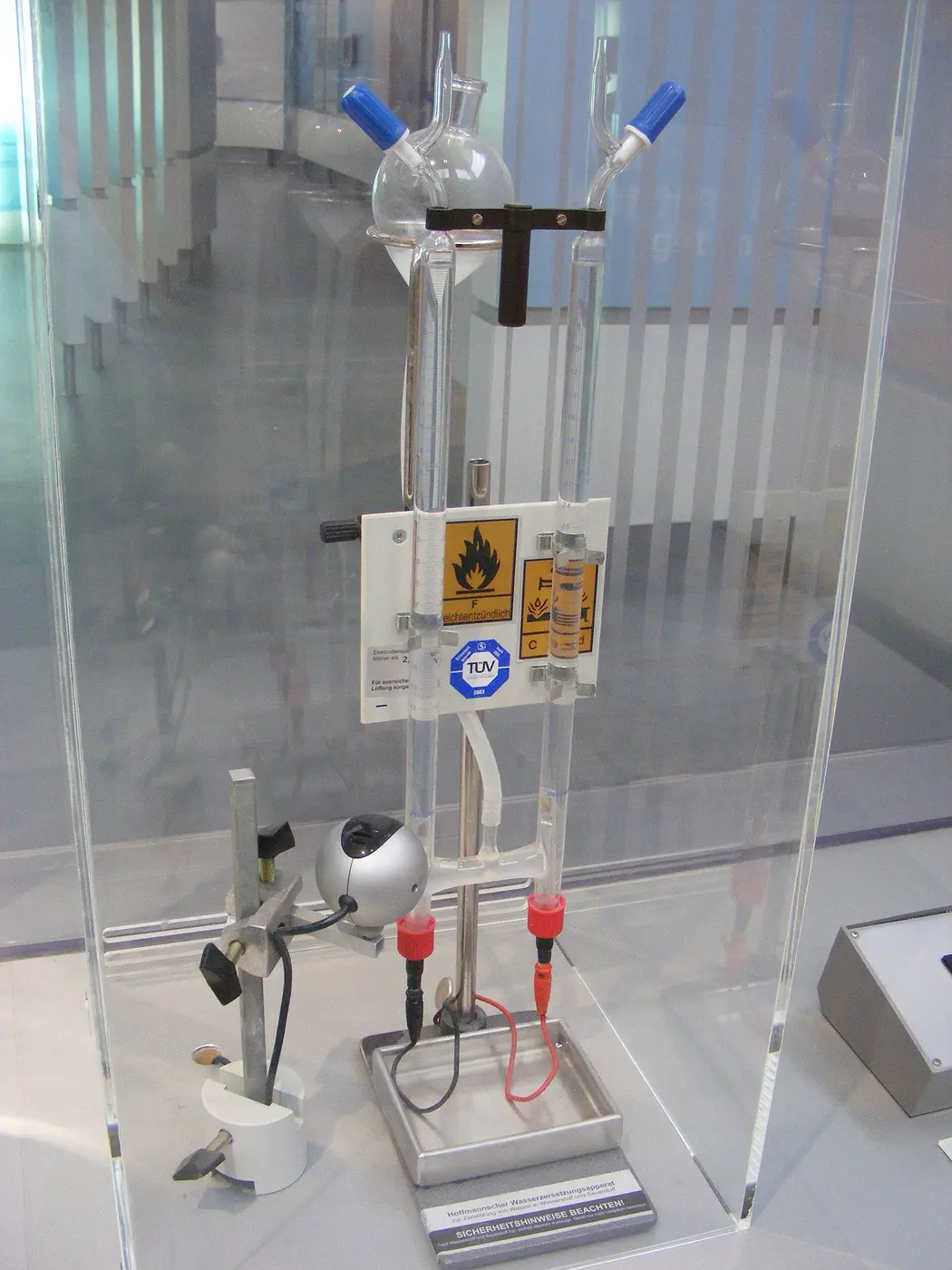

This is also why, when students split water by electrolysis in science class, a little sodium hydroxide or a similar substance is dissolved in it first. Plain water lets current through only poorly, so adding ions creates a path for the electricity.
Electricity around water is still dangerous
So would it be safe to touch electricity with hands wet with pure water? Not in the least.
All the water around us contains ions. Even if it were pure, the moment it touched your hands, sweat and dirt on the skin would dissolve into it. Besides, the fluids that fill our bodies are themselves salty and good conductors of electricity. When skin is wet, electricity can enter the body more easily, and the risk of electric shock rises sharply. The fact that pure water conducts poorly is no excuse for being casual with electricity around water.