What is the white fog from dry ice?
Not carbon dioxide, but tiny droplets of water and ice formed when moisture in the air is chilled. Carbon dioxide itself is invisible.
In Japan, cake shops and ice cream parlors often tuck a lump of dry ice into the box to keep things cold on the way home. Drop it into a glass of water once you get there, and it bubbles away as white smoke spills over the rim and pours across the table.
Dry ice is frozen carbon dioxide. So it seems only natural to assume that white smoke is carbon dioxide. In fact, what you are seeing is not carbon dioxide at all.
Carbon dioxide is invisible
The air we breathe out contains about 4 percent carbon dioxide, yet our breath does not normally look white. Like the carbon dioxide already in the air, carbon dioxide gas is colorless and transparent.
Dry ice turns straight from a solid into a gas, without ever becoming liquid, at an extremely low −78.5°C (−109°F). This is called sublimation. The carbon dioxide gas it gives off is very cold and chills the surrounding air sharply.
Air contains invisible water vapor. When that vapor is cooled enough, it can no longer stay a gas and condenses into tiny droplets of water or specks of ice. Those particles scatter light, and so they look white. Japan’s Consumer Affairs Agency explains the white smoke around dry ice in just this way: moisture in the air, turned into water and ice particles by the drop in temperature. It is basically the same thing that makes your breath visible on a winter morning, or forms clouds in the sky.

Why water makes more fog
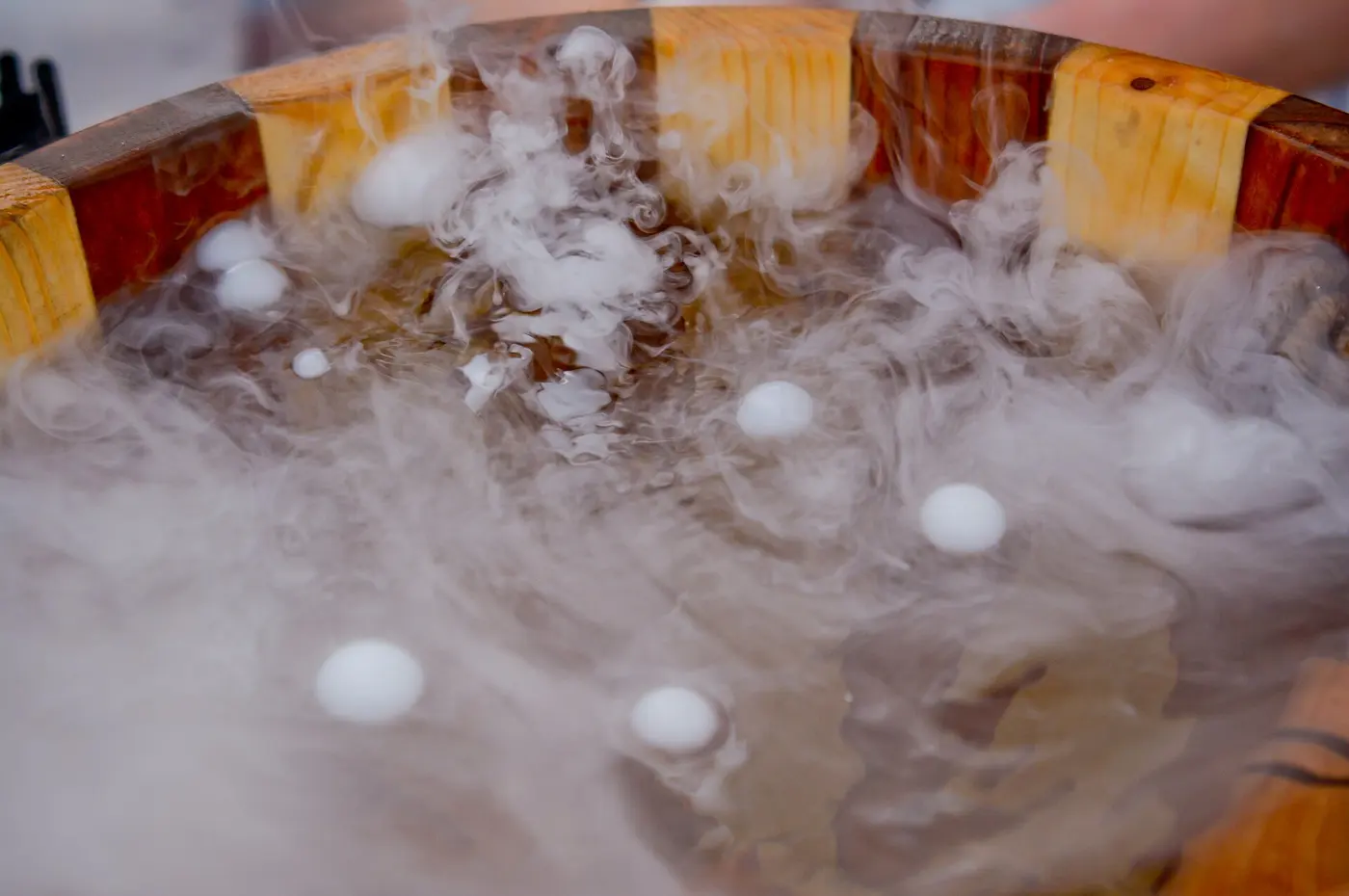
Left on its own, dry ice gives off only a faint white haze. Drop it into water, though, and the fog suddenly thickens.
Water is far warmer than dry ice, so dry ice in water sublimates furiously, producing a stream of ice-cold carbon dioxide bubbles. As each bubble bursts at the surface, it suddenly chills the moist air just above the water, creating masses of droplets. Theaters and event stages use exactly this effect to cover the floor in a low, cloud-like mist.
That said, not every detail of how the fog forms has been pinned down. Some researchers suggest that part of the white haze may be fine ice powder formed from water freezing around the dry ice. Either way, the white you see is not carbon dioxide gas.
Why the fog creeps along the floor
Instead of rising like steam, dry ice fog spills over the edge of its container and flows downward. That is because carbon dioxide gas is about 1.5 times heavier than air, and chilled air is heavier too. The white particles are simply riding along on that heavy, sinking current.
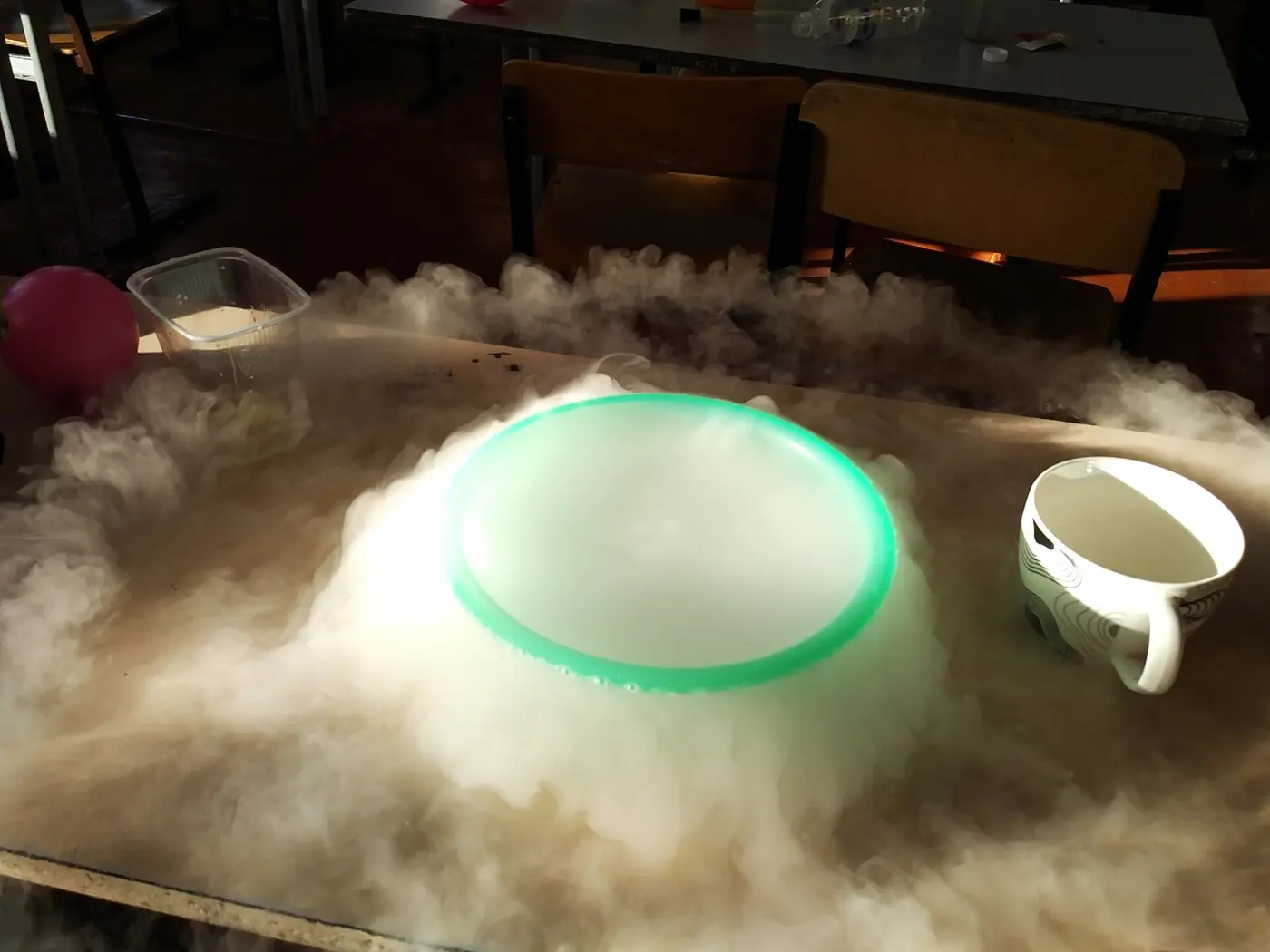

Before long, the white particles are warmed by the surrounding air, evaporate and vanish. But the carbon dioxide has not gone anywhere. It is still there, invisible, collecting in low places.
Beware the invisible gas
One kilogram of dry ice takes up about 0.64 liters. When it sublimates, it becomes roughly 500 liters of gas. Seal it in a plastic bottle or a jar and the pressure inside can build until the container bursts.
Carbon dioxide that collects in a confined space is dangerous too. In 2023, Japan’s Consumer Affairs Agency warned of deaths suspected to have been caused by carbon dioxide poisoning from dry ice placed in coffins to keep the body cool during funerals. In tests by the National Consumer Affairs Center of Japan, the carbon dioxide level inside a closed coffin passed 30 percent within 20 minutes, a concentration said to cause almost immediate loss of consciousness. When handling dry ice in a car, a basement or anywhere poorly ventilated, keep the air moving.