Why is ice slippery?
Most likely because the molecules on its surface move freely and act like a lubricant. The exact mechanism is still debated.
On a winter morning, your feet suddenly slide out from under you on a frozen pavement. At the rink, skaters balanced on thin blades glide effortlessly across the ice. We all know from experience that ice is slippery.
Ask why, though, and the answer turns out to be surprisingly unsettled. You may have been taught at school that pressure melts the ice, but that explanation has now been all but abandoned. The question dates back to the 19th century, and new theories are still being published in the 2020s.
The trouble with pressure melting
It has long been known that squeezing ice lowers the temperature at which it melts. In the mid-1800s, James Thomson, the older brother of the physicist later known as Lord Kelvin, described this effect, and in 1886 the Irish physicist John Joly argued that the ice beneath a skate blade melts under pressure and the resulting water lubricates the blade. It was an easy idea to grasp, and it stayed in textbooks for a long time.
Put numbers to it, however, and it falls apart. Each extra atmosphere of pressure lowers the melting point of ice by only about 0.0072°C. Even a person of around 50 kilograms (110 pounds) standing on a blade 1 millimeter wide and 15 centimeters long lowers it by just over 0.2°C. Yet people skate happily on ice at −10°C or −20°C (14°F or −4°F). To melt ice by pressure alone, you would need an absurdly heavy skater.


The next suspect: frictional heat
In 1939 the physicists Frank Bowden and T. P. Hughes ran experiments in an ice cave near the Jungfraujoch, high in the Swiss Alps, and proposed a different explanation. When something slides over ice, friction produces heat, which melts a thin film of water at the surface: the frictional heating theory.
For fast-moving skates and skis, this effect is believed to play a real part. But friction only produces heat once something is moving. On its own, it struggles to explain why ice is already slippery at the very first step you take from a standstill.
A surface that is loose to begin with
A third idea goes back even further, to Michael Faraday. Around 1850, Faraday noticed that two pieces of melting ice stick together and become one when they touch, and he suggested that the surface of ice might carry a thin, almost liquid layer.
Inside ice, each water molecule is firmly bonded to its neighbors in a crystal. The molecules on the very outside have fewer neighbors to hold on to, so they are bound more loosely. In 2018, a team of Dutch and German researchers combined friction measurements at temperatures from 0°C down to −100°C with studies of the surface molecules, and reported that the key to slipperiness is the ease with which those surface molecules can roll around.
According to that study, ice is at its most slippery at around −7°C (19°F). Warmer than that, the ice softens and the blade starts to dig in; cooled toward −100°C, the surface molecules lose their mobility and the ice turns into a high-friction surface. It is probably no coincidence that speed skating rinks keep their ice at about that temperature.
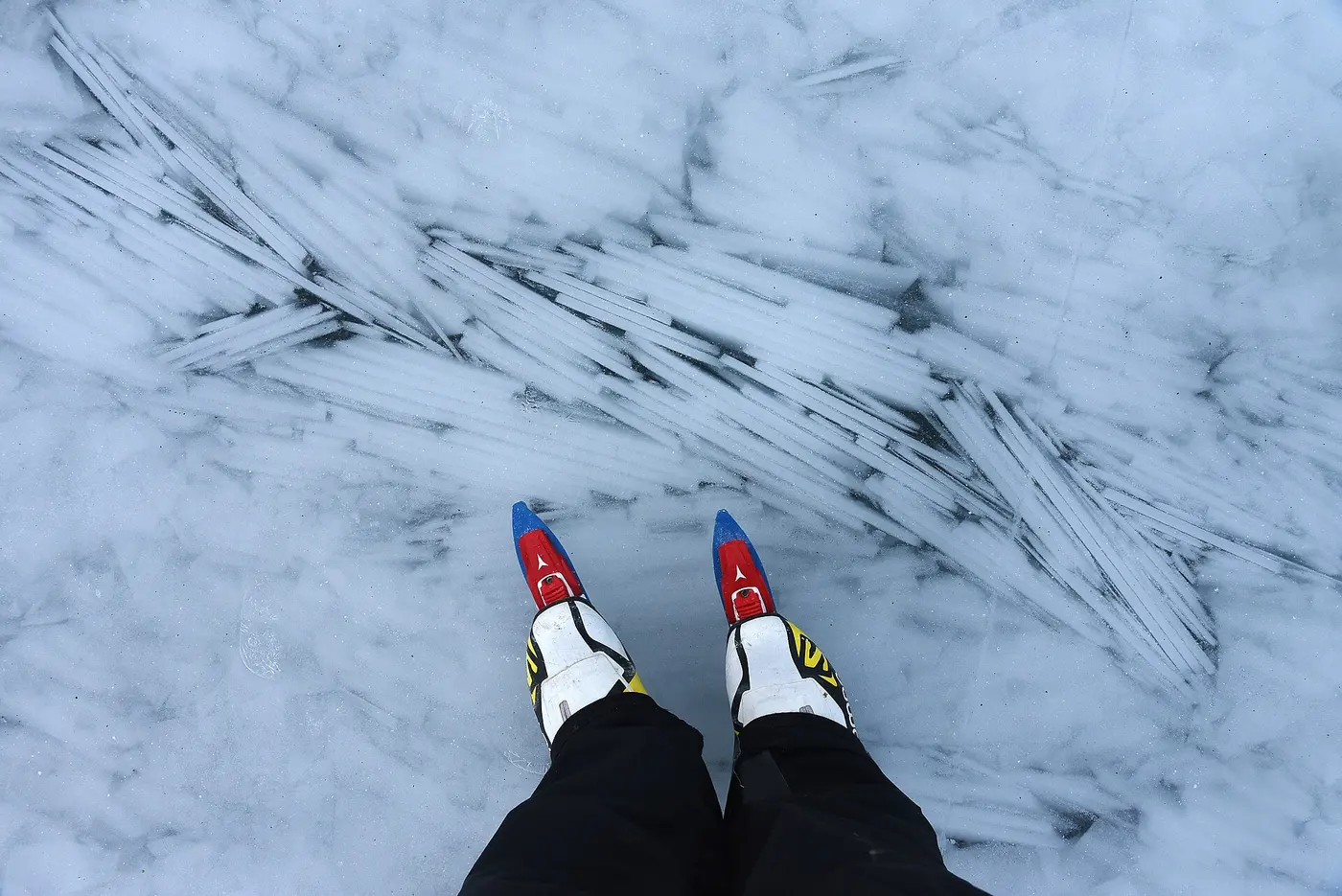

Still no final verdict
In 2025, a team at Saarland University in Germany published a new theory based on computer simulations. Tiny electrical imbalances in the molecules of a shoe sole or other surface disturb the orderly crystal at the surface of the ice, creating a thin disordered layer that does the lubricating. Pressure and friction, they argue, matter relatively little. In their calculations, a thin film still forms below −40°C, but it becomes more viscous than honey, and sliding almost stops.
Other researchers think that pressure, frictional heat and the surface layer all operate at once, to different degrees depending on the conditions. Experts have yet to agree on how much each mechanism contributes. The surface of something we see every winter still holds an unsolved mystery.