Is glass a liquid?
Glass is an “amorphous solid” with irregularly arranged atoms. The idea that old windows have flowed is a myth.
“Glass is actually a liquid that flows incredibly slowly. That’s why the windows of churches built centuries ago are thicker at the bottom.” Have you ever come across this claim in a trivia book or on a TV show?
It sounds convincing, but the short answer is that it’s a misconception. That said, it isn’t entirely off the mark. Glass is a material with a somewhat unusual character, one that sits somewhere between a liquid and a solid.
The truth about “bottom-heavy” windows
It’s true that old window glass is uneven in thickness. But that isn’t because it slowly flowed downward over hundreds of years. It was already uneven on the day it was made.
Flat glass used to be made by hand. One common technique was the “crown” method: a glassblower blew a bubble of molten glass, then spun it rapidly on the end of a rod so that centrifugal force flattened it into a large disc. Another method involved blowing the glass into a cylinder, slitting it open and flattening it out. Either way, the finished sheets were uneven in thickness from place to place, with ripples and distortions left in the surface. These were then cut into pieces and fitted into windows.
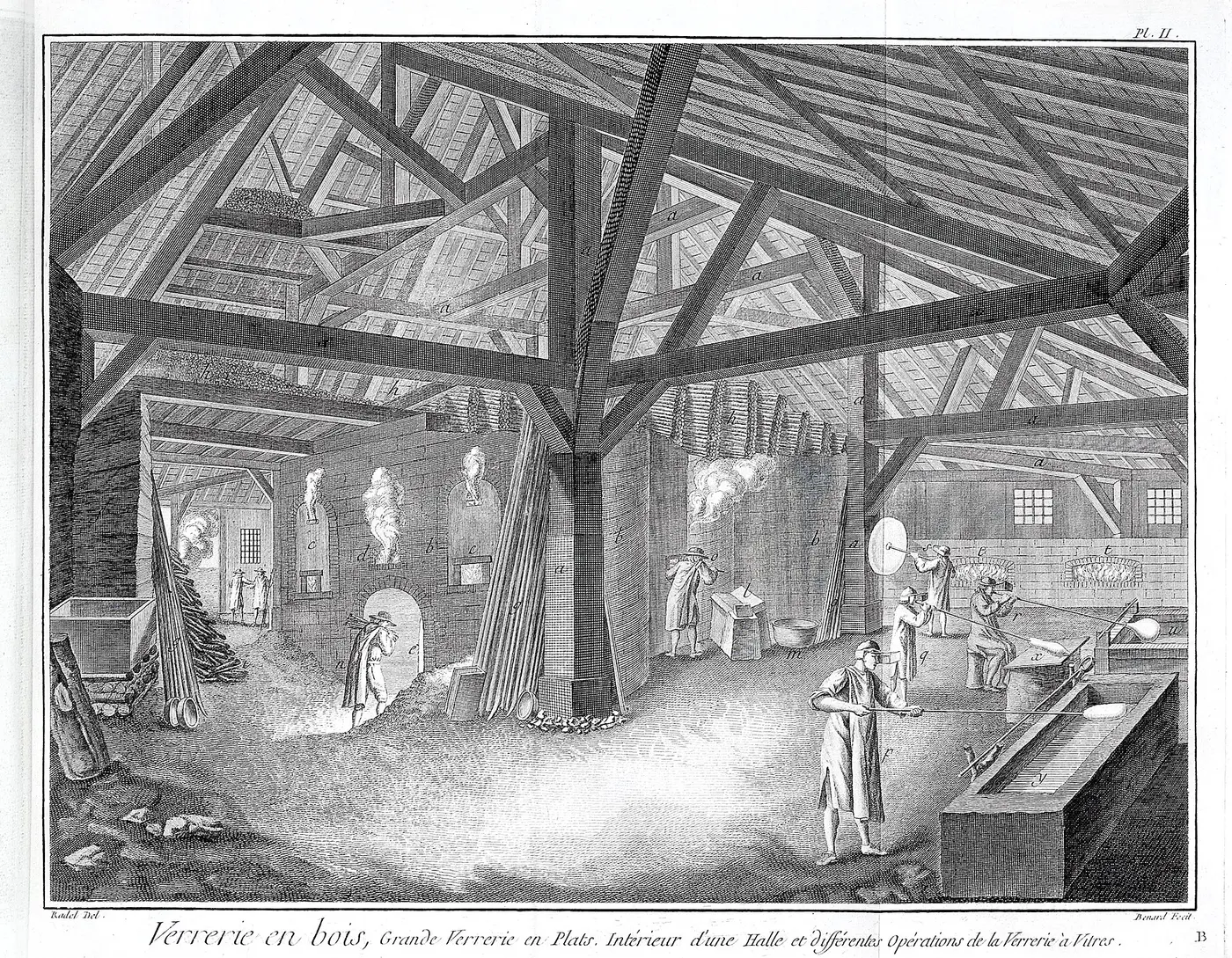

Since the panes were uneven to begin with, it’s hardly surprising that some windows ended up thicker at the bottom. Meanwhile, glass vessels made thousands of years ago still sit in museums with their shapes intact, which is often cited as further evidence that glass doesn’t flow.
Arranged like a liquid, behaving like a solid
So why is glass sometimes called a “liquid” at all?
In a crystal such as ice or quartz, the atoms or molecules are lined up in a neat, regular pattern. In glass, by contrast, the atoms are frozen in place while still arranged irregularly, as in a liquid. A material that solidifies without a regular arrangement like this is called an amorphous (non-crystalline) solid.
As molten glass cools, it becomes thicker and more syrupy, until at a certain temperature its atoms can barely move at all. This change is called the glass transition. Unlike melting ice, glass doesn’t switch sharply from liquid to solid at one precise temperature, so physicists have long debated how glass should be classified. Even so, glass at room temperature has every property of a solid, from its hardness to its ability to hold its shape.
Longer than the age of the universe
Still, some researchers wondered whether glass might flow just a tiny bit, and they actually ran the numbers.
In 1998, Edgar Zanotto, a materials scientist at the Federal University of São Carlos in Brazil, estimated how long it would take cathedral window glass to flow at room temperature. Using a different glass with properties similar to window glass, he calculated a time of 10³² years, and for cathedral glass, he said, it would be even longer. That’s beyond comparison with the roughly 13.8 billion years since the universe began.
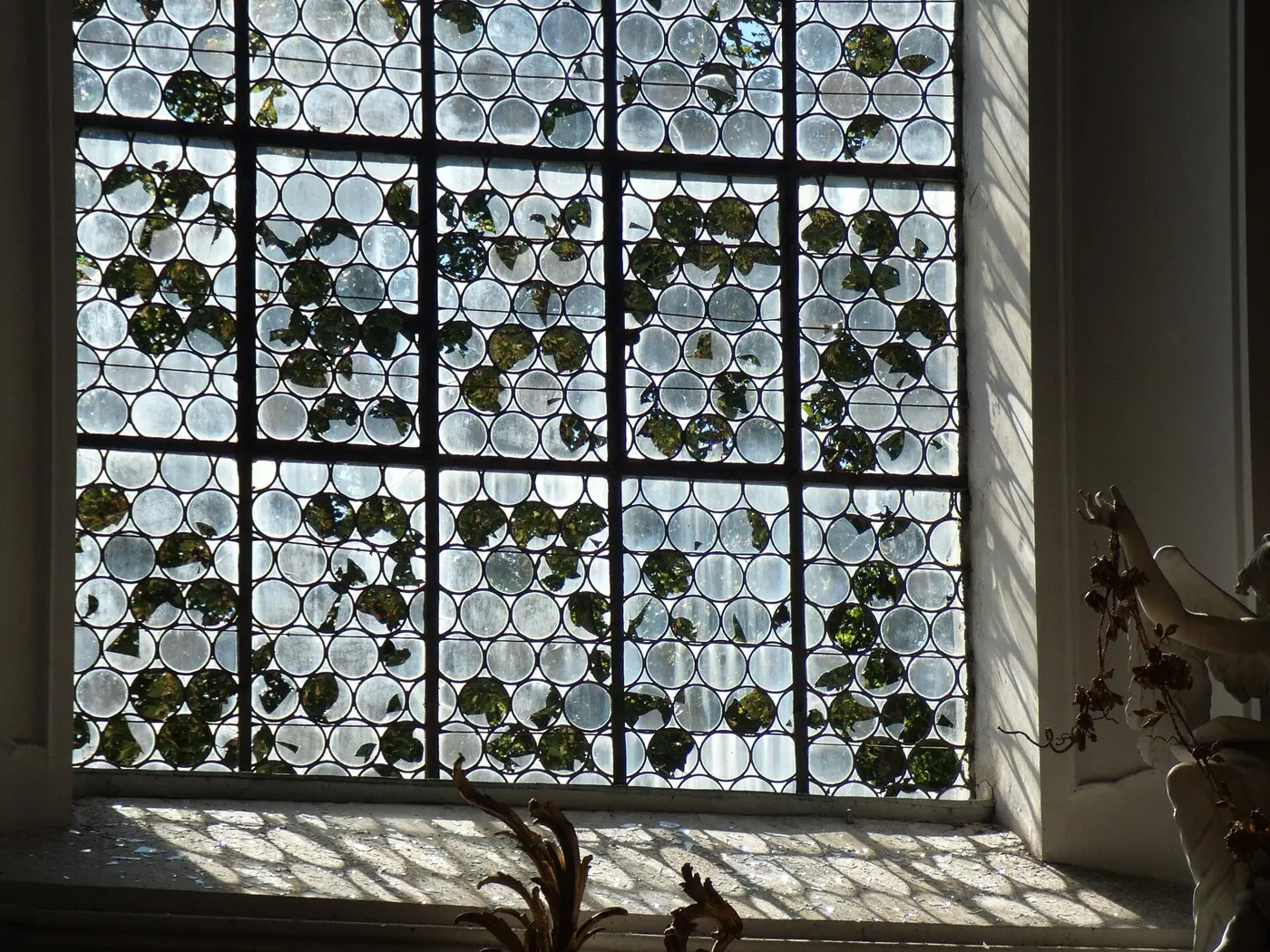

In 2017, researchers at the American glass maker Corning made glass with the same composition as windows in London’s Westminster Abbey and actually measured how viscous it was. From that, they estimated that at room temperature it would flow only about one nanometer in a billion years. A nanometer is a millionth of a millimeter. Not just the span of human history, but the entire history of the Earth, would barely change the shape of a window pane.
The distortions in old windows aren’t traces of glass flowing. They’re traces of the skill of glassmakers long ago.