Will Polaris always be the North Star?
No. Earth’s axis slowly changes direction, so every few thousand years the job passes to a different star.
26,000years
Take a long-exposure photograph of the northern sky and the stars draw concentric circles around a single point. Because Earth rotates, the whole sky appears to turn. Right next to the center of that rotation, the north celestial pole, shines a star that barely moves: the North Star.
Sailors and travelers have long relied on the North Star to find their way. Yet this star has not always marked north.
The north celestial pole’s next-door neighbor
The North Star, also called Polaris, is a second-magnitude star in the constellation Ursa Minor, the Little Dipper. It isn’t especially bright, but because it sits so close to the north celestial pole, it hardly changes position all night long.
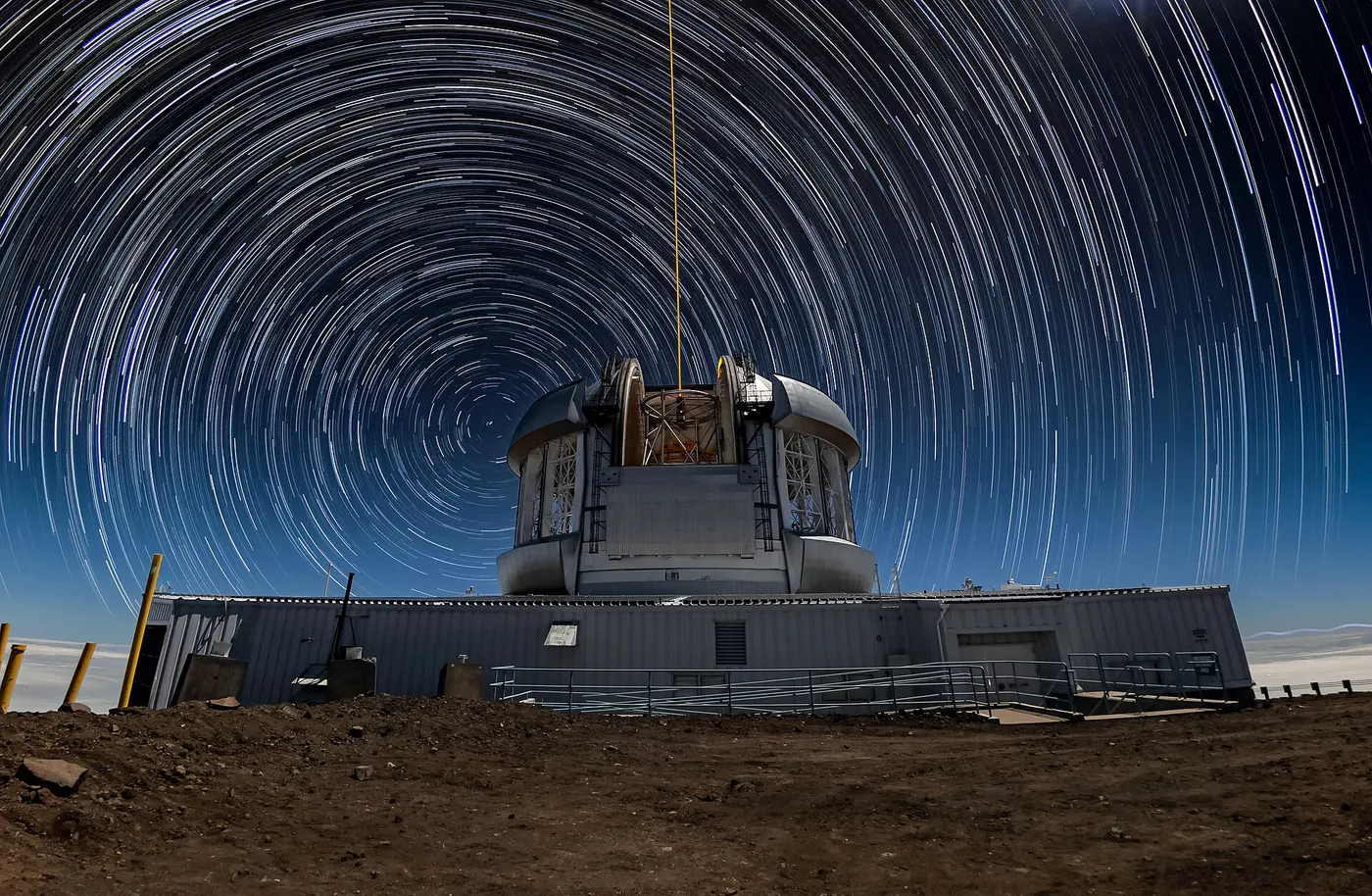

It isn’t exactly at the pole, though. In 2022, Polaris was about 0.65 degrees away from it. The full Moon spans about half a degree, so the gap is a little more than one full Moon. And right now that gap is slowly shrinking. Polaris is calculated to come closest to the pole around 2100, when the separation will drop below half a degree.
Getting closer, of course, means that one day it will start moving away again. The north celestial pole is slowly traveling across the starry sky.
Earth wobbles like a spinning top
The north celestial pole is simply the point in the sky that Earth’s rotation axis points to when extended northward. So if the pole moves, the direction of Earth’s axis itself must be changing.
Earth’s axis is tilted about 23.4 degrees from the perpendicular to the plane of its orbit. Earth is also not a perfect sphere; it bulges slightly around the equator. The gravity of the Moon and the Sun tugs on that bulge, trying to pull the axis upright. Instead of tipping over, the spinning Earth responds by slowly swinging the direction of its axis around in a circle. It is the same motion a spinning top makes when its axis wobbles while staying tilted, and it is called precession.
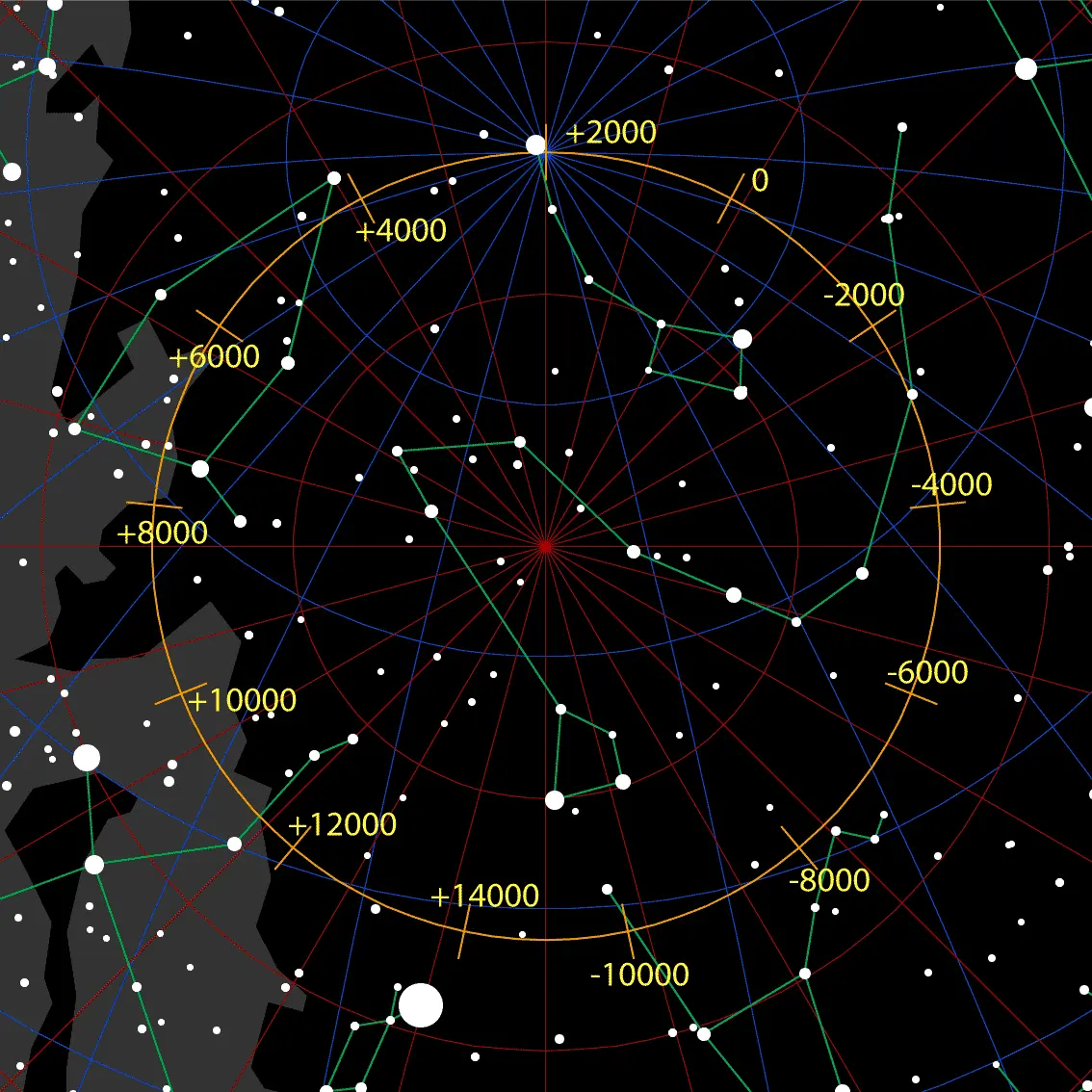
One full wobble takes about 26,000 years. Over that time, the northern end of the axis traces a huge circle across the sky, and stars near that circle take turns serving as the “North Star.”
The phenomenon is said to have been discovered by the ancient Greek astronomer Hipparchus in the second century BCE. Comparing star positions he had measured himself with older records, he noticed that the stars had shifted.
The North Star of the pyramid builders
So who held the job in the past?
When the pyramids were being built in ancient Egypt, the role of North Star belonged to Thuban, a star in the constellation Draco, the Dragon. Thuban came closest to the pole around 2830 BCE, when it is calculated to have been less than 0.2 degrees away—marking north far more precisely than Polaris does today. It is much fainter, though, at about magnitude 3.7.
The pole then drifted away from Thuban, and from about 1700 BCE until a little after 300 CE, two stars of Ursa Minor lay near it. Neither, however, was as close to the pole as Polaris is now. Over the long sweep of history, Polaris became the dependable North Star only fairly recently.

In 12,000 years, the North Star will be Vega
Looking ahead, the pole will pass by the stars of Cepheus, and around 3100 CE a star called Errai in that constellation is expected to take over as North Star.
Then, about 12,000 years from now, sometime after 14,000 CE, Vega in the constellation Lyra is expected to become the North Star. Vega is one of the brightest stars in the night sky, known in Japan as the Weaver Princess star of the Tanabata star festival. Still, it will sit about 5 degrees from the pole, so it won’t mark north nearly as precisely as Polaris does today.
As still more time passes, sometime after 20,000 CE, the pole will return to Thuban’s neighborhood. The great clock of the sky completes one turn roughly every 26,000 years.