What happens if you fall into a black hole?
A small black hole would tear you apart before you reached it; a giant one would let you cross its edge intact.
A black hole is an object whose gravity is so strong that not even light can escape it. Naturally, nobody has ever jumped into one to find out what it is like. But with Einstein’s general theory of relativity, physicists can work out in surprising detail what would happen.
The answer, oddly enough, flips completely depending on the black hole’s size. And the person falling in and the person watching from a distance would witness entirely different stories.
Stretched like spaghetti
Picture yourself approaching a black hole feet first. Gravity gets stronger the closer you are to its source, so your feet, being nearer the black hole, are pulled harder than your head. This difference in gravity from one place to another is called a tidal force. It is the same kind of force by which the Moon stretches Earth’s oceans and produces the high and low tides.
In everyday life, the difference in gravity between your head and your feet is far too small to feel. Near a black hole, though, it becomes enormous. Your body is stretched lengthwise and squeezed from the sides at the same time, until you are drawn out into a long, thin strand.
In his 1988 book A Brief History of Time, the physicist Stephen Hawking described an astronaut falling into a black hole being “stretched like spaghetti.” The book is said to be what popularized the name for this effect: spaghettification.
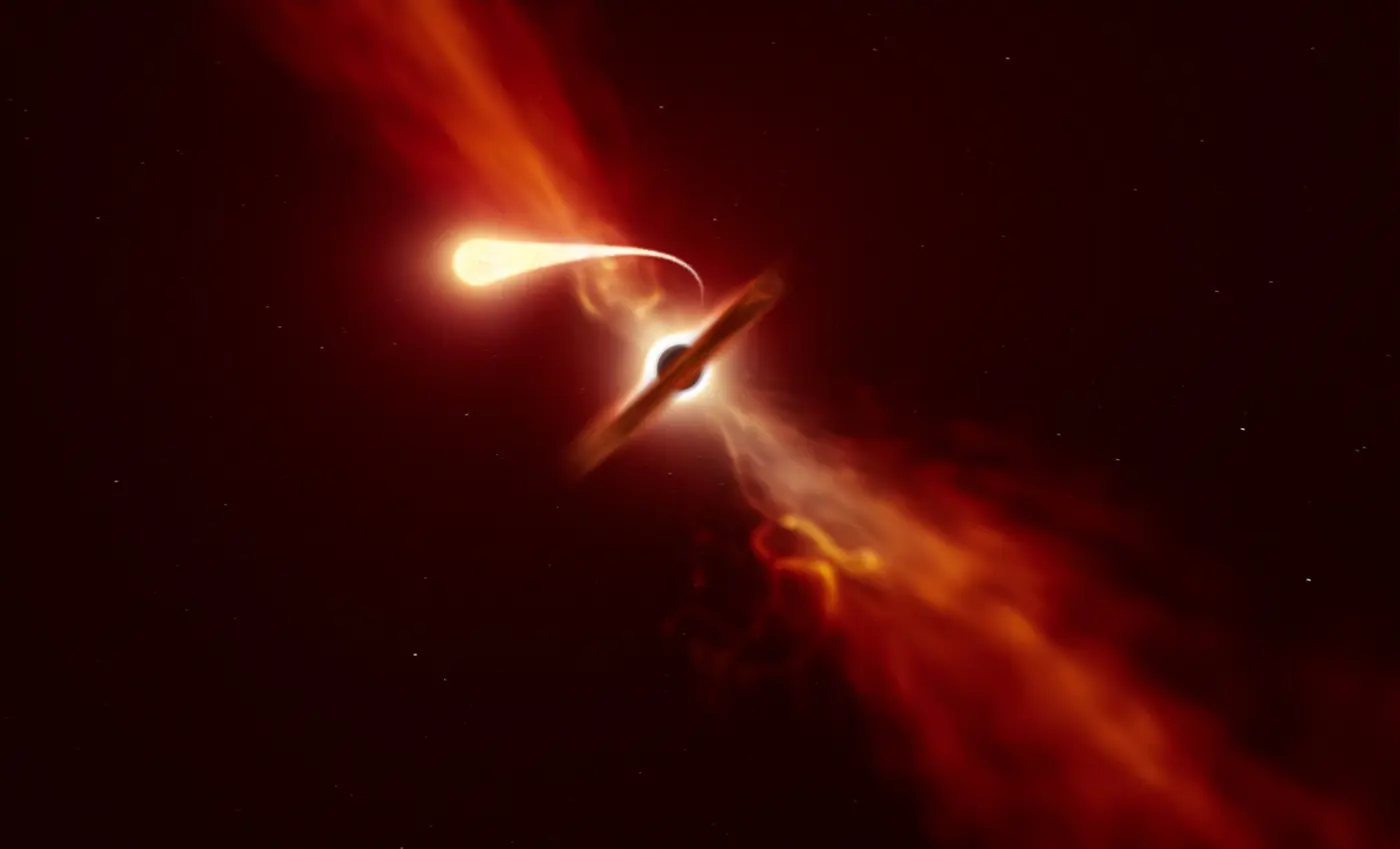

Not even a star can withstand this force, let alone a human. When a star strays too close to a black hole, it can be ripped apart and swallowed as a stream of gas. Astronomers call this a tidal disruption event, and they have actually observed such events with telescopes.
The smaller, the deadlier
The strange part is that smaller black holes are the more dangerous ones.
A black hole has a boundary called the event horizon. Once past it, nothing—not even light—can ever get back out. For a black hole of about 10 solar masses, the kind left behind when a star burns out, the event horizon has a radius of only about 30 kilometers (19 miles). With a boundary that small, gravity changes very steeply just outside it, and the tidal forces are ferocious. By the numbers, a human body would be torn apart long before reaching the horizon, while still thousands of kilometers away.
With the supermassive black holes found at the centers of galaxies, the situation reverses. The size of the event horizon grows in proportion to the mass, so the change in gravity near the boundary becomes much gentler. Sagittarius A*, the black hole at the center of our own Milky Way, has about 4.3 million times the mass of the Sun and an event horizon about 12 million kilometers in radius. There the tidal forces are very weak, and an astronaut is thought to be able to drift across the horizon without incident.
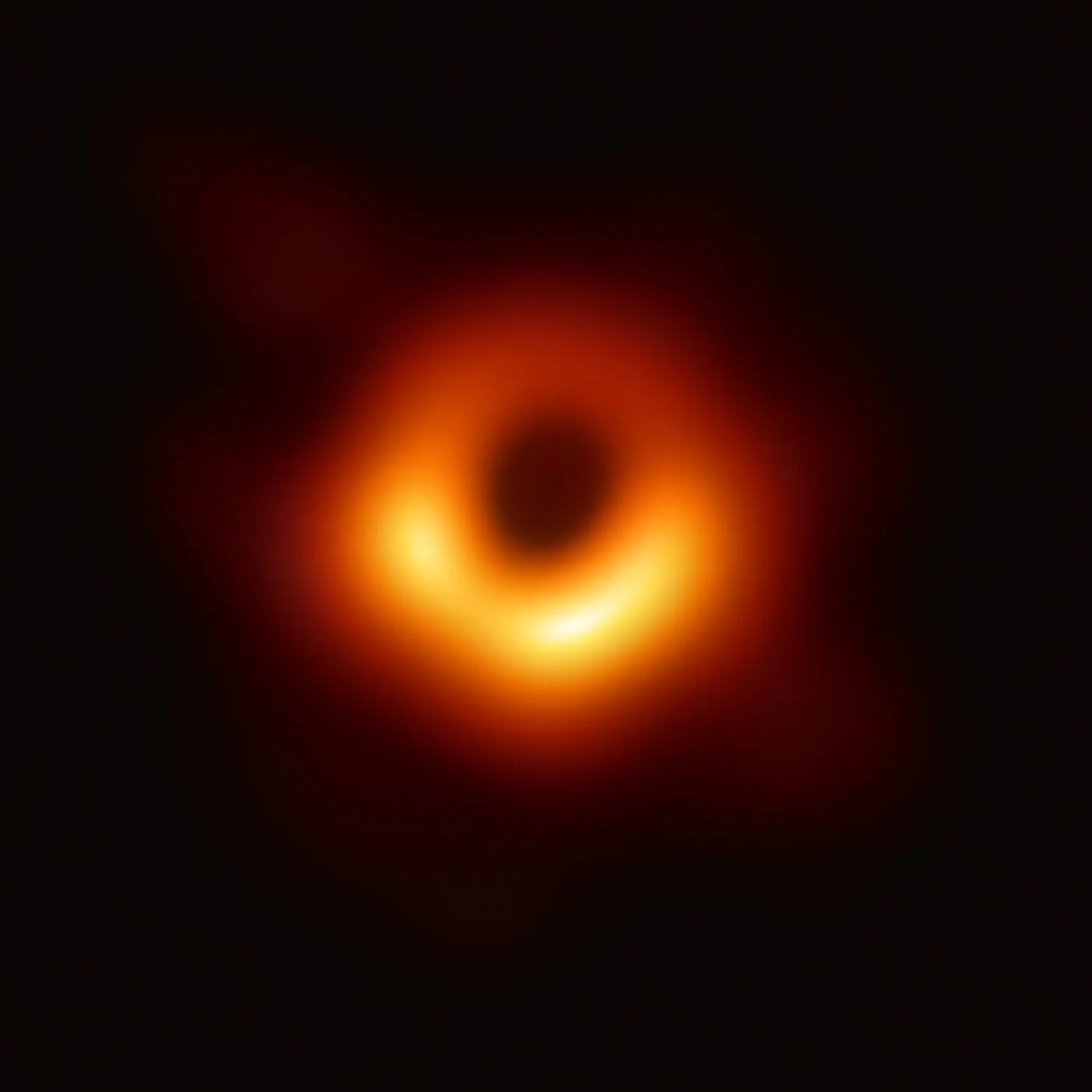

The black hole in the galaxy M87, the first ever to be imaged in 2019, is in another league entirely. It weighs about 6.5 billion Suns, and its event horizon has a radius roughly three times the distance from the Sun to Pluto.
Seen from outside, the fall freezes
Now suppose a friend watches the falling astronaut from far away. What would they see?
According to general relativity, time runs more slowly in strong gravity. To the friend, the astronaut seems to move more and more slowly as they near the black hole, and the hands of their wristwatch fall further and further behind. The light reaching the friend is stretched toward the red and grows steadily dimmer. In the end, the astronaut appears to stop just short of the horizon, then fades from view. As long as you watch from outside, you never see the moment they cross.
For the astronaut, meanwhile, time flows perfectly normally. With a large black hole, they might not feel anything special at the moment they cross the horizon. The same event looks completely different depending on where you stand. That is the world relativity describes.
Beyond the edge, nobody knows
Crossing the horizon is a one-way trip, however. There is no coming back out; the only direction left is inward. Even in a giant black hole, the tidal forces eventually grow stronger as you approach the center, and in the end spaghettification is thought to be unavoidable.
What happens at the center is beyond present-day physics. General relativity’s equations produce a “singularity” where density becomes infinite, and at that point the theory itself breaks down. Until a new theory unites gravity with the quantum world, the depths of black holes look set to remain one of the greatest mysteries in the universe.