What is the biggest star in the universe?
A leading candidate is the red supergiant Stephenson 2-18, estimated at about 2,150 times the Sun’s radius.
2150×
To us, the Sun is unimaginably large. It is about 1.39 million kilometers across; you would have to line up 109 Earths to span it from edge to edge. Yet hidden among the stars scattered across the night sky are giants that would make even the Sun look like a pea.
So which is the biggest star we know of? There is an answer, of sorts. But it always comes with the small print: “for now” and “by current estimates.”
The throne belongs to old red giants
The largest stars in the universe all belong to one type: the red supergiant. These are heavy stars, born with roughly 10 to several dozen times the Sun’s mass, that have reached old age and puffed their outer layers out enormously. Their surfaces sit in the 3,000-degree range (Celsius), cooler than the Sun’s, which is why they glow red.
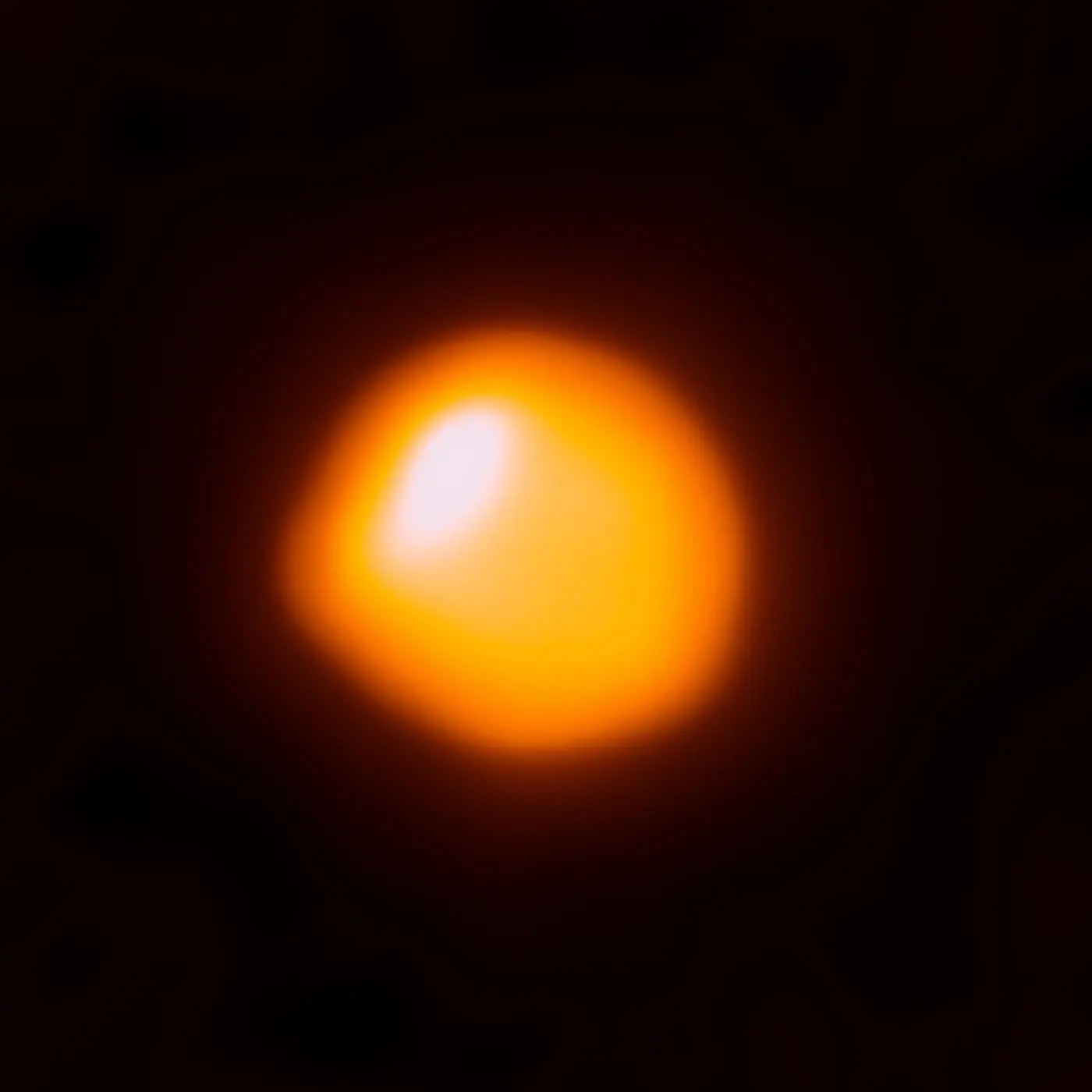

The names that come up most often are Stephenson 2-18, thought to belong to a star cluster in the direction of the constellation Scutum; NML Cygni in Cygnus; and UY Scuti, also in Scutum. Of these, Stephenson 2-18 has been given an estimated radius of about 2,150 times the Sun’s, and it is now often described as the largest star known.
A star that resists the ruler
Here we have to be honest: these numbers are quite uncertain.
Nobody can hold a ruler up to a distant star. Its size is calculated by combining its distance from Earth, its brightness and its surface temperature. But red supergiants are thousands of light-years away or more, and they are often wrapped in dust they have shed themselves, which makes both distance and brightness hard to pin down. Shift those starting figures a little, and the estimated radius can change dramatically.
For Stephenson 2-18, astronomers have pointed out that the uncertainty in its distance is large. Stellar theory also suggests there is an upper limit to how big a red supergiant can get, and by that standard, more than 2,000 times the Sun may simply be too big. Estimates for NML Cygni likewise vary from study to study, from about 1,200 to about 2,700 times the Sun’s radius.
On top of that, these stars have no clear boundary where you could say, “Here is the surface.” Their outermost gas is extremely thin and fades gradually into space. Where you decide the star ends can change how big it is.
A leaderboard rewritten again and again
No story captures this uncertainty better than that of UY Scuti.
In the 2010s, UY Scuti’s radius was estimated at about 1,700 times the Sun’s, and for a while it was widely known as “the largest star in the universe.” Then the Gaia space telescope remeasured stellar distances with great precision and found that UY Scuti was closer than thought. If a star is nearer but looks just as bright, it must be less luminous than assumed, and therefore not as large. The latest estimate shrinks its radius to about 900 times the Sun’s.
That is still enormous, but it was enough to knock it off the throne. In the same way, the star WOH G64 in the Large Magellanic Cloud was once considered one of the biggest, until its estimates were revised. The stars themselves did not shrink. Each time our measuring tools improve, the leaderboard gets rewritten.
Put it where the Sun is
Numbers alone don’t quite land, so let’s drop it into our solar system.
A radius 2,150 times the Sun’s comes to about 1.5 billion kilometers. Swap the Sun for Stephenson 2-18, and the star’s surface would swallow the orbits of Mercury, Venus, Earth, Mars and Jupiter, reaching roughly as far as Saturn’s orbit. Even light would need more than eight hours to travel once around it.
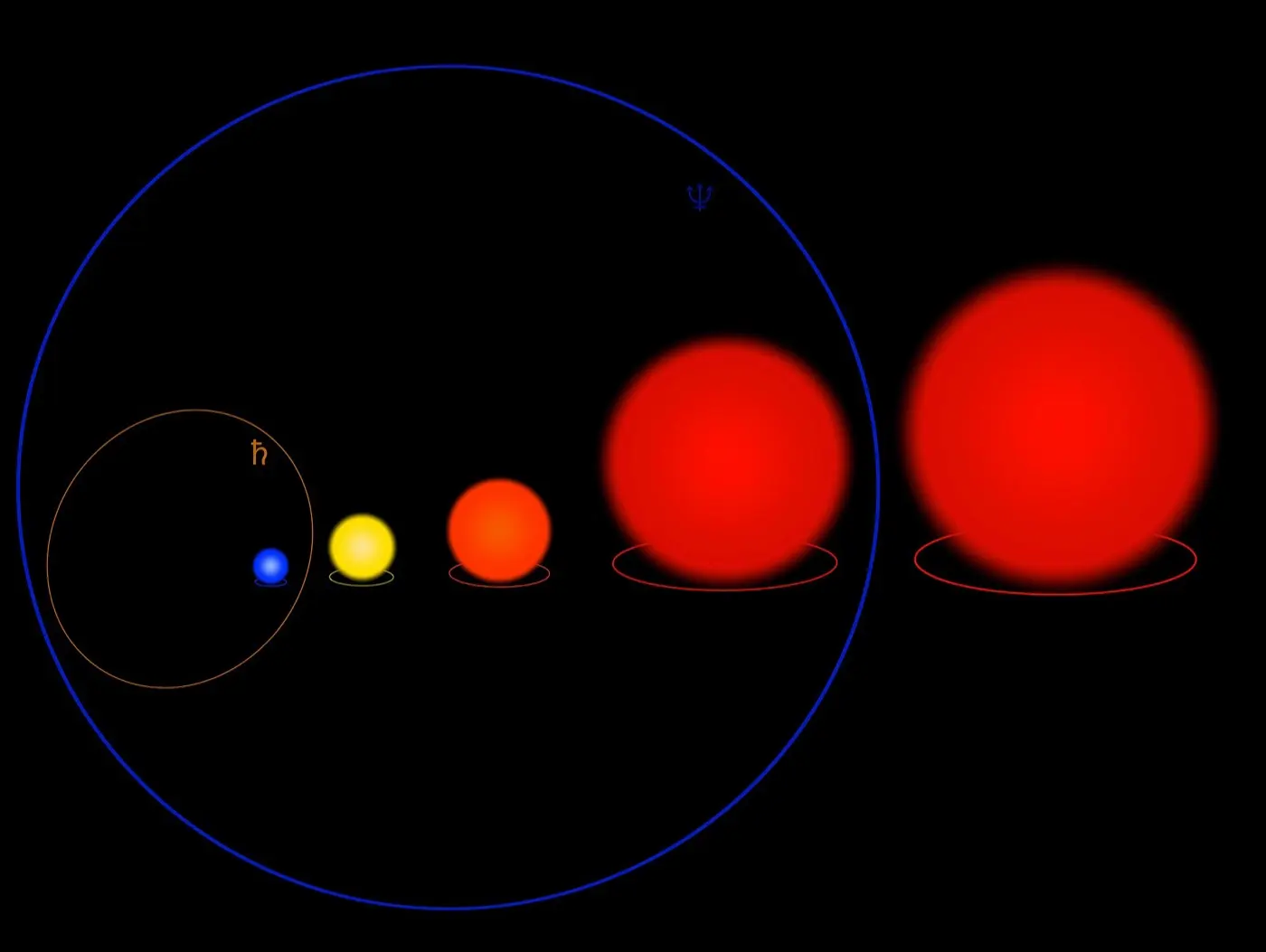

A jet flying at 900 kilometers per hour could circle the Sun in about 200 days. Circling this star would take more than 1,000 years. By volume, nearly 10 billion Suns would fit inside.
Yet for all that swelling, its mass is thought to be only a few dozen times the Sun’s. It is something like a giant balloon: its outer gas is far thinner than the air we breathe at ground level.