Why is Pluto no longer a planet?
A 2006 definition of “planet” made Pluto, which hasn’t cleared its orbit of other bodies, a “dwarf planet.”
In Japan, schoolchildren once memorized the planets with the chant “sui-kin-chi-ka-moku-do-ten-kai-mei”—the first syllables of Mercury, Venus, Earth, Mars, Jupiter, Saturn, Uranus, Neptune and Pluto. Many English speakers learned a similar mnemonic. But today’s textbooks have dropped the last one, mei, for Pluto. In 2006, Pluto was removed from the ranks of the planets and moved into a new category: “dwarf planet.”
Pluto itself did not shrink or disappear. What changed was on the human side: our yardstick for what counts as a planet.
1930: the long-awaited “ninth planet”
Pluto was discovered on February 18, 1930. At Lowell Observatory in Arizona, a young observing assistant named Clyde Tombaugh compared two photographs of the same patch of sky taken a few days apart and spotted a tiny dot that had shifted slightly.
The name Pluto comes from the Roman god of the underworld. It was suggested by Venetia Burney, an 11-year-old girl in Oxford, England. The Japanese name, Meiōsei (冥王星, “star of the king of the underworld”), is said to have been coined by Nojiri Hōei, a writer known for his essays about the stars.
Much smaller than anyone thought
When it was first found, Pluto was thought to be possibly as large as Earth. But as observations improved, the estimates kept shrinking.
After its moon Charon was discovered in 1978, astronomers could work out Pluto’s mass precisely from the moon’s motion. The result was about one twenty-fifth the mass of Mercury. Pluto turned out to be lighter than Earth’s Moon. When the New Horizons spacecraft flew past in 2015 and measured it, its diameter came out at about 2,370 kilometers (1,470 miles), about two-thirds the diameter of the Moon.
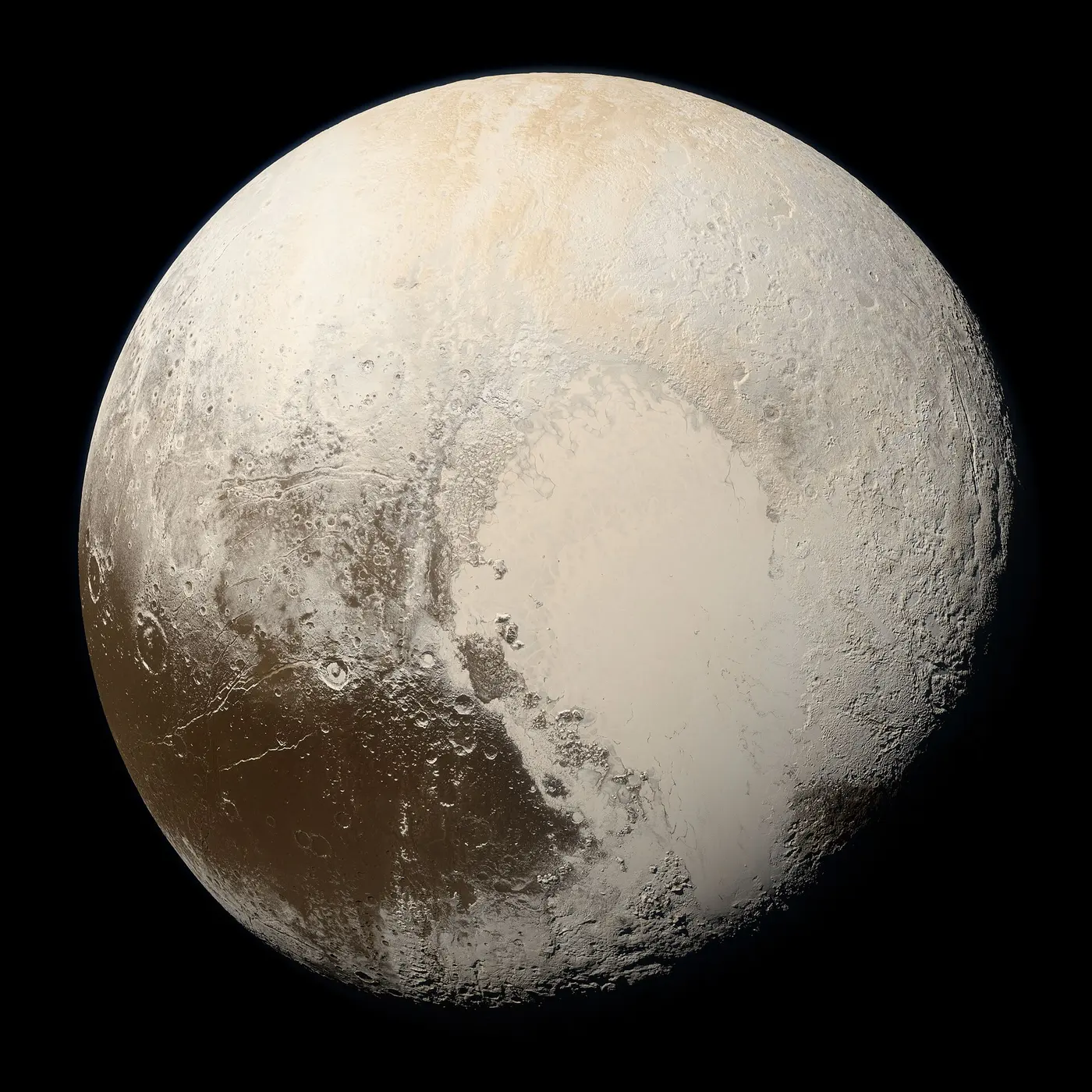

Then, in the 1990s, astronomers began finding small icy bodies similar to Pluto beyond Neptune. Pluto was not an isolated planet after all, but one member of a vast population known as trans-Neptunian objects.
The goddess of strife delivers the blow
In 2005 came the decisive announcement. A team led by the American astronomer Mike Brown had found a body orbiting farther out than Pluto and about the same size. At first, it was even thought to be larger than Pluto.
If Pluto was a planet, surely this object deserved to be called one too. But if more objects like it kept turning up, how many planets would there be? Astronomers finally had to decide, clearly, what a planet is.
The object was later named Eris, after the Greek goddess of strife and discord. Given the uproar it had caused among astronomers, it was a name with a decidedly ironic twist.
Three conditions for a planet
On August 24, 2006, the General Assembly of the International Astronomical Union (IAU), meeting in Prague, Czech Republic, adopted a definition of a planet. A planet is a body that meets all three of the following conditions.
It orbits the Sun. It has enough mass for its own gravity to pull it into a round shape. It has cleared the neighborhood around its orbit of other objects.
Pluto meets the first two. The third was the problem. Many trans-Neptunian objects orbit near Pluto, and Pluto cannot be said to stand out dramatically among them. By one researcher’s estimate, Earth’s mass is about 1.7 million times the combined mass of the other bodies near its orbit. Pluto’s, by contrast, does not even reach 0.1 times.
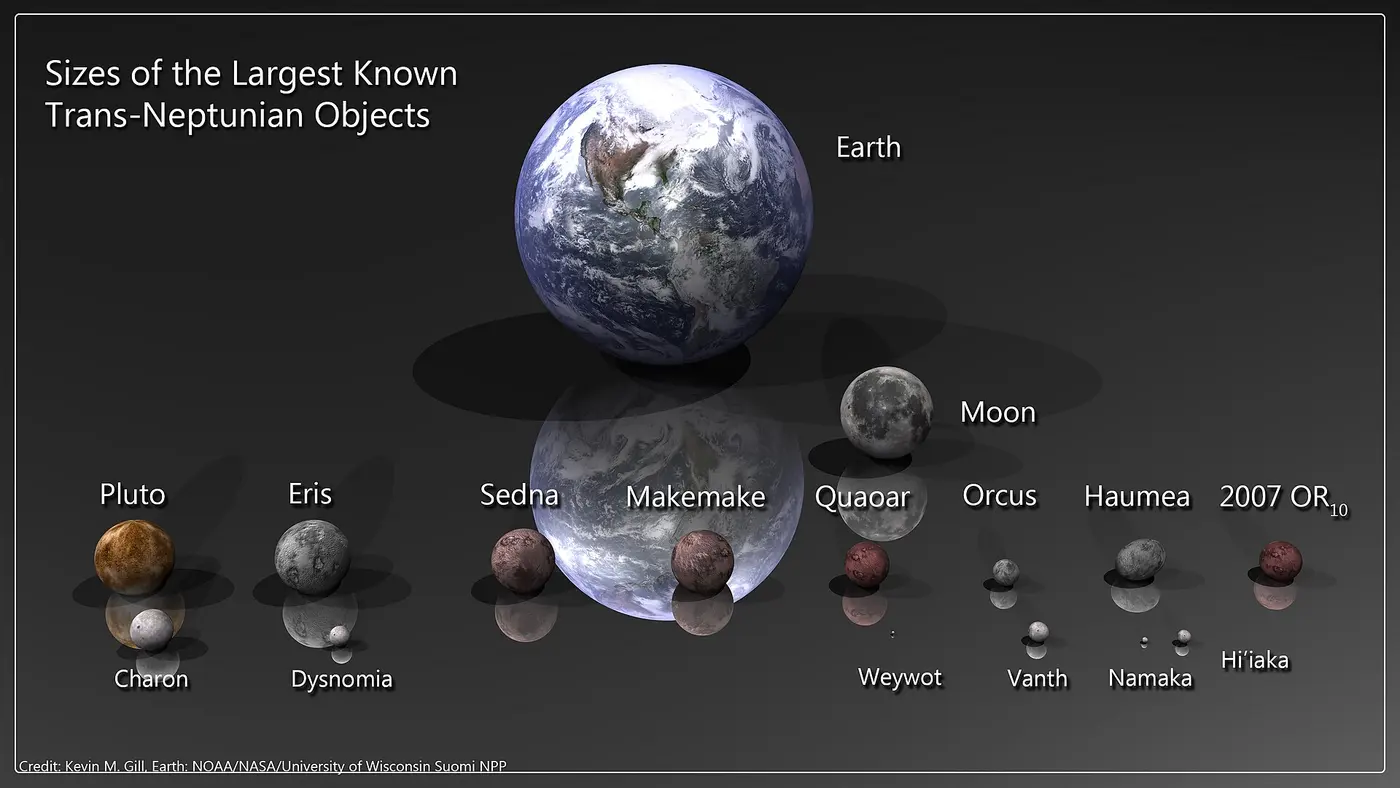

And so Pluto, along with Eris and others, was classified as a “dwarf planet.” Just over 400 astronomers took part in the vote, a small fraction of the world’s astronomers, and the decision remains disputed to this day. Alan Stern, the planetary scientist who led the New Horizons mission, has criticized the third condition itself, pointing out that asteroids still remain near the orbits of Earth and Jupiter.
Incidentally, New Horizons’ observations showed that Pluto’s diameter is slightly larger than Eris’s. Eris, however, is nearly 30 percent more massive, so even the question of which one is “bigger” depends on how you measure.