Do identical twins have the same fingerprints?
No. Their overall patterns may look alike, but the fine flow of the ridges is unique to each person.
Identical twins are born when a single fertilized egg splits in two partway through its development. As a result, the two share almost exactly the same genes. Their faces and builds can be so alike that even their own families sometimes struggle to tell them apart.
So what about the prints on their fingertips? If the genes are the same, you might expect the fingerprints to be identical too. In reality, though, even identical twins do not have matching fingerprints. The fact that prints differ even between twins is one of the reasons fingerprints came to be trusted as a way of telling individuals apart.
Similar, but never the same
Fingerprint patterns fall into three broad types: whorls, loops, and arches. A whorl spirals around a center, a loop sweeps off to one side like the curve of a horseshoe, and an arch rises in a gentle hump across the finger.
When researchers study identical twins, they find that these broad types, along with features such as the number of ridges, tend to be very similar. Genes clearly play a big part in setting the overall look of a fingerprint.
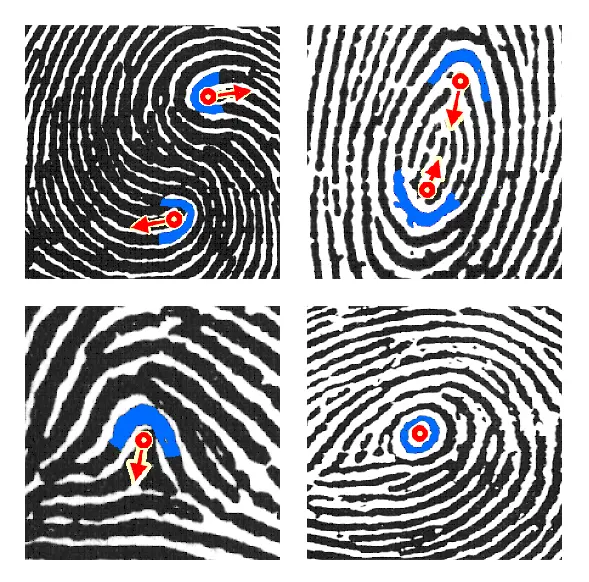

When fingerprints are matched, however, the deciding evidence lies in much finer details. Where does a ridge come to an end? Where does it fork in two? Where does it shrink to a tiny dot? The positions and arrangement of these “minutiae” differ clearly even between twins. Two prints that look alike from a distance turn out, under magnification, to belong to two different people.
A pattern made in the womb
Fingerprints take shape long before birth. From around the third month of pregnancy, ridges begin to form deep in the skin of the fetus’s fingertips. By about the middle of pregnancy, the basic pattern, which will stay the same for life, is said to be in place.
During this period, the fingertips are subject to countless small influences from their surroundings: the fetus’s position in the womb, the way the fingers touch the amniotic fluid and the wall of the uterus, how fast the fingers are growing, the flow of blood, and more. Even twins cannot spend those months in exactly the same spot, in exactly the same posture. These tiny differences in conditions are etched into the fingertips as differences in the fine flow of the ridges.
Waves spreading from three places
For a long time, exactly how the ridges of a fingerprint are drawn remained unclear. A major step toward solving the puzzle came in 2023, in a paper published in the journal Cell by a research team including scientists at the University of Edinburgh in the UK.
According to the team, fingerprint ridges spread out like waves from three places on the fingertip: the center of the finger pad, the area just below the nail, and the crease of the joint nearest the fingertip. How those waves spread is governed by the interplay of several molecules. Some molecules encourage ridges to form, while others hold them back. This tug-of-war is thought to produce the striped pattern naturally.
It closely resembles the mechanism that the mathematician Alan Turing proposed to explain how patterns such as stripes and spots form on animals’ bodies. When and where the three waves begin, and where they collide, determines whether the result is a whorl or a loop. The slightest difference in when the waves start, or in the shape of the finger, is enough to change the final pattern. Genes set the overall plan, but they do not decide every last stroke.
Fingerprint science and a surprising link to Japan
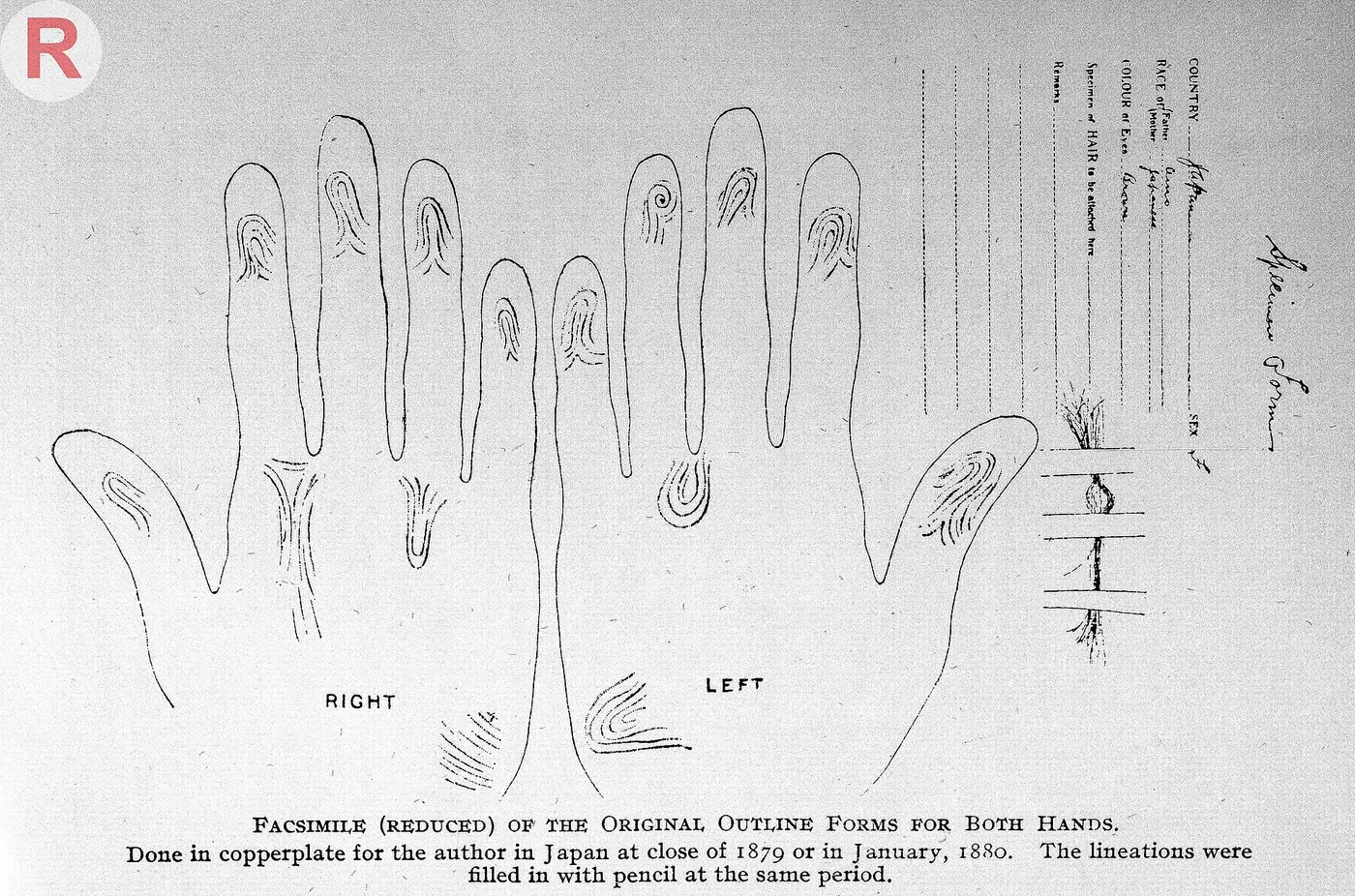
Japan turns up, unexpectedly, in the history of identifying people by their fingerprints. In the late 19th century, Henry Faulds, a Scottish doctor working in Tsukiji in Tokyo, is said to have begun studying fingerprints after becoming intrigued by finger marks left on Japanese pottery.
In 1880, Faulds sent a short paper on the furrows of the skin of the hand to the scientific journal Nature, suggesting that finger marks left at a crime scene might make it possible to identify the culprit. In the years that followed, fingerprints spread around the world as a means of identifying individuals.