How did the Moon form?
The leading theory says a Mars-sized body slammed into the early Earth, and the Moon formed from the debris.
382kg
The Moon is arguably the celestial body humanity knows best. We built calendars around its phases, saw a rabbit in its markings (the figure Japanese folklore finds there), and eventually sent 12 astronauts to walk on its surface.
And yet the question “How was the Moon born?” still has no complete answer. The story most scientists currently favor reads like a scene from a disaster movie: a colossal collision.
Three old theories
Until the middle of the 20th century, there were three main ideas about where the Moon came from.
The first was the “fission” theory. Proposed in 1879 by the astronomer George Darwin, son of the evolutionist Charles Darwin, it held that the young Earth spun so fast that a piece of it tore off and became the Moon. The second was the “capture” theory: the Moon formed somewhere else and was caught by Earth’s gravity. The third was the “sister” theory, which said that Earth and the Moon formed side by side from the same raw material.
None of these had a decisive edge, and the debate dragged on for a long time. What changed everything was the Apollo program.
The rocks the astronauts brought back
Between 1969 and 1972, six Apollo landings returned a total of about 382 kilograms (842 pounds) of lunar rock and soil to Earth. When scientists examined them closely, they found some surprises.
First, the proportions of oxygen isotopes (atoms of slightly different weights) in lunar rocks turned out to be almost identical to those in Earth rocks. Bodies in the solar system are thought to carry slightly different ratios depending on where they formed, so the Moon and Earth must be made of extremely similar material. That was bad news for the capture theory, which imagined a body arriving from elsewhere.
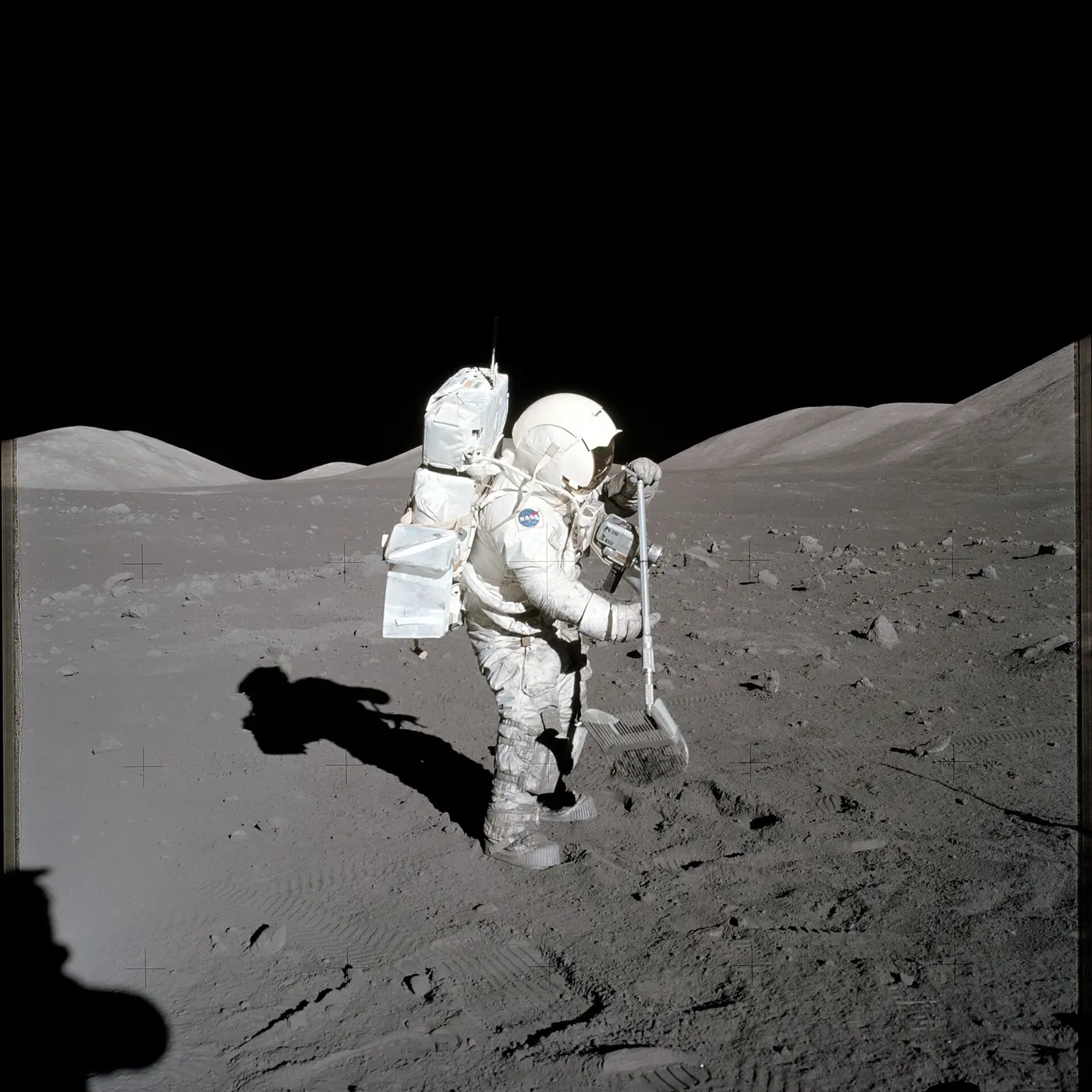

At the same time, the Moon rocks contained very little water or other substances that evaporate easily, as if they had once been baked at high temperature. It also emerged that the Moon’s entire surface had probably once been covered by a “magma ocean” of molten rock. The Moon was also known to have almost no large iron core like Earth’s. Explaining all of this together was hard for either the fission theory or the sister theory.
Theia, a body the size of Mars
Building on these clues, a new idea emerged in the mid-1970s: the giant-impact hypothesis. William Hartmann and Donald Davis published it in 1975, and Alastair Cameron and William Ward put forward their version in 1976.
The story goes like this. About 4.5 billion years ago, shortly after the solar system formed, a body about the size of Mars struck the newborn Earth. The energy of the impact melted and vaporized rock and flung it out around the planet. The debris formed a disk circling Earth, which eventually clumped together into the Moon.
Since what flew off was mostly iron-poor outer rock, the Moon has little iron. Because that material was exposed to intense heat, it is short on substances that evaporate easily. The hypothesis neatly explained the features the Apollo rocks had revealed. It won broad support after a 1984 conference in Kona, Hawaii, and today it is the standard scenario for the Moon’s origin.
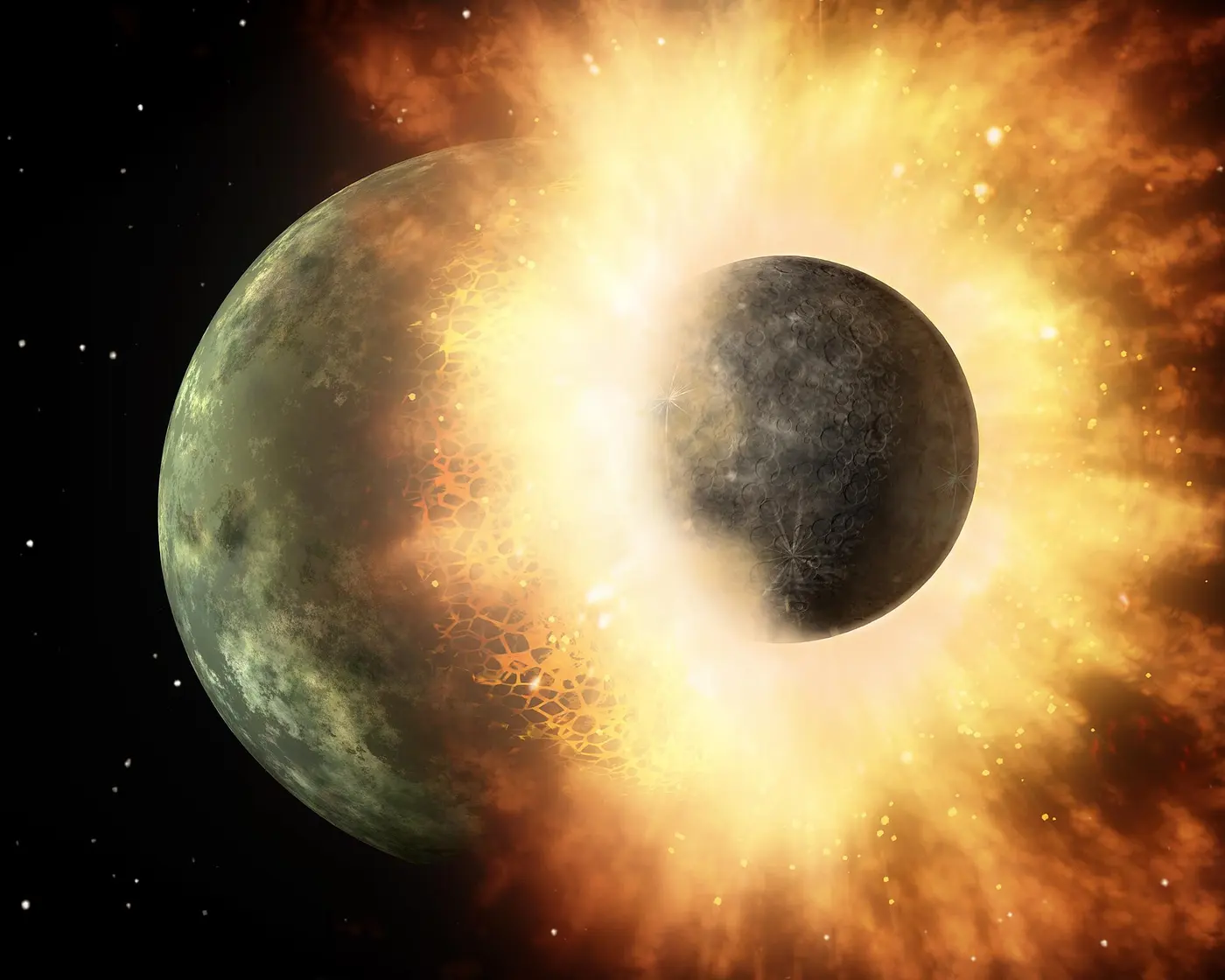

The impactor was later named Theia, after the goddess who, in Greek mythology, was the mother of Selene, goddess of the Moon.
A puzzle of too much resemblance
As research went on, however, a new mystery surfaced. In many simulations, most of the Moon’s material comes from Theia rather than Earth. If so, Moon rocks should still carry a slightly different “Theia signature.” In reality, though, the Moon and Earth turned out to be almost too alike: their isotope ratios match nearly indistinguishably, not only for oxygen but for titanium and other elements too.
Researchers have proposed a range of revised scenarios to solve this puzzle. One says the impact was far more violent, so that material from Earth and Theia was vaporized and thoroughly mixed. Another says there was not one giant impact but a series of smaller ones, each producing a small moon that eventually merged. Some researchers think Theia may simply have been made of material very similar to Earth’s. In 2023, a study even suggested that huge anomalous regions deep in Earth’s mantle could be the sunken remains of Theia.
Most researchers agree on the broad outline: a large body hit Earth and the Moon was born. But the details are still being rewritten.