Why does the sensitive plant fold up when touched?
Water drains from cells at the base of its leaves, so they fold and droop. The movement helps protect it from hungry insects.
Brush the feathery little leaves with a fingertip, and they snap shut one pair after another before the whole leaf droops from its base. The sensitive plant, Mimosa pudica, is a plant many people remember poking endlessly as children. In Japanese it is called ojigisō, the “bowing plant.”
Plants do not usually move fast enough for us to see. The sensitive plant, though, visibly moves the moment it is touched. How can a plant with no muscles or nerves move so quickly? And why does it bother?
The bashful plant
The sensitive plant is a member of the legume family native to South America. It reached Japan aboard Dutch ships during the Tenpō era (1830–1844), late in the Edo period, and was prized as a rarity. Besides “bowing plant,” it is also called nemurigusa, the “sleeping grass,” because it folds its leaves at night as if going to sleep.
Its species name, pudica, is Latin for “bashful” or “shy.” East and West alike, people have seen in its drooping leaves something like a person lowering their face in embarrassment.
The pulvinus does the work
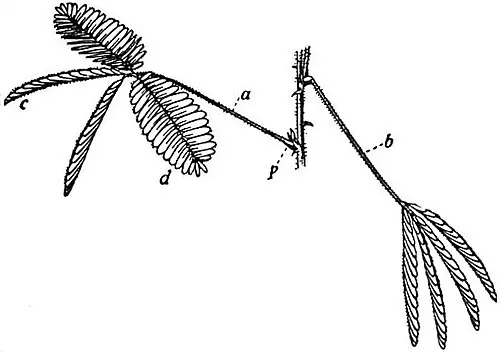
The movement comes from small swellings at the base of each leaf and leaflet, called pulvini (singular: pulvinus).
A pulvinus is packed with cells swollen with water. When the plant is stimulated, potassium and other ions flow out of the cells on one side of the pulvinus, and water follows them out. The cells on that side shrink while those on the opposite side stay plump. The pulvinus bends toward the shrunken side, and the leaflets fold or the leaf stalk drops.

What a glowing plant revealed
Scientists have studied the sensitive plant since the time of Charles Darwin, yet exactly how the signal travels, and what the movement is for, long remained a mystery.
In 2022, a research group led by Professor Masatsugu Toyota of Saitama University in Japan created a “glowing” sensitive plant by adding a gene that lights up in response to calcium ions. When a leaf was wounded, they could watch calcium and electrical signals spread out from the injury through the veins. Once a signal reached a pulvinus, the leaf began to move in only about 0.1 seconds.
The team also used genome editing to make a “non-bowing” plant that could not form pulvini, then set moving and non-moving leaves side by side and let grasshoppers feed. The grasshoppers ate more of the leaves that could not move. On the moving leaves, the leaflets kept folding shut while the insects were eating, and the grasshoppers stopped and wandered off elsewhere. The bow, in other words, is a defense against insects.

Can it learn when not to bow?
Bowing has a cost, however. While its leaves are folded, the plant cannot catch as much light, and it takes somewhere between a quarter and half an hour to open up again. Bowing for no reason is a waste.
In 2014, Australian researcher Monica Gagliano and her colleagues dropped potted sensitive plants from a short height again and again. At first the plants folded their leaves every time they were dropped, but with repetition they stopped doing so. They still folded when shaken by hand, so they had not simply worn themselves out. It was as if they had learned that being dropped was harmless. And when the same plants were tested again a month later, they still did not fold.