Why does metal feel colder than wood?
Metal draws heat from your hand much faster. In the same room, it’s really no colder than wood.
2000times
On a cold morning, grab a horizontal bar at the playground with bare hands and it feels so cold you want to let go. Yet the wooden bench right next to it doesn’t feel nearly as cold. Indoors, too, a metal doorknob feels chilly while the wooden door does not. Everyone has experienced this.
So it is tempting to think the metal must be colder than the wood. In fact, if both have been sitting in the same place for a while, they are almost exactly the same temperature.
Same temperature, different feeling
Anything left in a room for a long time trades heat with the air until it settles at room temperature. If the room is at 20°C (68°F), a metal spoon and a pair of wooden chopsticks are both at about 20°C. Hold a thermometer to them and it should show the same reading.
They feel different because our skin doesn’t measure the temperature of what it touches. What it senses is how quickly its own heat is escaping, and how much the skin cools down as a result. The surface of your hand is somewhere in the 30s °C, so when you touch something at 20°C, heat flows from your hand into the object.


Worlds apart in carrying heat
How fast heat escapes depends on how well a material conducts heat, a property called thermal conductivity. At room temperature, copper comes in at about 400, aluminum about 240 and iron about 80. Glass, by contrast, is around 1, and pine wood a mere 0.1 or so (the unit is W/m·K). Aluminum conducts heat about 2,000 times better than wood, and copper more than 3,000 times better.
Metals are full of electrons that can move freely, and these carry heat away quickly. So when you touch metal, the heat flowing in from your hand is whisked off deep into the metal, and the spot you are touching barely warms up. Your hand keeps losing heat, so the metal feels cold.
Wood, on the other hand, carries almost no heat inward. The heat from your hand stays at the surface, and the spot you touch quickly approaches the temperature of your hand. The flow of heat soon weakens, so you hardly feel any chill. The countless tiny gaps in wood, filled with air that conducts heat poorly, help too.
Which melts ice faster?
There is a fun experiment that shows this clearly. Take a sheet of aluminum and a sheet of plastic that have been sitting at room temperature, and put an ice cube on each.
To the touch, the aluminum feels much colder. But put the ice on, and surprisingly, it is the ice on the aluminum that melts first. The aluminum rushes heat from its surroundings into the ice, and the cube melts away before your eyes. The ice on the plastic is slow to melt.
Feeling cold and being cold are two different things. The metal that feels cold is, in fact, a material that is very good at moving heat.
Why you can sit on a sauna’s wooden benches
The same mechanism works in reverse. In a Finnish sauna, the air can reach about 80 to 100°C (176 to 212°F). People can still sit there in bare skin because the benches are made of wood.
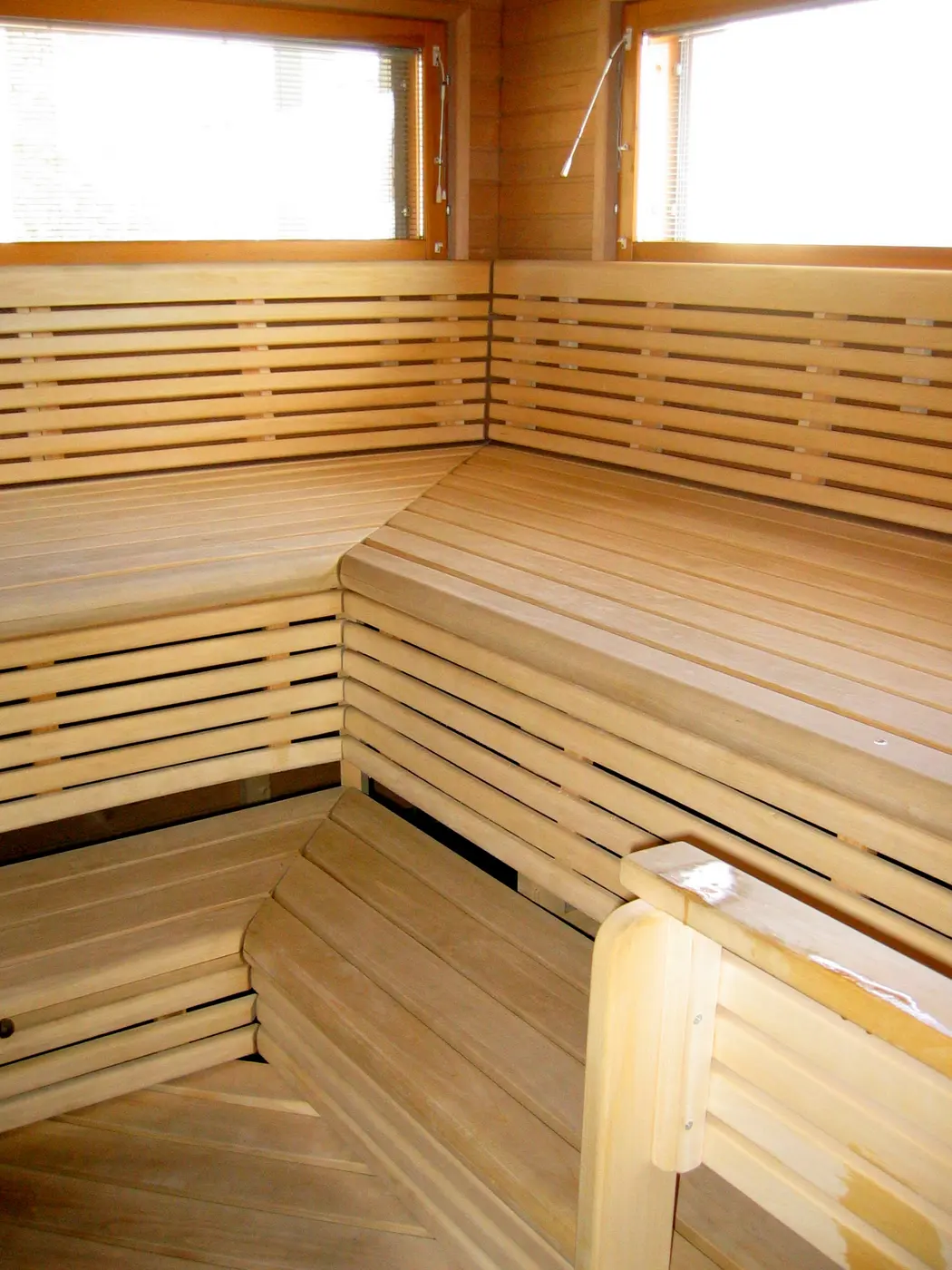

Because wood passes heat along only slowly, the part touching your skin cools a little almost at once, and only a small amount of heat flows into your skin. If the bench were metal at the same temperature, heat would pour into your skin and burn you in no time. That is also why sauna benches are often built so that nails and other metal fittings don’t touch the skin, for example by fastening them from underneath.
The same goes for the wooden or plastic handles on frying pans and pots. Tools for handling hot and cold things quietly make use of these differences in how well materials conduct heat.