Why do magnets stick to things?
Near a magnet, countless tiny magnets in iron line up, turning the iron itself into a magnet that is drawn in.
770°C
We use magnets to pin notes to the refrigerator door and to find north with a compass. They are about as ordinary as tools get, yet if someone asks why they stick, most of us find ourselves surprisingly stuck for an answer. An invisible force reaches across empty space and tugs on a piece of iron. Think about it for a moment, and it is a genuinely strange phenomenon.
What is more, magnets are picky. They leap onto an iron paper clip, but they pay no attention at all to an aluminum can, a copper coin or a piece of plastic. Follow that difference far enough and you end up deep inside matter, at the electrons within atoms.
The source of the force: electrons
All matter is made of atoms, and atoms contain electrons. As it turns out, each individual electron behaves like an extremely tiny magnet. Physicists call this property the electron’s “spin.” It is sometimes compared to a spinning top, but it is really a more quantum-mechanical quality, something the electron is simply born with.
So why isn’t everything around us a magnet? In most atoms, electrons pair up two by two in opposite directions, canceling out each other’s magnetism. Even when some atoms are left with magnetism that is not canceled out, they usually point every which way, so the material as a whole does not become a magnet.
Iron “likes” to line up
Iron, cobalt, nickel and a few other metals are different. Their atoms have unpaired electrons, and on top of that, neighboring atoms have a strong tendency to line up their tiny magnets in the same direction. This force is called the exchange interaction, and it can only be explained by quantum mechanics.
As a result, iron contains small regions in which the atomic magnets all point the same way. These are called magnetic domains. In an ordinary iron nail, though, the domains point in all sorts of different directions, so from the outside their magnetism cancels out. That is why a nail on its own does not attract other pieces of iron.
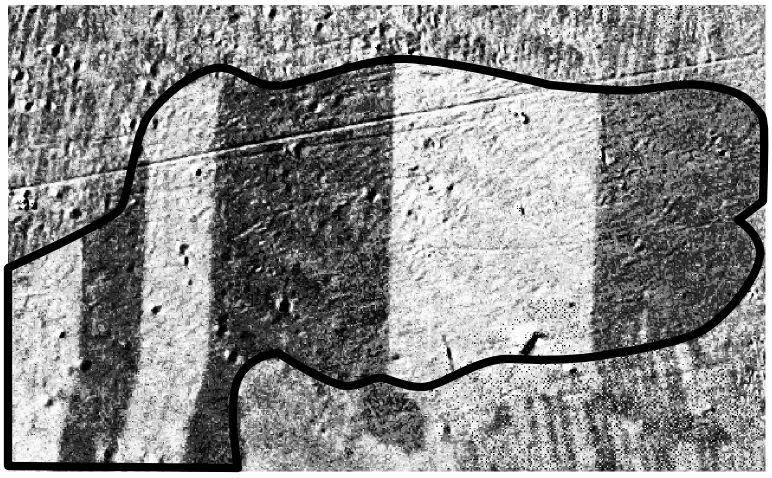

Bring a magnet close, and iron becomes a magnet too
When you bring a magnet near an iron paper clip, the domains inside the clip that are aligned with the magnet’s force begin to grow. The clip itself becomes a temporary magnet, with a south pole forming on the side nearest the magnet’s north pole, and a north pole on the side nearest its south pole. Since north and south poles attract, the clip jumps to the magnet. A magnet first turns iron into a magnet like itself, and then pulls it in.
That is also why a second paper clip can hang from one already stuck to a magnet: the first clip has become a magnet. Aluminum and copper, by contrast, have almost no tendency to line up, so they do not stick to an ordinary magnet. They are not completely unaffected; they are very faintly attracted or repelled. But the force is far too small to feel with your hand.
Permanent magnets, like the ones on your fridge, are made of materials designed so that once their domains are lined up, they stay that way even after the outside force is gone.
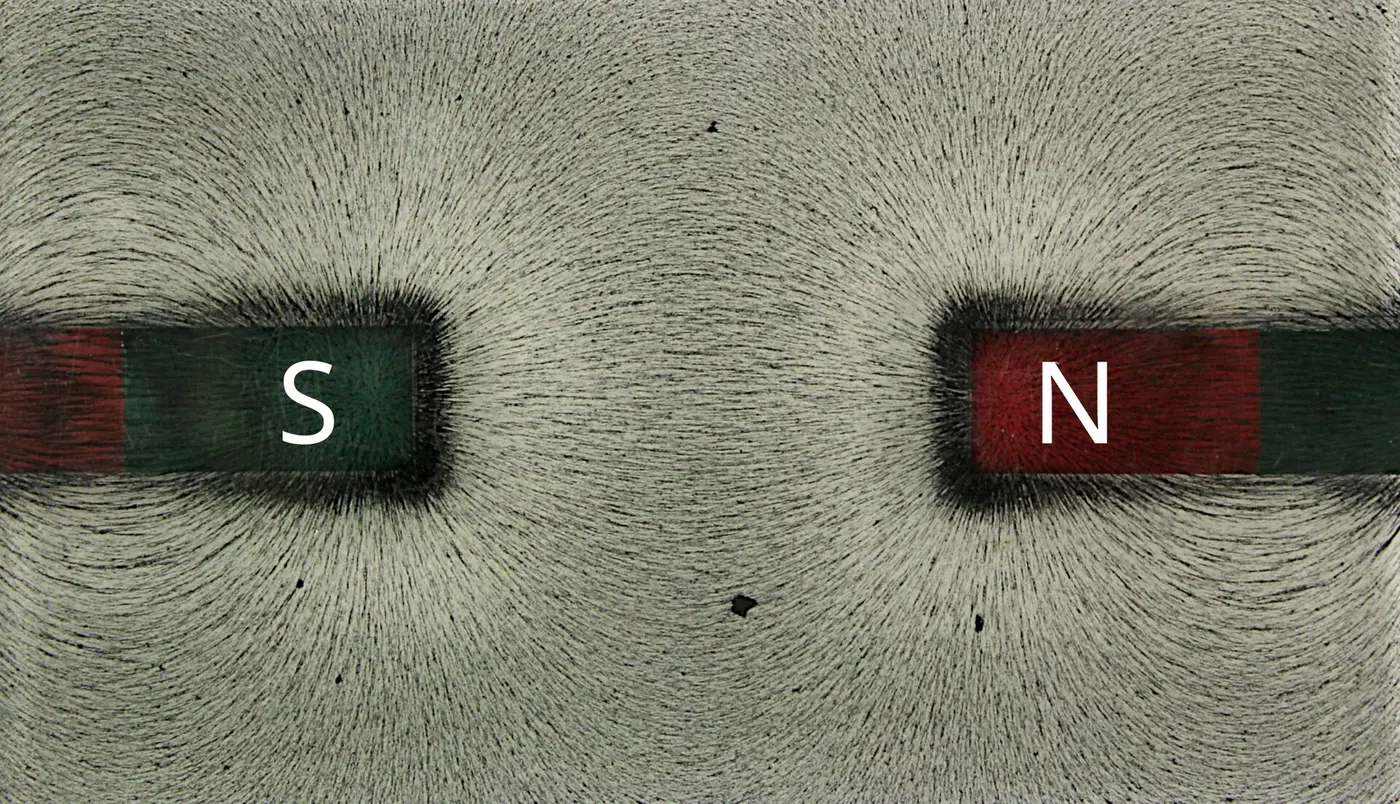

Heat it up, and the attraction disappears
Heat iron, and above a certain temperature it stops sticking to magnets. For iron, that temperature is about 770°C (1,418°F). It is called the Curie temperature, after the French physicist Pierre Curie. The heat makes the atoms jiggle so violently that it overpowers the force keeping their magnets lined up. Once the iron cools down, it sticks to magnets again.
Another curiosity: if you snap a bar magnet in half, you do not get one magnet that is all north and another that is all south. Each piece becomes a smaller magnet with its own north and south poles. That is because each electron, the root of magnetism, is already a magnet with a north and a south pole of its own.