When was zero discovered?
Rules for calculating with zero as a number were set down in 7th-century India; placeholder signs came earlier.
628
Today’s low is zero degrees; the match ended nil–nil. We use zero almost every day. Yet across the long sweep of human history, zero is a fairly recent invention. The ancient Egyptians who built the pyramids did not use a zero, and neither did the ancient Greeks who developed sophisticated geometry.
To answer the question “When was zero discovered?” you first need to know that zero has two faces.
A sign for an empty place
The first face is zero as a placeholder. When we write “205,” we mean two hundred and five. The zero in the middle is a marker that says “nothing in the tens place.” Without it, telling 25, 205 and 250 apart in writing would be a struggle.
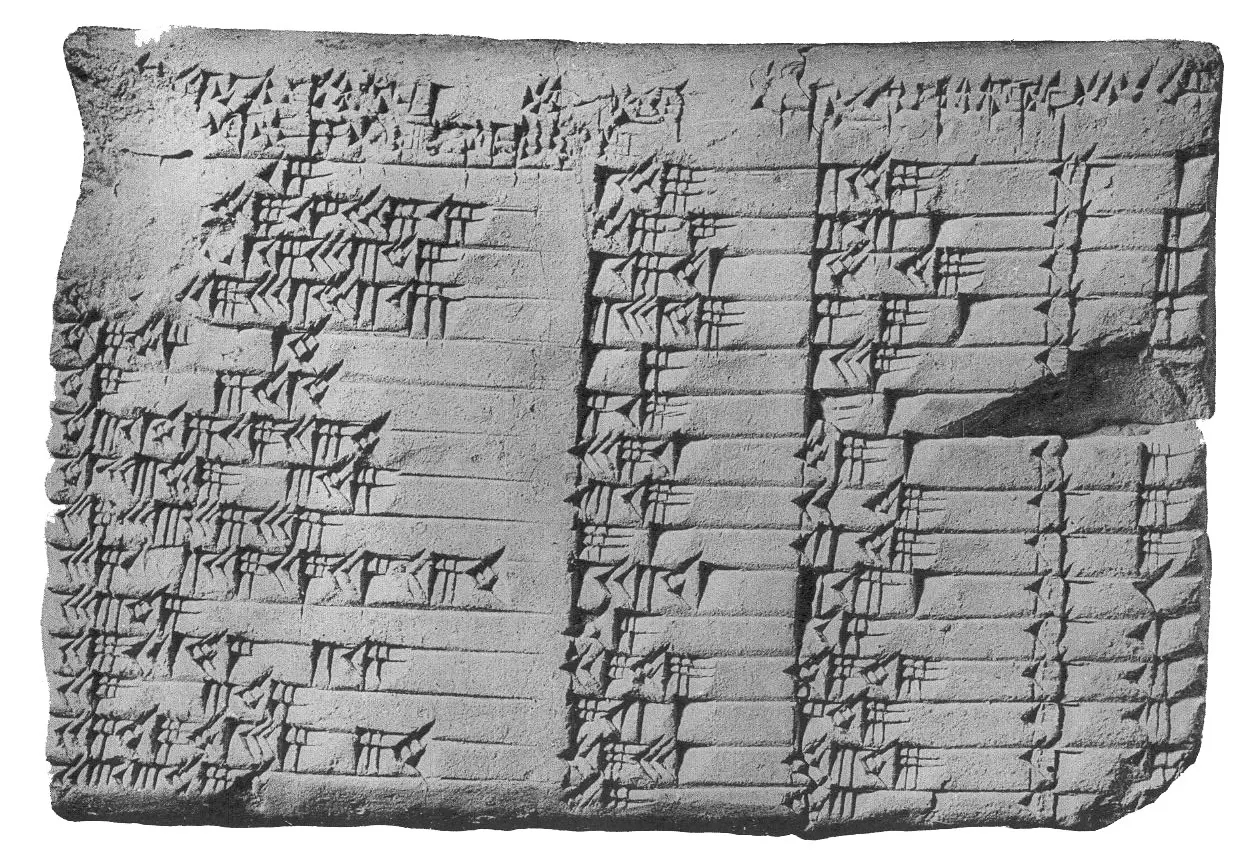
The people of ancient Mesopotamia were early users of a sign like this. In Babylonia, where numbers were counted in a base-60 system, a special symbol marking an empty place was being written on clay tablets by about 300 BCE. But it was only ever a mark meaning “this spot is empty.” It was not a number in its own right that could be used in calculations.

Far away in Mesoamerica, the Maya independently used a sign of their own for zero. Shaped something like a shell, it was used for writing calendar dates and had been carved on stone monuments by the 4th century at the latest.
Zero becomes a number in 7th-century India
The second face is zero as a number—something you can calculate with. The person who clearly set this idea down in writing was Brahmagupta, a 7th-century Indian astronomer and mathematician. In a work on astronomy he wrote in 628, he treated zero as a number in its own right and laid out rules for calculating with it: adding zero to a number leaves it unchanged; subtracting a number from itself gives zero; multiplying a number by zero gives zero. He also set out rules for calculating with negative numbers.
When it came to dividing by zero, though, his answers differed from those of modern mathematics. Division by zero was that tough a problem. Treating “nothing” as a number was a huge leap of imagination.
The oldest written zero
So how far back can we trace a written character shaped like zero?
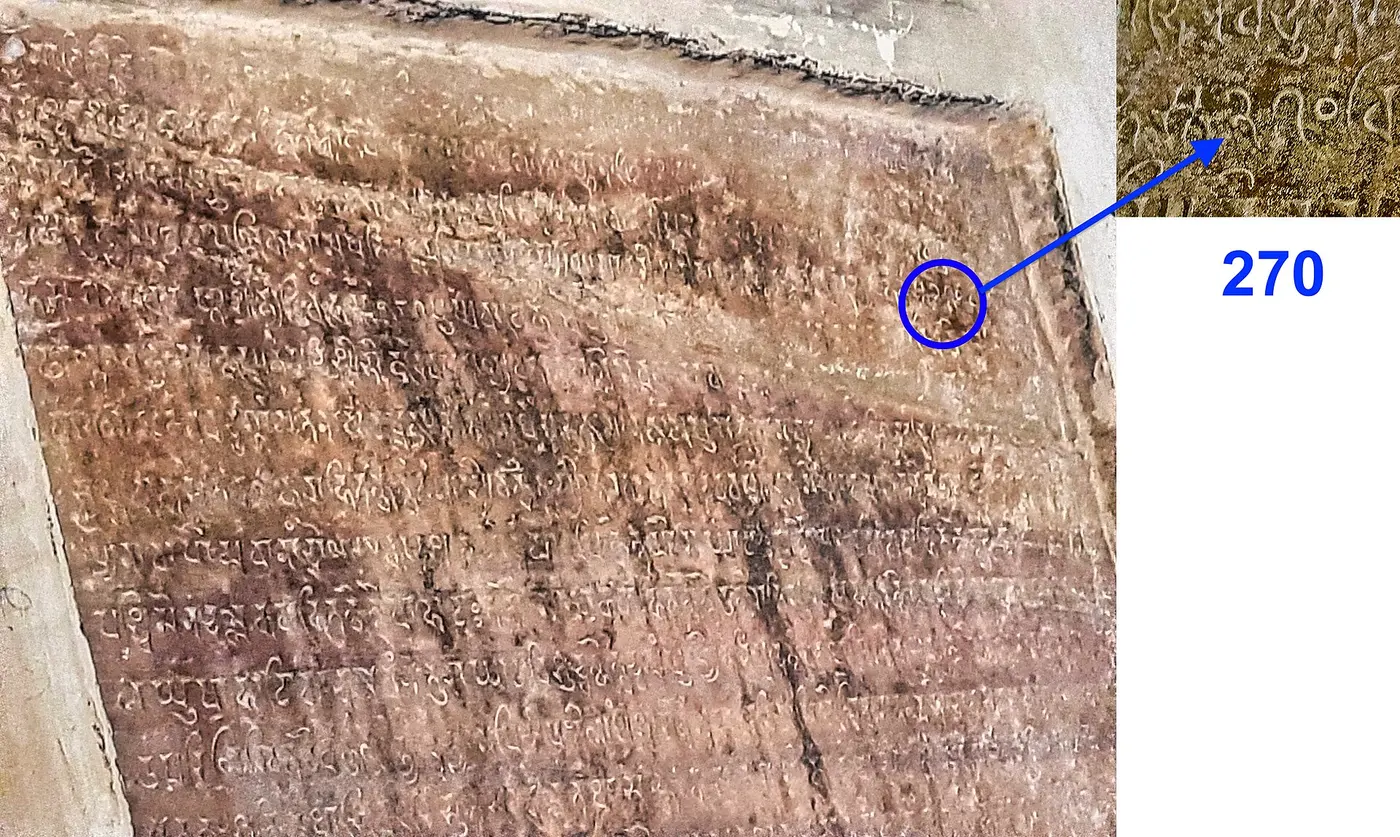
At a temple in Gwalior, a city in central India, there is an inscription carved in 876. It includes numbers such as “270,” written with a small circle that looks very much like our zero. For a long time, this was known as the oldest securely dated zero in India.

An older example is an inscription from 683 found in Cambodia, in which zero is written as a small dot. Zeros written as dots also appear many times in the Bakhshali manuscript, a mathematical text unearthed in what is now Pakistan. Radiocarbon dating announced in 2017 placed some of its fragments in the 3rd or 4th century, which made headlines. However, the dates vary from fragment to fragment, and when the manuscript was actually written is still debated.
From “empty” to “zero”
Zero and the place-value numerals born in India later spread to the Islamic world. In the 9th century the Baghdad mathematician al-Khwarizmi introduced this method of calculation, and from there it traveled on to Europe. In 1202 the Italian mathematician Fibonacci presented these numerals in a book of his own.
You can follow the name on its journey too. In Sanskrit, zero was called “shunya,” a word meaning “empty.” It was translated into Arabic as “sifr,” which also means “empty,” and after passing through Latin and other languages it is thought to have become the English word “zero.”