Are sunsets on Mars blue?
Yes. Fine dust in the air keeps blue light close to the Sun, so the setting Sun is ringed with a pale blue glow.
On Earth, the sky around the setting Sun turns orange and red. A blue sky by day, a red one at dusk: to us, it is the most ordinary of sights.
So what color is a sunset on Mars, the “Red Planet,” where both the ground and the sky look reddish? You might picture an even redder sunset. The photos taken by rovers on Mars turned that expectation upside down.
The blue sunset a rover saw
On April 15, 2015, NASA’s Curiosity rover photographed the Sun sinking toward the horizon in Gale Crater on Mars. It was the first sunset Curiosity had captured in color.
The images showed a small white Sun in a grayish sky, surrounded by a pale blue glow. On Mars, the sky near the setting Sun turns blue.
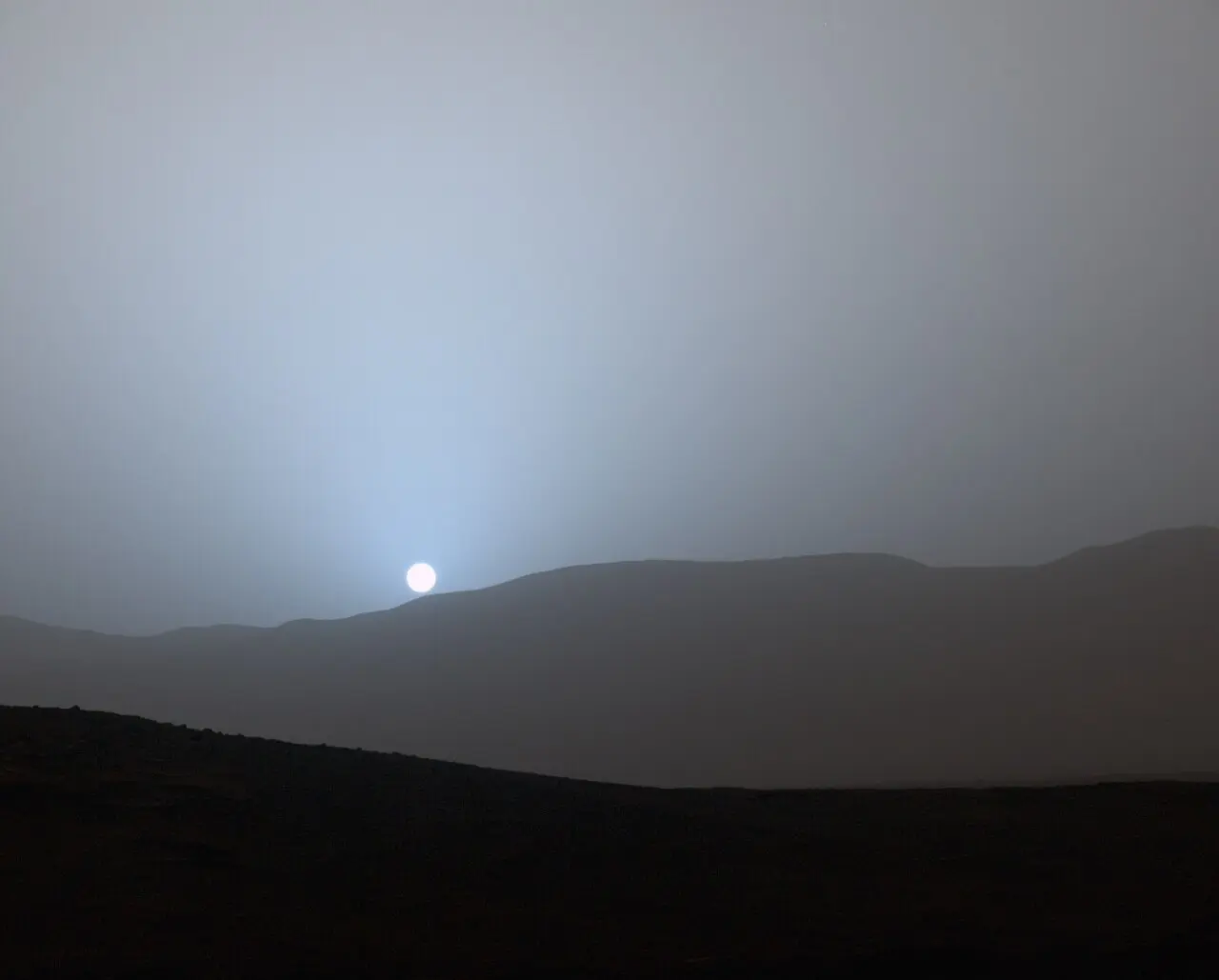
This isn’t a case of image processing exaggerating the colors. According to NASA, the color in this picture was calibrated to remove the camera’s quirks, and the camera sees color very much as the human eye does. It is actually a little less sensitive to blue than we are, so a person standing there would likely see at least as much blue as the photo shows. Back in 2005, another rover, Spirit, had captured a similar blue sunset in Gusev Crater.
The key is fine dust in the air
Earth’s sky is blue because air molecules scatter the blue part of sunlight in all directions. At sunset, sunlight travels a long way through the air, the blue gets scattered out along the way, and the red light that remains makes the sunset red.
The Martian atmosphere is only about one hundredth as dense as Earth’s. What it does have is fine dust, always hanging in the air. The particles are a few micrometers (a few thousandths of a millimeter) across, far larger than air molecules.
This dust scatters different colors in different ways. Yellow and red light gets spread widely across the sky, while blue light keeps traveling closer to its original direction, near the Sun. So the blue light gathers around the Sun. In the evening, when sunlight passes through more of the atmosphere, the effect grows stronger. Mark Lemmon of Texas A&M University, the Curiosity team member who planned the observations, explained that “the very fine dust is the right size so that blue light penetrates the atmosphere slightly more efficiently.”
A reddish daytime sky
Only the area around the Sun is blue; the rest of the sky is yellow to orange. By day, too, the Martian sky is not blue like Earth’s but reddish. That is because the soil and rocks that the dust comes from are rich in iron oxide, the same compound as rust.
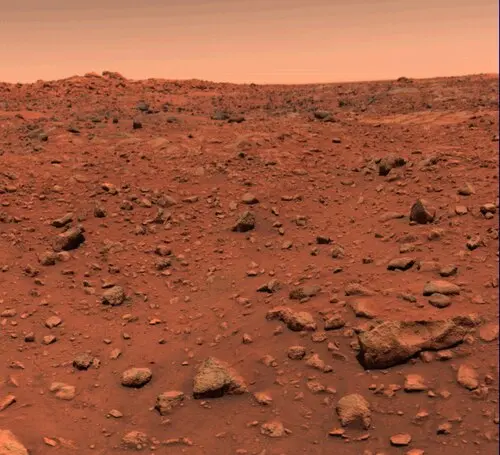

In July 1976, when NASA’s Viking 1 lander sent back the first color photo from the surface of Mars, the version first released to the public reportedly showed an Earth-like blue sky. It had been rushed out without proper color calibration. Once the colors were corrected, the sky turned out to be reddish. Reddish by day and blue around the Sun at dusk, the Martian sky is almost the reverse of our own.
Sunsets as a dust gauge
Blue sunsets are not just beautiful. By studying the brightness and color of the sky at dusk and dawn, scientists can work out how high the dust reaches in the atmosphere. Curiosity’s 2015 images were taken in a lull between dust storms, while some dust still hung high in the air.
When there is a lot of dust high up, sunlight keeps being scattered around into the sky even after the Sun has set. That is why twilight on Mars is long, lasting up to about two hours after sunset or before sunrise.