Why do comet tails point away from the Sun?
They are pushed back by the pressure of sunlight and by the “solar wind” streaming out from the Sun.
Comets stretching long tails across the night sky have unsettled people since ancient times. In Japan they are also called hōkiboshi, “broom stars,” and the English word “comet” comes from a Greek word meaning “long-haired.”
Seeing one, you naturally picture it charging across the sky with its tail streaming out behind. In fact, a comet’s tail has nothing to do with the direction it is moving. It always points away from the Sun. When a comet is heading back out from the Sun, it actually travels tail first.
A dirty snowball wakes up
The heart of a comet, its nucleus, is a small lump of ice and dust a few kilometers to a dozen or so kilometers across. The American astronomer Fred Whipple famously likened it to a “dirty snowball.”
While it is far from the Sun, the nucleus stays frozen solid, drifting quietly through dark space. As it nears the Sun, however, the ice on its surface warms and turns to gas, bursting out along with the dust trapped inside. This forms the “coma,” a hazy, atmosphere-like cloud around the nucleus. A large coma can reportedly grow up to 15 times the diameter of Earth.
The tail is simply this gas and dust from the coma, swept away from the sunward side.
A blue tail and a white tail
Many bright comets actually have two tails, each with a different character.
One is the ion tail, or plasma tail. When gas is struck by the Sun’s ultraviolet light, it becomes electrically charged ions. Meanwhile, the Sun is blasting out a stream of charged particles called the solar wind at hundreds of kilometers per second. The ions get caught up in the magnetic field this wind carries and are swept along with it. That is why the ion tail stretches out narrow and straight, almost directly away from the Sun. It looks bluish, thanks to light given off by carbon monoxide ions.
The other is the dust tail. This one forms when fine dust grains are pushed by sunlight itself. Light exerts a tiny but real push on things, known as radiation pressure. The dust reflects sunlight and glows white or yellowish. Because it is not swept away as forcefully as the ion tail, the dust tail lags behind along the path the comet has traveled, forming a broad, gently curving fan.
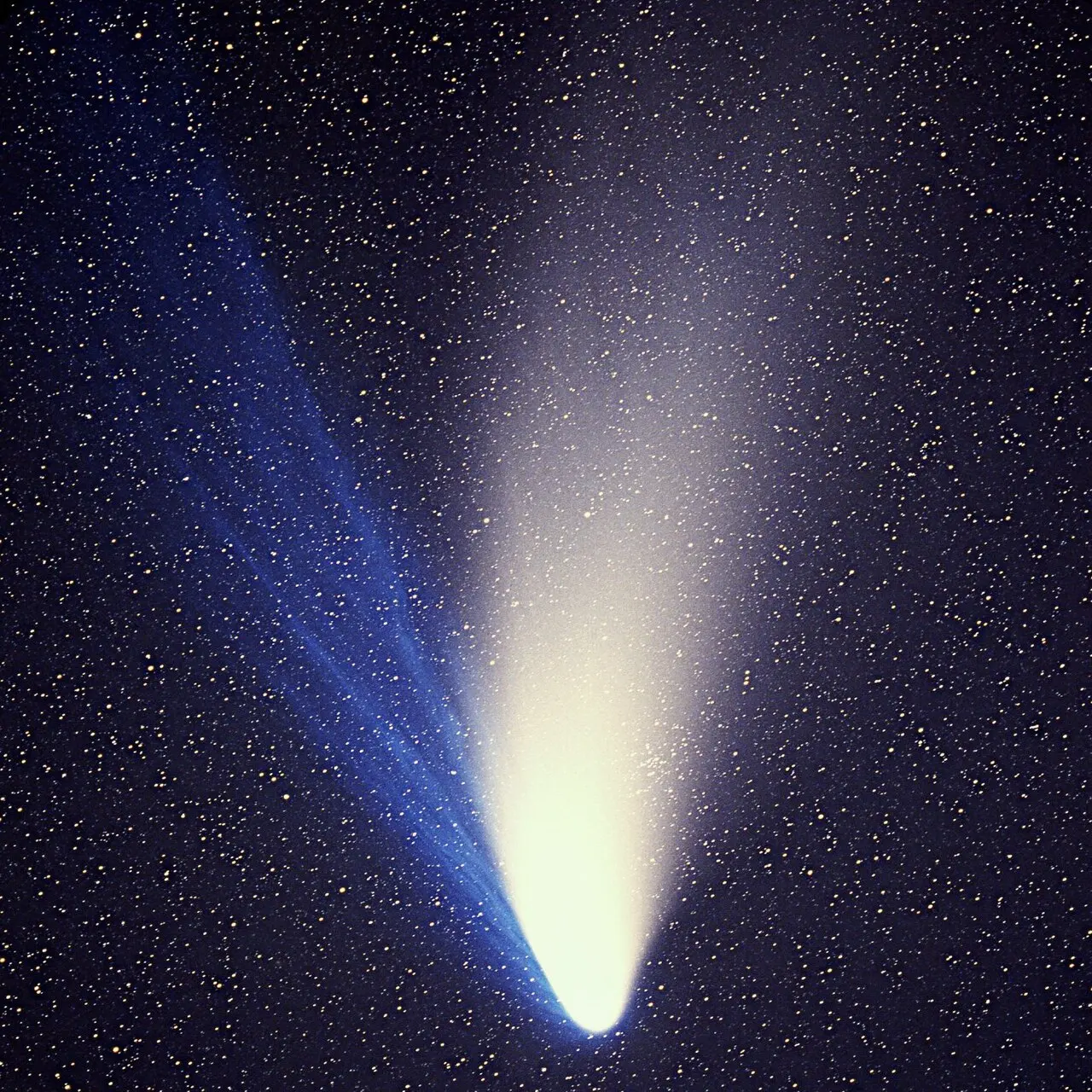

Tails can grow to astonishing lengths. For Comet Hyakutake, which passed close to Earth in 1996, later analysis revealed that the Ulysses spacecraft had flown through its tail about 570 million kilometers from the nucleus. That is about 3.8 times the distance between the Sun and Earth.
The tail that revealed the “solar wind”
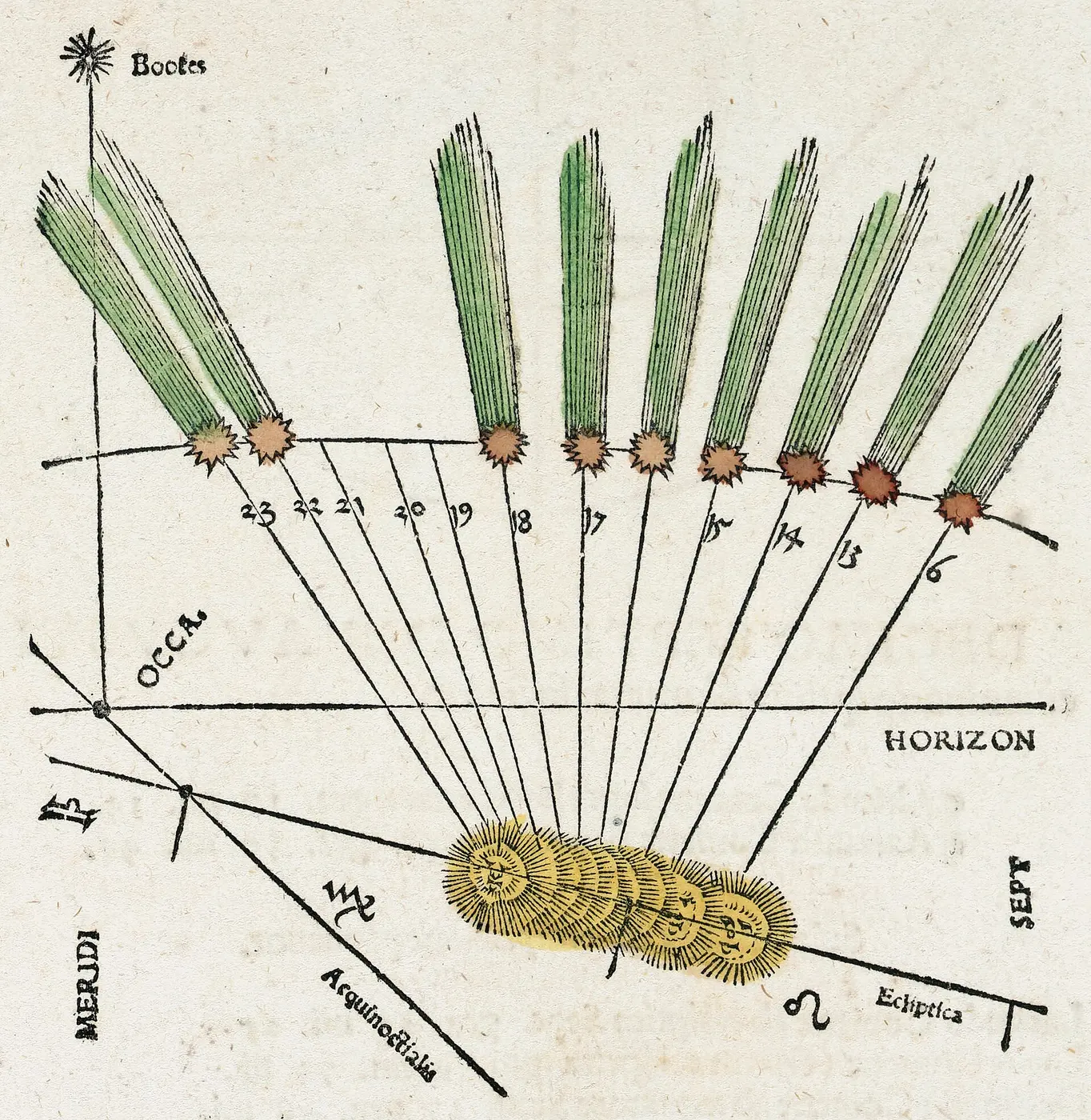
People noticed long ago that comet tails point away from the Sun. The 16th-century German astronomer Petrus Apianus observed the comet of 1531—the one later known as Halley’s Comet—and recorded, with illustrations, that its tail always pointed away from the Sun.

Why this happens, though, remained a mystery for a long time. The sticking point was that ion tails were being blown back far more strongly and straightly than the pressure of light alone could explain. In the early 1950s, the German astronomer Ludwig Biermann seized on this and argued that the Sun must be constantly pouring out a stream of particles. His idea was later worked into the theory of the “solar wind,” and around 1960 spacecraft detected it directly.
Comet tails, it turned out, are windsocks in space, showing which way an invisible wind from the Sun is blowing.