What is the largest seed in the world?
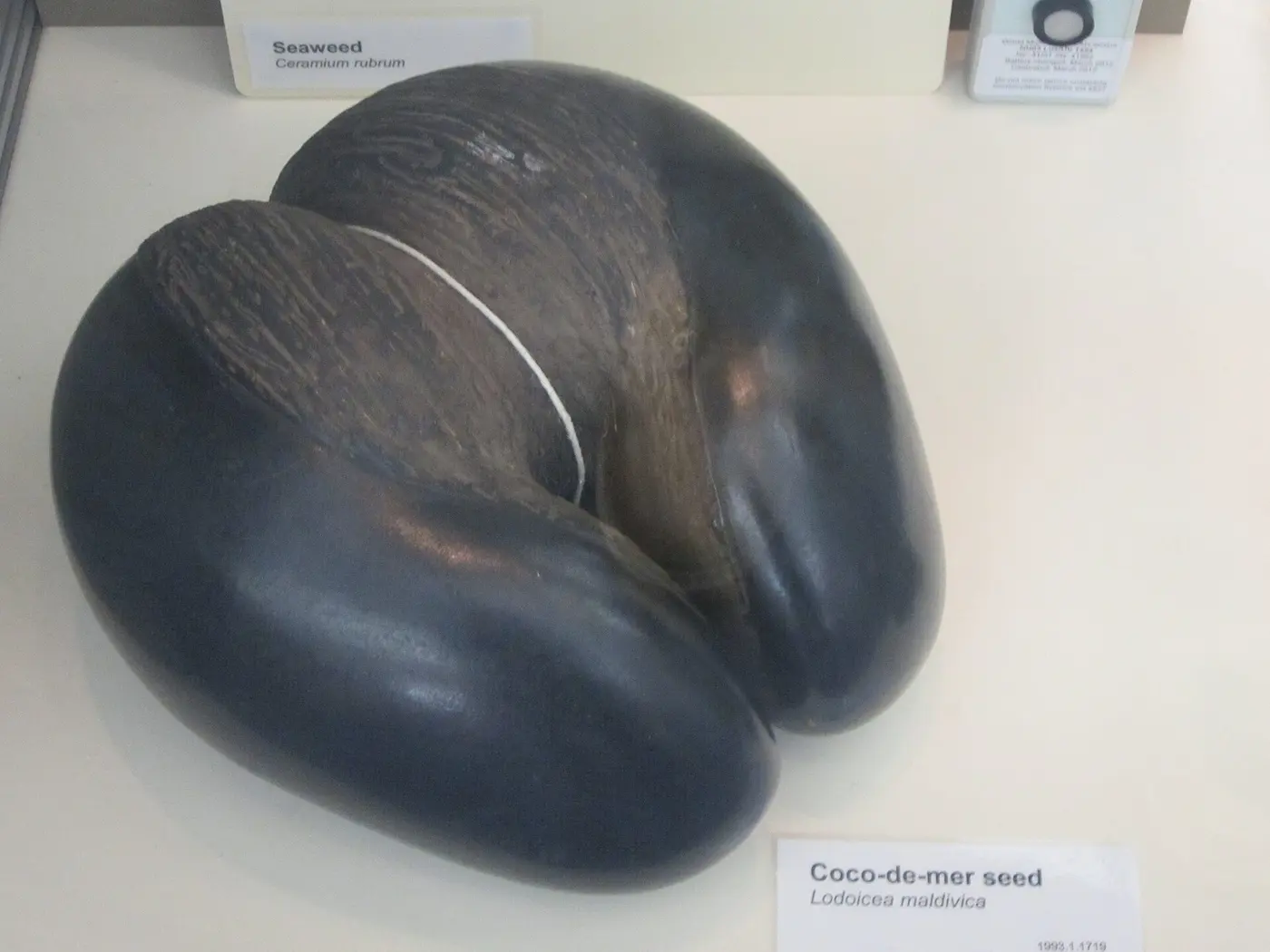
The seed of the coco de mer, a palm from the Seychelles. It can weigh up to about 25 kilograms.
25kg
Say “seed” and most of us picture something small, like a sunflower or morning glory seed, the kind you can hold a handful of in your palm. If we think of a big seed at all, it is probably a coconut.
On islands in the Indian Ocean, however, grows a plant whose seeds dwarf any coconut. They usually weigh more than 10 kilograms, and the biggest reach about 25 kilograms (55 pounds)—a weight a young child could barely lift even with both arms wrapped around it. This is the coco de mer, famous for having the largest and heaviest seed in the world.
Legend of a tree on the seabed
The coco de mer’s seeds were long shrouded in mystery. Huge fruits occasionally washed up on beaches in the Maldives and elsewhere around the Indian Ocean, but no one had ever seen the tree they grew on.
Sailors came to believe the fruit grew on trees at the bottom of the sea. And in fact, because the fruit is so heavy, it sinks when it first falls into the ocean. Only after its outer husk rots away does gas forming inside make it light enough to rise to the surface. Watching fruit float up from the depths, it is little wonder people imagined an undersea tree.
The rare fruits were treated as treasures with mysterious powers and traded among royalty and nobility for high prices. It was not until the late eighteenth century that their true home was traced to the Seychelles, an island nation in the Indian Ocean. Incidentally, the species name maldivica means “of the Maldives,” yet the palm has never grown wild there. The name of the place where the fruit washed ashore simply stuck.
A giant seed with two rounded lobes
The coco de mer is a palm that can grow 25 to 30 meters tall. Its fan-shaped leaves are enormous, measuring 7 to 10 meters long.
With the husk still on, the fruit can weigh about 25 to 45 kilograms, and the seed inside alone weighs about 10 to 25 kilograms. The seed has a distinctive shape, like two rounded lobes joined together, which gave the plant its Japanese name, futagoyashi (双子椰子), or “twin palm.” In French it is called coco de mer, “coconut of the sea.”

Wild coco de mer palms grow only on two islands in the Seychelles, Praslin and Curieuse. The Vallée de Mai Nature Reserve on Praslin, which protects a forest of these palms, is a UNESCO World Heritage Site.
A very patient life
The coco de mer takes its time with everything. It is said to take six to seven years from flowering for the fruit to ripen, and about two more years for the seed to sprout.
When it germinates, a root-like tube grows out of the seed, and the young shoot finally emerges above ground some distance away—usually about 4 meters, and sometimes nearly 10 meters. It can then take several more decades before the tree flowers. Male and female flowers grow on separate trees, and only the female trees bear fruit.
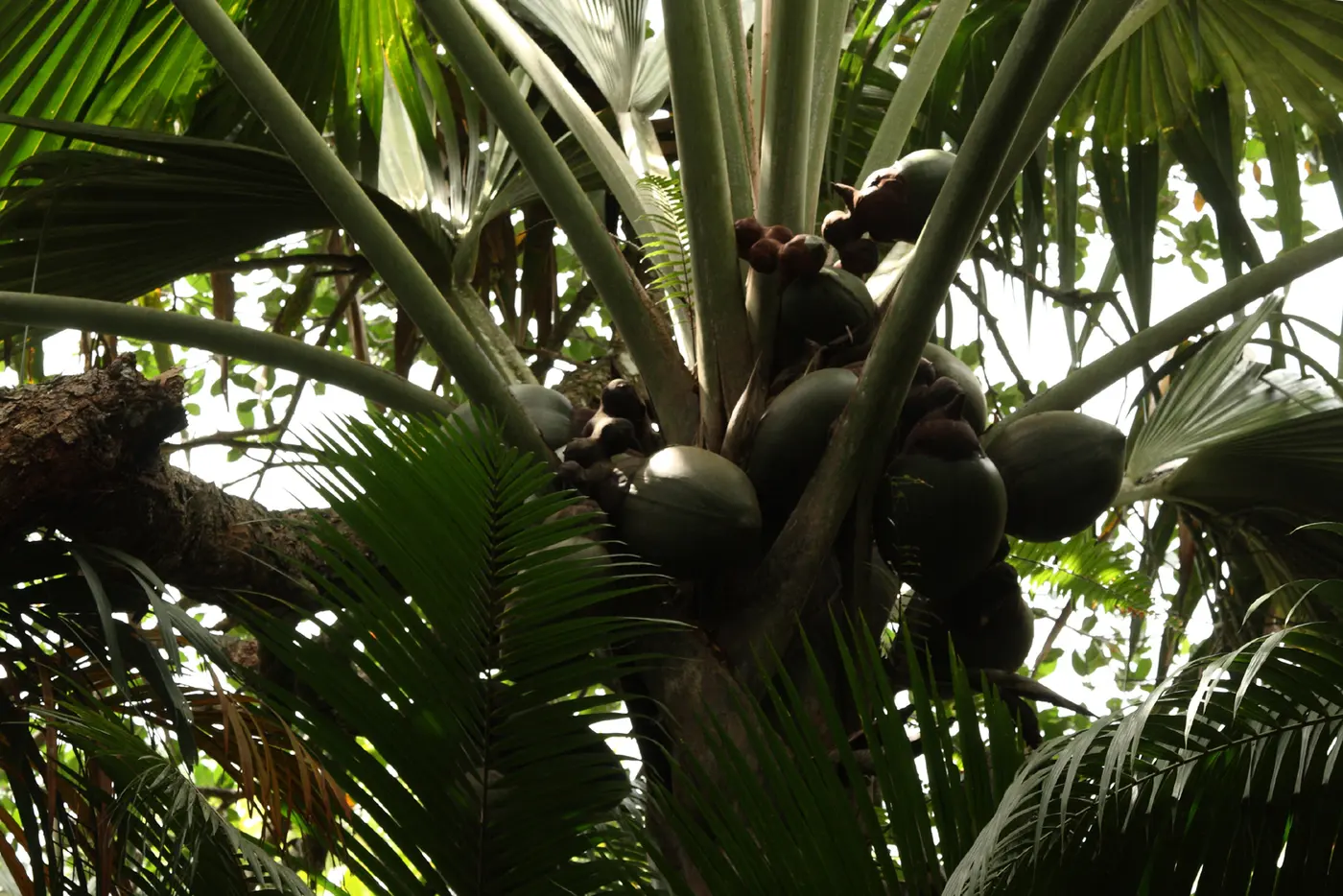

Today, there are estimated to be about 8,000 mature coco de mer palms growing in the wild, and the species is listed as endangered. The government of the Seychelles strictly controls the export and trade of the seeds.
Why did it grow so big?
Researchers have offered an intriguing idea about why the palm makes such enormous seeds. The soil on the islands where it grows is extremely poor in nutrients.
The coco de mer’s giant leaves are shaped like funnels, catching falling pollen and bits of debris. These are washed down to the base of the trunk along with rainwater, and this is thought to gradually enrich the soil around the tree. Heavy seeds don’t roll far; they land near their parent. They grow slowly in a nourishing spot prepared by the parent, drawing on the generous food supply packed into the seed. The giant seed may be the product of evolution tailored to exactly that way of life.