Which is older, the Kojiki or the Nihon Shoki?
The Kojiki was finished in 712, eight years before the Nihon Shoki. Yet the oldest surviving manuscripts belong to the Nihon Shoki.
The gods Izanagi and Izanami giving birth to the islands of Japan, the hero who slays the eight-headed serpent Yamata no Orochi, the white hare of Inaba: many of the best-known Japanese myths have come down to us through two books, the Kojiki (“Records of Ancient Matters”) and the Nihon Shoki (“Chronicles of Japan”). Together they are often called the Kiki.
Both were compiled at the start of the Nara period in the early eighth century, and they are the oldest histories to survive in Japan. So which of the two was finished first?
The Kojiki in 712, the Nihon Shoki in 720
According to the Kojiki’s preface, the project began with Emperor Tenmu in the late seventh century. He had Hieda no Are, a 28-year-old attendant with an extraordinary memory, learn by heart the genealogies of the imperial line and the old traditions. But the emperor died and the work stalled. Later, on the orders of Empress Genmei, the official Ō no Yasumaro wrote down what Are recited and presented the result on the 28th day of the first month of 712. It runs to three volumes, from the creation of heaven and earth to the reign of Empress Suiko in the early seventh century.
The Nihon Shoki, for its part, was compiled by a team led by Prince Toneri and completed in 720, according to the Shoku Nihongi, a later official history. It is a massive work of 30 volumes plus a volume of genealogies, covering the age of the gods through the reign of Empress Jitō at the end of the seventh century.
Going by completion dates, then, the Kojiki came first, by eight years.
Why two books at once?
Why produce two books on similar subjects just eight years apart? The two are quite different in character.
The Kojiki is written in Chinese characters, but in a style adapted so that it can be read as Japanese, with songs and the names of gods spelled out using characters for their sounds. Its myths and heroic tales flow together as one continuous story.
The Nihon Shoki is written in formal classical Chinese modeled on Chinese histories, recording events year by year in chronological order. It was produced as Japan’s official state history and became the first of the “Six National Histories.” Another distinctive feature is that after the main text it often lists alternative versions of a story, each introduced with the phrase “one book says.”
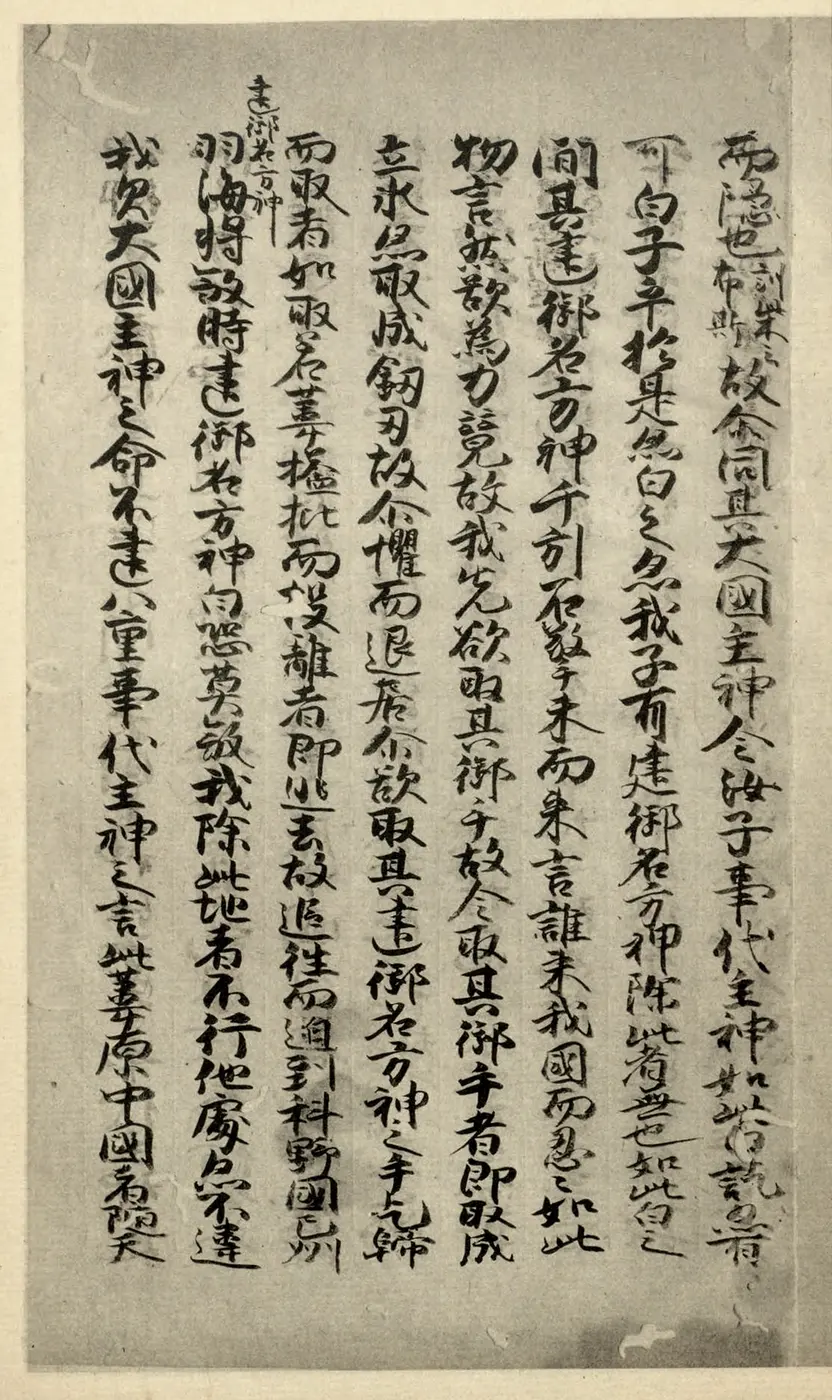

The Kojiki has few witnesses
In fact, the evidence that the Kojiki was finished in 712 comes almost entirely from its own preface. The Shoku Nihongi records the completion of the Nihon Shoki, but says nothing about the Kojiki being presented. Hieda no Are’s name does not appear in any other record either.
Since the Edo period (1603–1868), some scholars have argued that the Kojiki is a later forgery. Then, in 1979, the tomb of Ō no Yasumaro was found by chance in a tea field in the city of Nara. A copper epitaph plate inside recorded his court rank and his death in 723. The compiler, it turned out, was a real person, and today most scholars accept that the Kojiki dates from the early Nara period.
The manuscripts turn the tables
When it comes to the oldest surviving physical copies, however, the order is reversed. The oldest manuscript of the Kojiki is the Shinpukuji manuscript, kept at Ōsu Kannon (Shinpukuji temple) in Nagoya, which was copied in 1371–72. The Nihon Shoki, by contrast, survives in the Tanaka manuscript, copied in the ninth century.
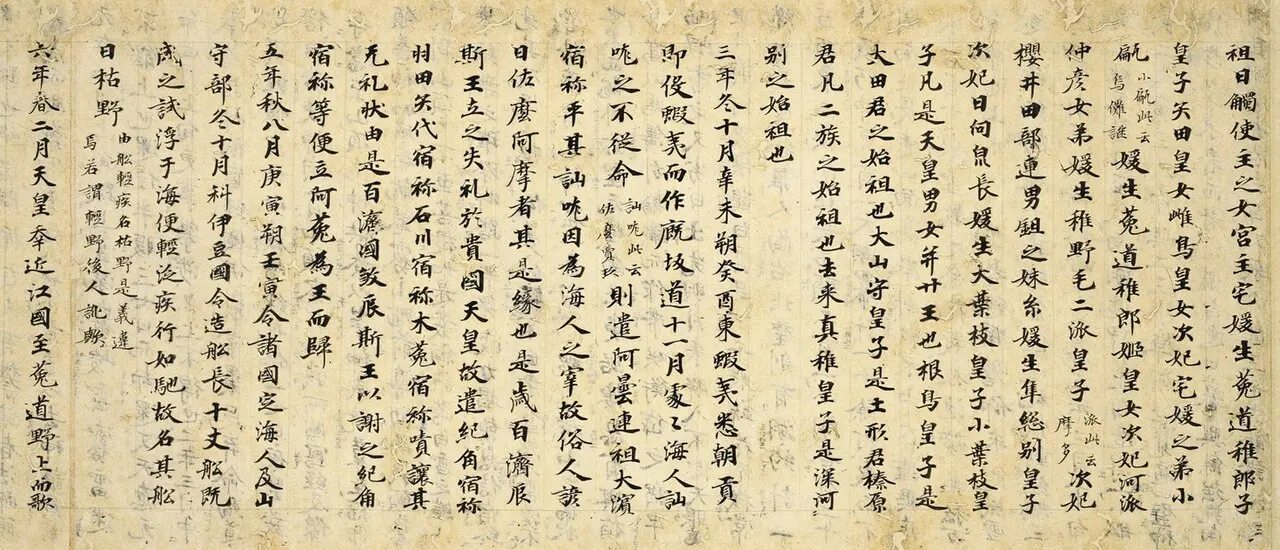

The gap reflects the very different paths the two books took. From the year after its completion, the Nihon Shoki was the subject of lectures at the imperial court, and as the official history it was read and copied again and again. The Kojiki, meanwhile, long stood in its shadow. It won wide attention only after the Edo-period scholar Motoori Norinaga spent 35 years writing Kojiki-den, a 44-volume commentary on it.