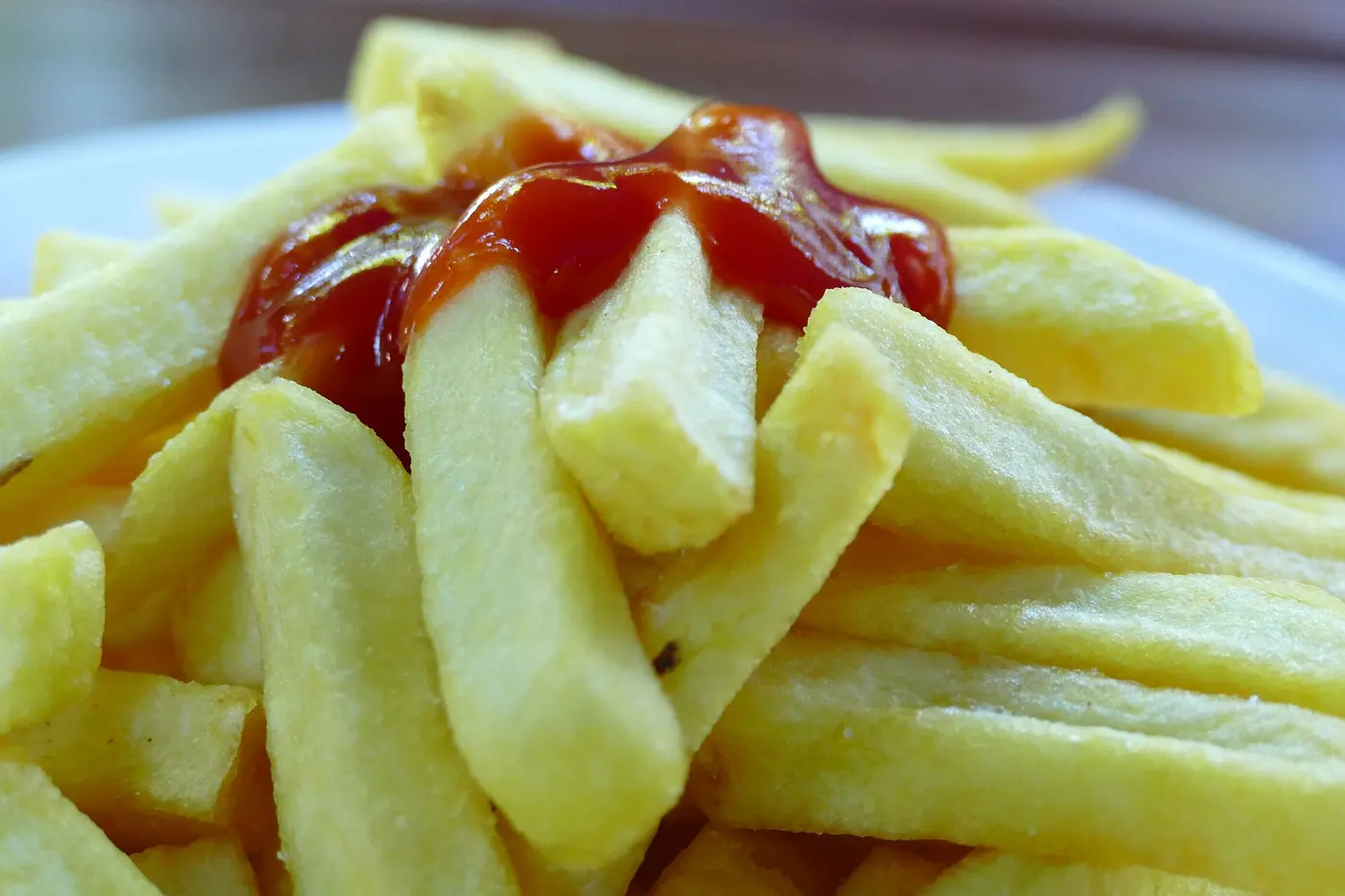
Did ketchup start out as fish sauce?
The leading theory traces the name to a southern Chinese word for fish brine. Tomatoes came in the 1800s.
1812
Fries, burgers, omurice (Japanese rice wrapped in an omelet), spaghetti Napolitan. Ketchup is a fixture at tables everywhere, Japan included. Sweet, tangy and red, it is so bound up with tomatoes that most people assume the two are inseparable.
Yet the word “ketchup” itself has nothing to do with tomatoes. In fact, the leading theory traces it back to a salty liquid made by steeping fish.
A southern Chinese word for fish brine?
The origin most often cited is a word from Hokkien (also called Minnan), the language spoken in China’s Fujian province, Taiwan and nearby. A dictionary of the Amoy (Xiamen) dialect published in 1873 lists the word 膎汁, pronounced kê-tsiap. The first character means salted fish or shellfish; the second means juice. In other words, it seems to have meant the salty liquid from pickled seafood: a kind of fish sauce.
Fish sauce is made by layering fish with salt and letting it ferment. Thai nam pla, Vietnamese nước mắm and shottsuru from Akita in northern Japan all belong to the same family.


The other candidate is the Malay word kicap, which originally meant soy sauce; in Indonesia, sweet soy sauce is still called kecap manis. But the Malay word itself appears to have come from Chinese, so either way the usual view is that the trail leads back to southern China. That said, the etymology is disputed and cannot be called certain.
European traders and sailors are thought to have met these sauces in Southeast Asian ports and carried the name home. In English texts, the spelling “ketchup” appears in 1682 and “catchup” in 1690.
In Britain, mushroom and walnut ketchup
Once it reached Britain, “ketchup” set off down a different path from the original fish sauce. The authentic ingredients were hard to come by, so cooks tried to make similar salty sauces from what they had on hand.
Eighteenth-century British cookbooks include all kinds of ketchup recipes. The Compleat Housewife, first published in 1727, has a ketchup made with anchovies, shallots, vinegar, ginger and more. The fish still hints at its fish-sauce ancestry.
Before long there were ketchups made from mushrooms, walnuts and oysters. Mushroom ketchup was especially popular: mushrooms were salted, and the dark juice they gave off was boiled down. The result was a savory, umami-rich sauce for seasoning meat dishes and soups. Ketchup in this era was neither red nor sweet. It was a dark, salty liquid.
Tomato ketchup was born in America
Tomatoes did not join the story until the 19th century. The earliest known tomato ketchup recipe is said to be one published in 1812 by James Mease, a physician in Philadelphia.
Some early tomato ketchups still contained anchovies. An 1817 recipe uses them, but by the middle of the century the anchovies had faded away. Having begun as fish juice, ketchup finally parted ways with fish.
The company that turned tomato ketchup into a global condiment was founded by the American businessman Henry J. Heinz. It began selling tomato ketchup in 1876, and its octagonal glass bottle appeared in 1889. Made in factories and sold in bottles, ketchup became an American household staple and went on to spread around the world.
Today, in almost every country, “ketchup” simply means tomato ketchup. In Britain, though, mushroom ketchup is still on sale: a dark, salty condiment that preserves the old-fashioned form of the sauce.