What happens if you light a candle in space?
The flame stops reaching upward and turns into a dim blue ball. With no air currents, it burns quietly and slowly.
Light a candle and the flame stands straight up in the shape of an upside-down teardrop. Tilt the candle, and the flame still points upward. It is so familiar that we tend to assume that is simply what flames look like.
In fact, a flame points up only because Earth has gravity. Light a candle where gravity is absent, and the flame looks completely different.
Why flames on Earth are pointed
Inside a candle flame, wax melted and vaporized by the heat combines with oxygen from the surrounding air and burns. The hot gases this produces are lighter than the air around them, so they rise. Fresh air then flows in from below to take their place, bringing the flame a new supply of oxygen.
This flow of warm air rising and cool air rushing in, called convection, stretches the flame upward into its long teardrop shape.
A candle flame looks bright yellow because tiny particles of soot, formed when the fuel does not burn completely, are heated until they glow. On Earth, the rising current carries the soot upward, where it shines brightly near the top of the flame.
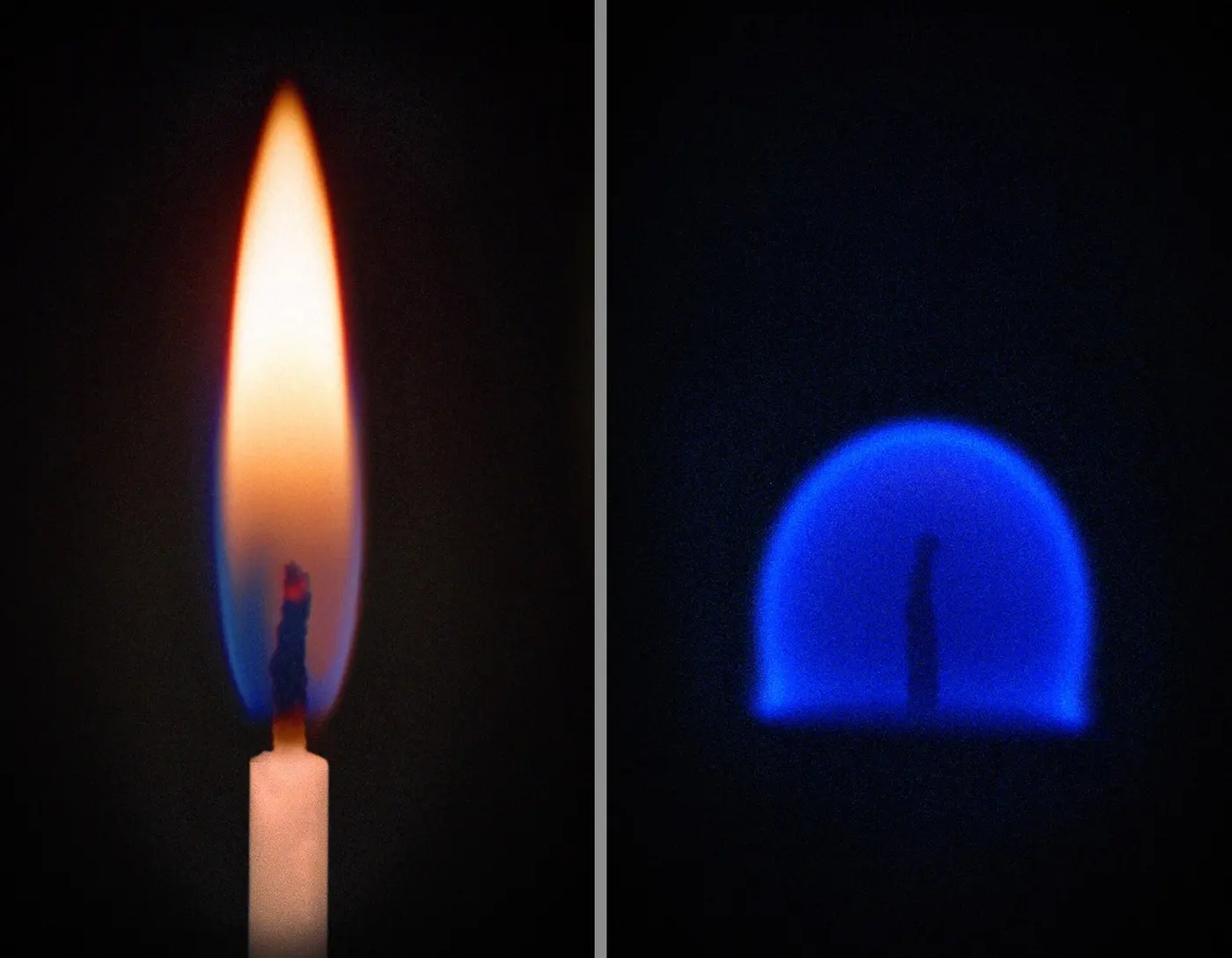

In space, a round blue flame
In microgravity, the near-weightless conditions inside a space station, hot gas and cool air no longer move according to how heavy they are. Without convection, the flame is not pulled upward and instead spreads out around the wick.
Oxygen is not carried in on a current of air. It arrives a little at a time from every direction by diffusion, as molecules slowly seep through the air. So the flame takes the shape of a sphere or half-sphere around the wick.
Its color changes too. Less soot forms, and what does form burns away more easily, so the yellow glow fades and the flame turns a dim blue.
A candle that burned for 45 minutes
Candles have actually been lit in space. In 1992, during a flight of the space shuttle Columbia, candle flames were studied inside a sealed experiment box. Those flames usually lasted less than 60 seconds, most likely because the box held only a limited amount of oxygen.
Later, in experiments aboard the Russian space station Mir in the 1990s, the flames were small half-spheres about 1.5 centimeters (0.6 inch) across. They glowed yellow just after ignition, then settled into a dim blue. The longest-lived flames burned for 45 minutes. Just before going out, the flames were seen to pulse in size about once a second.
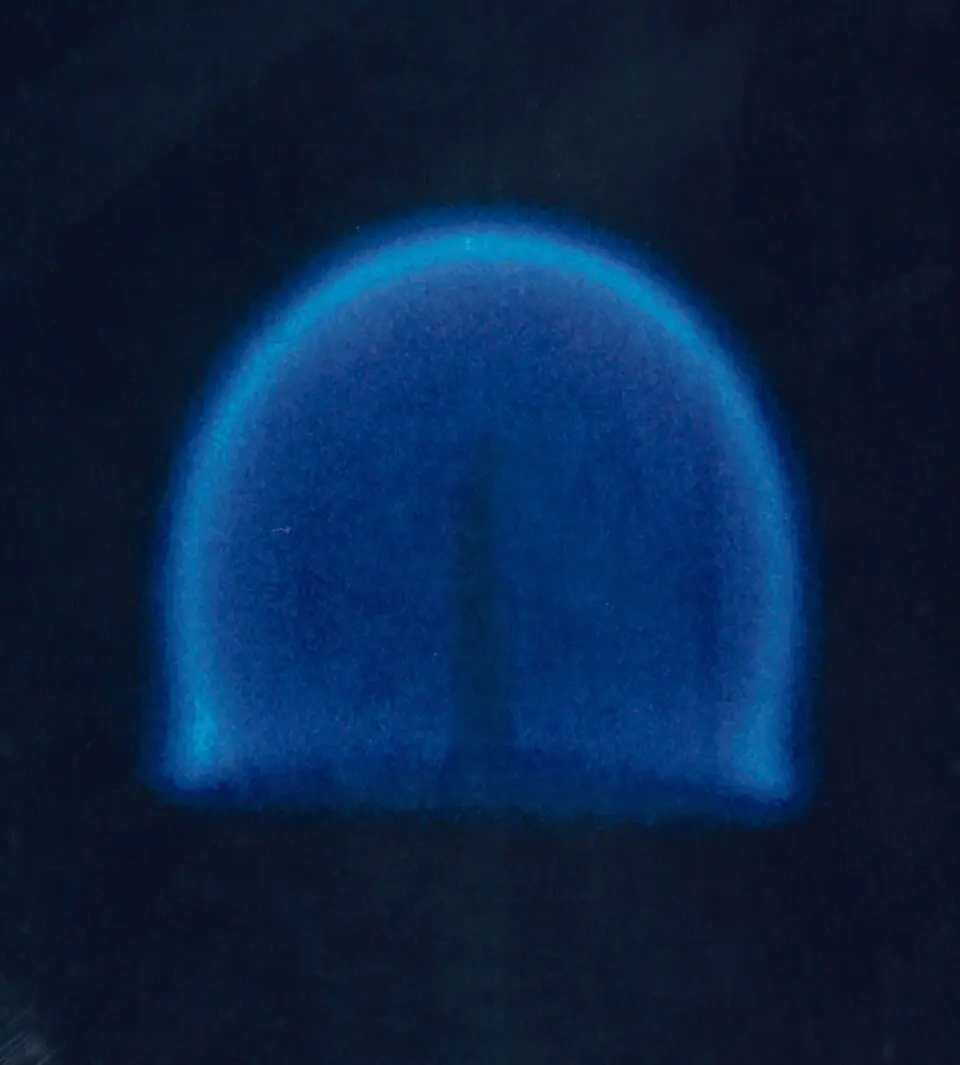

Without convection, the carbon dioxide and water vapor produced by burning are not carried away from the flame either. Fresh oxygen can only arrive by diffusion, so the flame burns far more quietly and slowly than it would on Earth.
Making weightlessness on the ground
You do not have to go to space to get weightlessness, at least for a few seconds. Drop an experiment from a great height, and while it falls, everything inside it is effectively weightless.
In Japan, from 1991 to 2003, a facility in Kamisunagawa, Hokkaido, used the deep shaft of a closed coal mine for exactly this. Capsules dropped down the shaft gave about 10 seconds of weightlessness, and they were used for combustion experiments among others.
A fire aboard a spacecraft is a life-threatening emergency. Knowing how fire spreads in weightlessness, and how to put it out, is essential to keeping space travel safe. Flames freed from the influence of gravity also take simple shapes that let scientists test the basic workings of combustion in detail, research that helps engines and furnaces on Earth burn fuel efficiently without making soot.