Were animals the first to ride in a balloon?
Yes. In September 1783, a sheep, a duck and a rooster flew in a French hot air balloon, two months before any human.
The Wright brothers made their powered airplane flight in 1903. Yet 120 years earlier, people had already risen into the sky, hanging beneath huge bags of hot air.
The setting was 18th-century France. And the first to set off on a balloon voyage, before a king and a vast crowd, were not people at all but three animals.
Two brothers from a paper-making family
The hot air balloon was invented by the brothers Joseph-Michel and Jacques-Étienne Montgolfier, born into a family of paper makers in the town of Annonay in southeastern France.
Noticing that smoke from a fire rises, the brothers began experimenting with bags of paper and cloth filled with smoke. Joseph, however, believed that smoke contained a special gas that made things float, and he is said to have favored fuels that gave off plenty of smoke, such as damp straw and wool. In fact, what lifted the balloon was not the smoke but air that had been heated and become lighter.
On June 4, 1783, the brothers gave their first public demonstration in Annonay. Their large balloon of cloth and paper, carrying no one, drifted through the sky for about 10 minutes and came down some 2 kilometers (just over a mile) away.
A sheep, a duck and a rooster
Word quickly reached Paris, and on September 19 that year a public demonstration was held in front of the Palace of Versailles for King Louis XVI and Queen Marie Antoinette.
The worry was whether living creatures could survive high in the sky. So it was decided to send animals up before people. Into a basket hung beneath the balloon went one sheep, one duck and one rooster. The sheep is said to have been named Montauciel, roughly “climb-to-the-sky.”
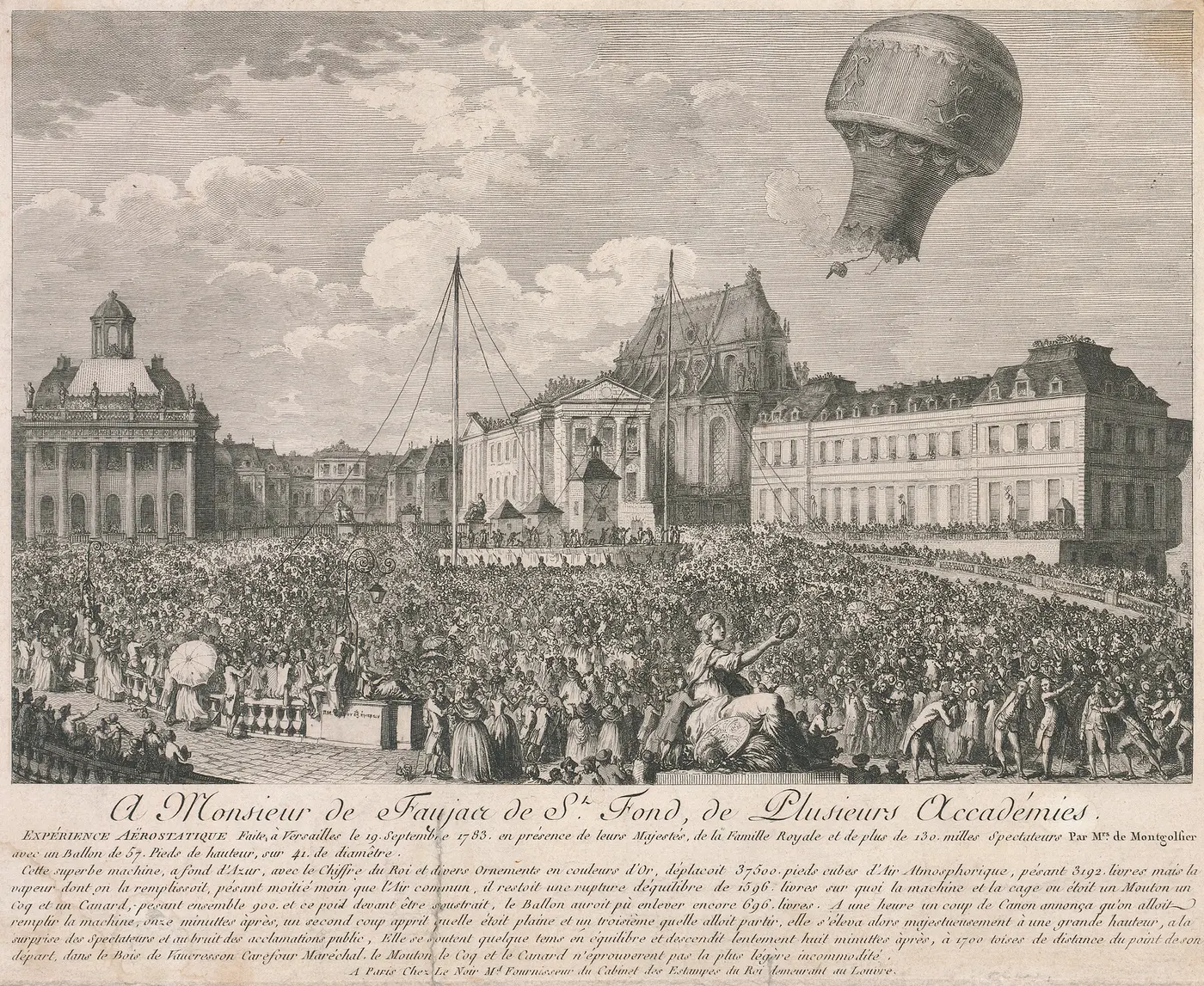

The balloon rose to about 500 meters (1,600 feet), flew for around eight minutes, and came down about 3 kilometers (2 miles) away. All three animals returned to earth alive, proving that living creatures could survive a flight. One story has it that the sheep trod on the rooster during the landing and injured it. Prints of the day speak of “more than 130,000 spectators,” a sign of how much excitement the event caused.
Two months later, people take to the air
With the animals safely back, it was the humans’ turn. On October 15, 1783, Jean-François Pilâtre de Rozier, a teacher of physics and chemistry, went up in a balloon tied to the ground by a rope, rising to a height of 26 meters (85 feet).
Then on November 21, a balloon carrying Pilâtre de Rozier and the Marquis d’Arlandes took off, untethered, from the gardens of the Château de la Muette in Paris. It was the first free flight of a balloon with people aboard. Over about 25 minutes it drifted some 9 kilometers (5.5 miles) across Paris and landed safely.
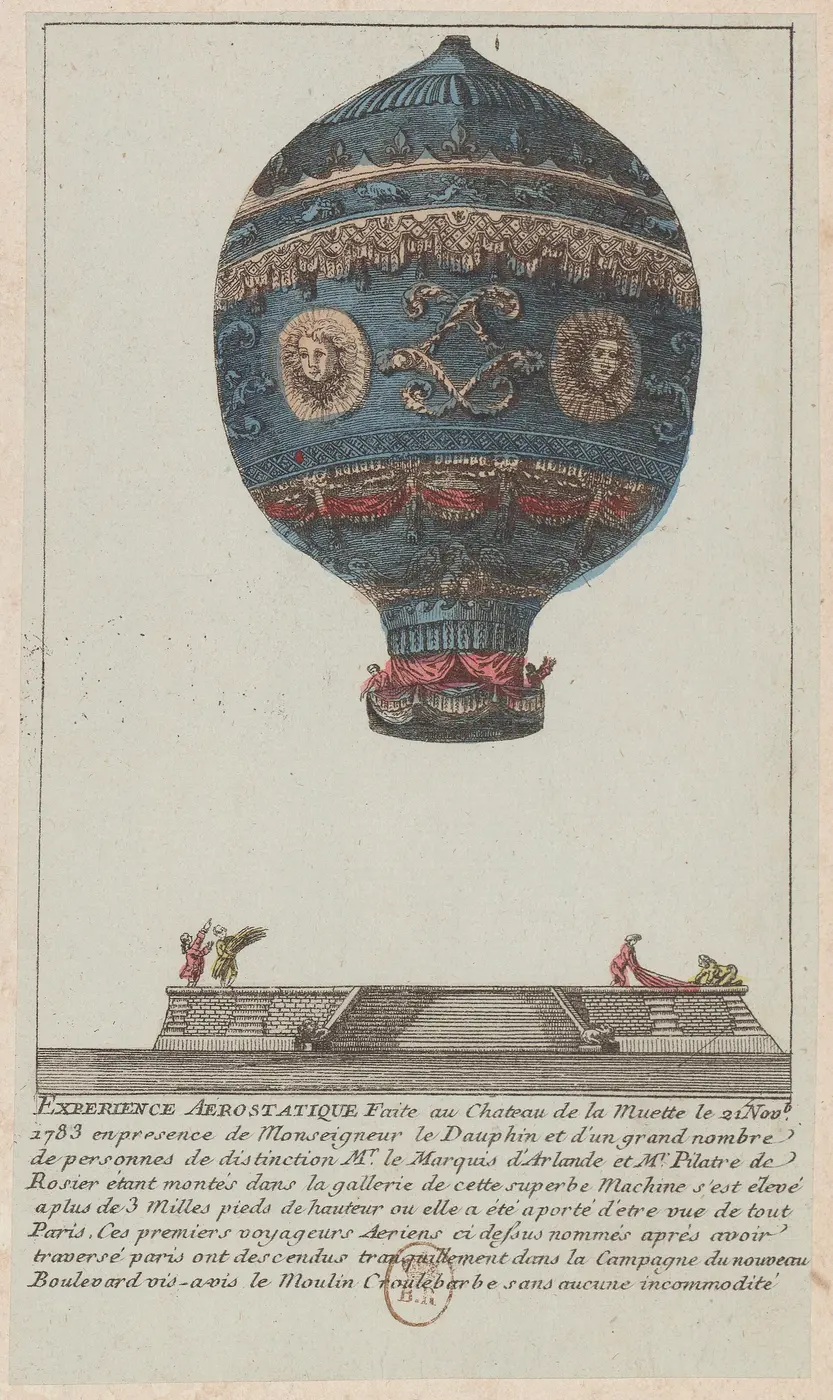

Louis XVI, it is said, originally intended to send up condemned prisoners, since the job was so dangerous. Pilâtre de Rozier argued that the glory of being first to fly should not go to criminals, and lobbied until he and his companion were allowed to go instead.
Ten days later, on December 1, a balloon filled with hydrogen gas also carried people aloft. 1783 had become the year humans flew.
The first hot air balloon flight in Japan
It was not until September 1969 that people rose into the air in a Japanese-built hot air balloon. According to the Japan Balloon Federation, the Icarus No. 5, combining an envelope made by a student group from Kyoto with a burner built by the Hokkaido University exploration club, lifted off near Lake Toya in Hokkaido, Japan’s northernmost main island.
The Montgolfiers burned straw, but today’s hot air balloons heat their air with propane burners.