Do honeybees talk by dancing?
Yes. In a figure-eight dance, the angle shows the direction of the flowers and the length of the waggle shows the distance.
1973
A honeybee that has been gathering nectar in a patch of flowers flies home to the hive. Soon afterward, one bee after another sets off for that same patch. It is as if someone had told them, “There are good flowers over there.”
In fact, someone has. Not with words, but with a dance. The little routine performed inside the hive spells out the direction and distance of the flowers with map-like accuracy.
Directions written in a figure eight
A worker bee that has found a source of nectar or pollen returns and begins to dance on the vertical honeycomb inside the hive. The best-known routine is the figure-eight dance, also called the waggle dance.
First she runs straight ahead, waggling her abdomen vigorously from side to side. Then she circles around to the right or left, returns to her starting point, and does another straight waggle run. This time she circles back the other way. Repeated over and over, the path traces a figure eight. A single dance can include anywhere from a few to more than 100 of these circuits.
When the flowers are very close, the bee is said to perform a “round dance” instead, circling with little waggling. Exactly where the switch from one dance to the other happens varies with the type of bee and between studies.
Angle means direction, time means distance
The key part of the figure eight is the straight waggle run. Its direction points toward the flowers.
Inside the hive it is completely dark, and the sun is nowhere to be seen. So the bees treat “straight up” on the comb as the direction of the sun. A waggle run straight up means “fly toward the sun”; a run tilted 60 degrees to the right of vertical means “fly 60 degrees to the right of the sun.” They are translating an angle in the sky into an angle on the comb, measured against gravity. The sun moves across the sky over the day, and the angle of the dance is said to shift along with it.
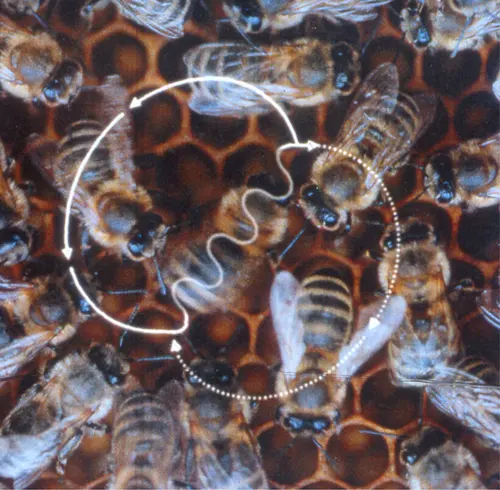

Distance, meanwhile, is conveyed by how long the waggle run lasts. The farther away the flowers, the longer the run. In western honeybees, roughly one second of waggling is said to correspond to about one kilometer (0.6 miles). The relationship isn’t perfectly proportional, though: studies report that the increase levels off beyond about a kilometer. And because bees estimate distance not from how far they actually fly but from how much scenery streams past their eyes on the way, the “scale” can shift depending on the landscape.
How do the other bees read the dance in total darkness? They follow close behind the dancer, touching her with their antennae and picking up the vibrations and sounds she makes by buzzing her wings. That, at least, is how they are thought to receive the message.
Von Frisch’s discovery and a long debate
The meaning of the dance was worked out by the Austrian-born zoologist Karl von Frisch. He studied honeybees for decades, published research on their dances in the 1920s, and through years of further observation and experiment established that the angle of the dance indicates direction relative to the sun and the length of the waggle indicates distance. For this and other work, he shared the 1973 Nobel Prize in Physiology or Medicine with Konrad Lorenz and Nikolaas Tinbergen, fellow pioneers of the study of animal behavior.
Still, the idea that an insect could use a symbolic “language” was extremely bold. In the 1960s, critics argued that bees were not using the information in the dance at all, but simply searching for the floral scent clinging to the dancer’s body.
In the end, technology settled the argument. In 2005, a British research team fitted honeybees with tiny antennas on their backs, tracked their flights by radar, and published the results in Nature. Bees that had watched a dance flew off toward the area indicated by its direction and distance.

Dancing is learned by watching
Bees were long assumed to be born knowing how to dance perfectly. But in 2023, a team of researchers in China and the United States reported a surprising result in Science.
Bees raised without any chance to watch older bees dance made larger errors in angle when they danced for the first time, signaled distances that were too long, and tended to dance in a more disorderly way. Accurate directions, it seems, depend on learning from experienced dancers. Even this tiny insect’s conversation has an apprenticeship.