Why is home plate a pentagon?
To help umpires judge the edges of the strike zone. Home plate became a pentagon in 1900.
43.2cm
Of the four bases on a baseball diamond, first, second and third are all squares. Home plate, where the batter stands, is the odd one out: a pentagon, shaped like a little house drawn upside down.
Matching the other bases would seem simpler to make and easier to remember. So why does home plate alone have a special shape? Follow its history and you find that the shape is the result of two transformations.
It started as a round iron plate
In mid-19th-century America, when baseball’s rules were first being put in order, home plate was round. From about 1857 to 1867 it was a circular iron plate painted white, covering roughly one square foot—a little over 30 centimeters (about a foot) across.
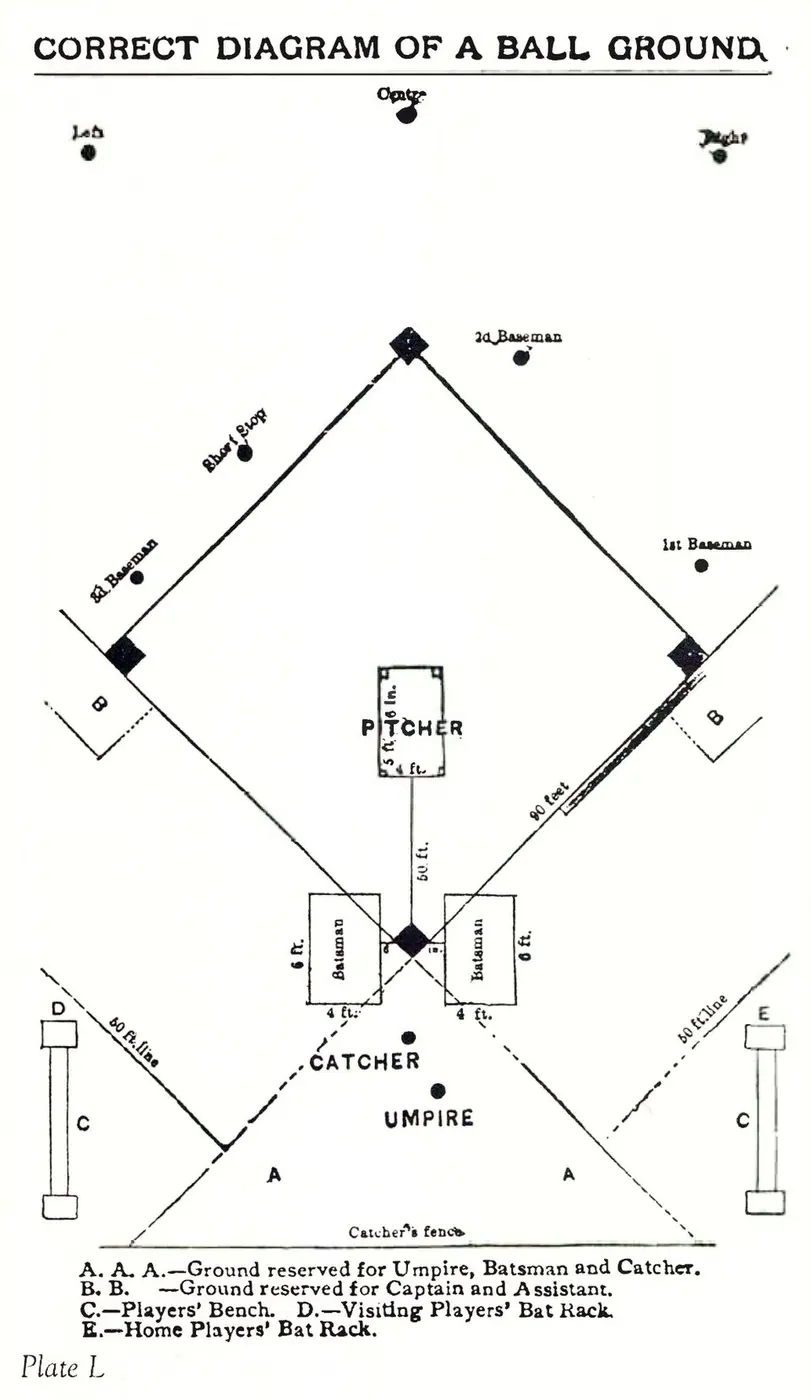
In 1868, home plate became a square, 12 inches (about 30.5 centimeters) on each side. Then in 1871, the professional league of the day, the National Association, turned that square 45 degrees: a diamond orientation, with one corner pointing at the pitcher and the opposite corner at the catcher. Materials varied—stone, iron, wood—but the white 12-inch square lasted until the end of the century.

The trouble with a diamond
The diamond-shaped plate had a drawback. When calling balls and strikes, the left and right edges of the plate—the boundaries of inside and outside—were defined by the two corners sticking out to the sides. From the pitcher’s point of view, the plate pointed a sharp corner toward him, with no straight “edge” to show where a pitch had to pass to be a strike. For umpires, too, judging those boundaries by corners that were mere points was no easy task.
The pentagon solved this problem. It is credited to Robert Keating, a former pitcher who pitched in just one game for the Baltimore Orioles in 1887—a man who understood the frustrations of both pitchers and umpires.
The pentagon of 1900
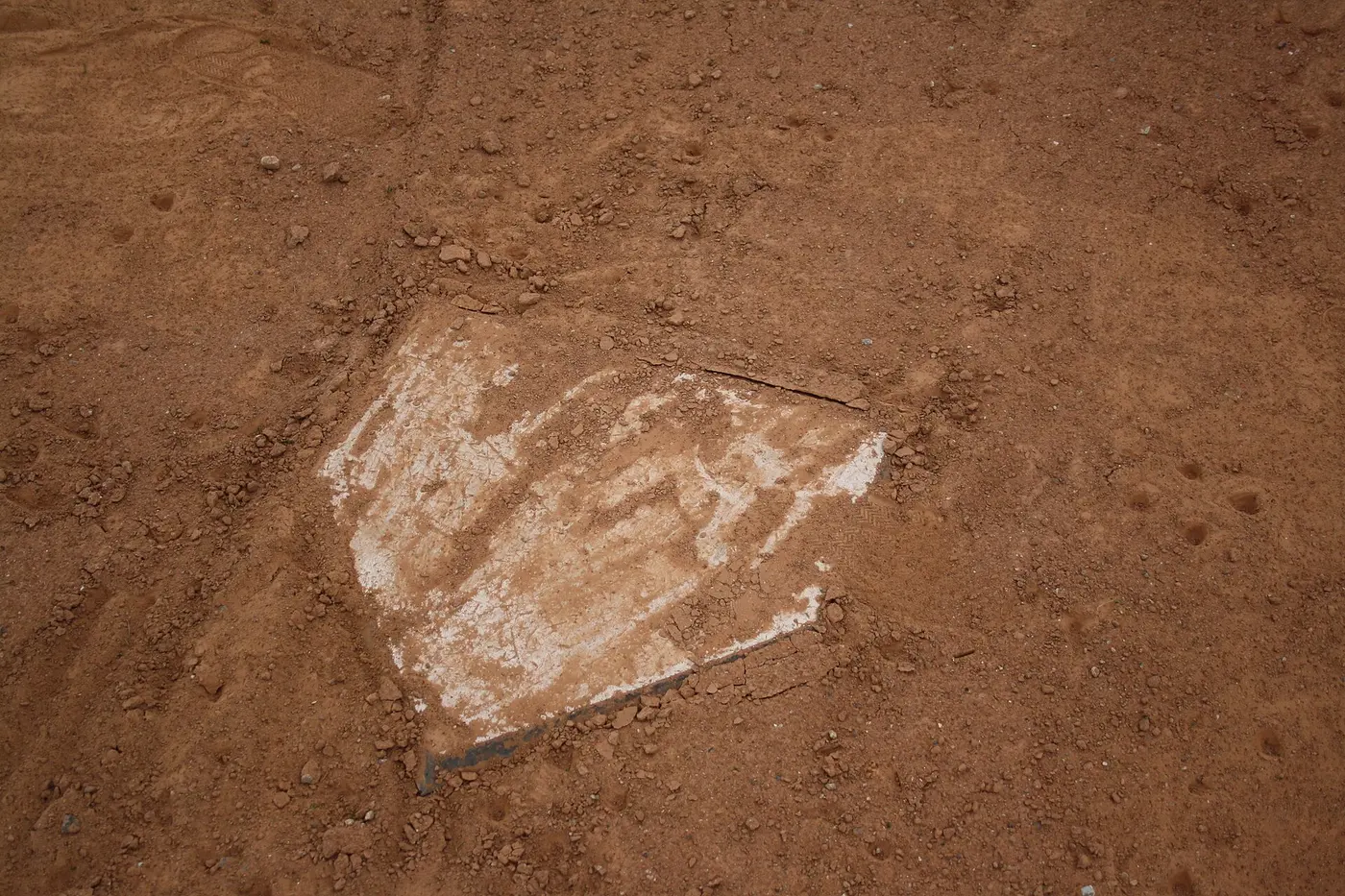
Keating’s pentagon was adopted by the National League in 1900. On the pitcher’s side is a straight edge 17 inches (about 43.2 centimeters) wide. From there, 8.5-inch sides run back on each side, parallel to the batter’s boxes, and finally two 12-inch sides meet at a right angle to form the point on the catcher’s side.
Thanks to this shape, the left and right edges of the strike zone became clearly visible as straight lines. More consistent calls are said to have been the pentagon’s biggest advantage. The point on the catcher’s side is a right angle because the first- and third-base lines meet at right angles at home plate.
Now think back to the old diamond. If you set a 12-inch square at 45 degrees, its width from side corner to side corner is the length of the diagonal. Work it out and you get about 17 inches—almost exactly the width of the new pentagon. You could say that the width of the strike zone stayed the same, and only the shape was tidied up to be easier to see.

From stone to rubber
The material changed along with the shape. The pentagonal plate was required to be made of white rubber. Stone or iron plates risked injuring runners sliding into home; rubber made that far less of a worry.
Japan’s official baseball rules, too, specify home plate as a five-sided slab of white rubber. When umpires keep brushing the dirt off home plate during a game, it’s because seeing that white pentagon’s outline clearly is essential to calling pitches accurately.