Why was volleyball invented?
In 1895 a YMCA instructor devised it for older members who found basketball far too rough.
In school gyms and club practices, on beaches and park lawns, volleyball is about as familiar as sports get: two teams batting a ball back and forth, trying never to let it touch the floor. Because a net separates the sides, players almost never collide with an opponent.
That lack of contact was the whole point from the very start. Volleyball was invented for people who could not keep up with a rougher game.
Basketball was too much
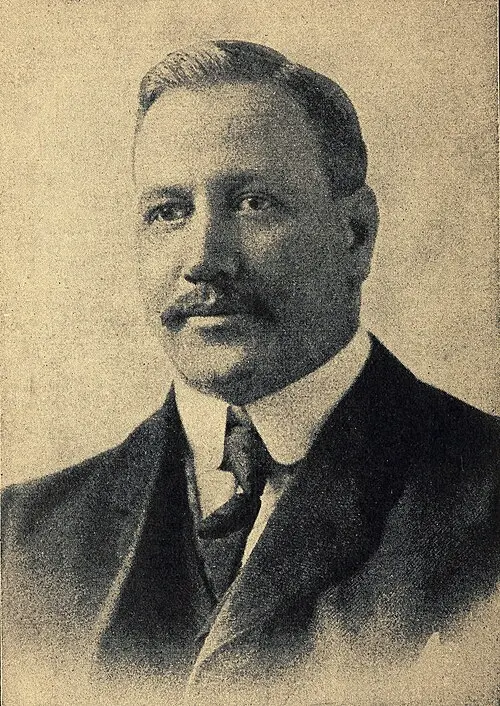
In 1895, William G. Morgan was the physical director of the YMCA in Holyoke, Massachusetts, and he had a problem. Many of the members who came to his gym were middle-aged businessmen dropping by after work.
Morgan had trained at the YMCA’s International Training School in nearby Springfield (today’s Springfield College), where he met James Naismith, the inventor of basketball. Basketball itself had been born at that school only in 1891, and it was still a brand-new indoor game.
But a game of sprinting up and down the court and bumping into people was too strenuous for the older members. So Morgan set out to create a gentler indoor game that would still give them a proper workout.
A tennis net raised overhead
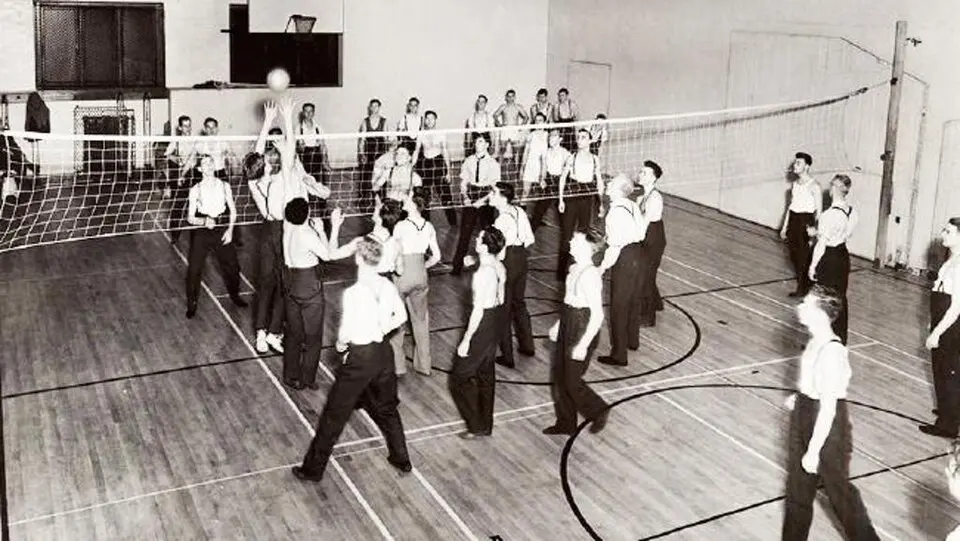
Morgan’s idea was to borrow a tennis net. He raised it to about 1.98 meters (6 feet 6 inches), just above the head of an average man. Players would hit the ball with their hands to send it into the other team’s court before it touched the floor. With a net dividing the teams, nobody would crash into anybody.
Under the first rules, the court measured about 7.6 by 15.2 meters (25 by 50 feet), there was no limit on the number of players per side, and a team could touch the ball as many times as it liked before sending it over. A match was divided into nine “innings,” like baseball, with each team serving three times per inning.

The ball was the tricky part. A basketball was too heavy, while the rubber bladder from inside one was too light. Morgan asked the sporting goods maker A.G. Spalding & Bros. to produce a special ball: a rubber bladder encased in leather, 25 to 27 inches (about 64 to 69 centimeters) around and weighing 9 to 12 ounces (about 250 to 340 grams). That is barely different from today’s official ball, which is 65 to 67 centimeters around and weighs 260 to 280 grams.
From “Mintonette” to “volleyball”
Morgan called his game “Mintonette,” a name that nodded to badminton, from which he had drawn inspiration.
In 1896, at a conference of physical education directors at the Springfield training school, Morgan gave a demonstration of the new game. Watching it, Professor Alfred Halstead remarked that the heart of the game was the “volley,” hitting the ball back before it lands, and suggested calling it “volleyball.” The new name stuck and is still used today.
At first, though, it was written as two words, “volley ball.” It only became the single word “volleyball” in 1952.
Across the ocean to Japan
Volleyball spread around the world through the YMCA’s network. Accounts differ on exactly when it reached Japan. It is usually said to have been introduced at the Tokyo YMCA in 1908 by Hyozo Omori, who had studied at the YMCA training school in the US, and Franklin H. Brown of the American YMCA, who arrived in 1913, then worked hard to spread it.
Japan also grew its own version of the game. At the 1927 Far Eastern Championship Games, a nine-a-side format was adopted at Japan’s suggestion, and for about 30 years afterward, volleyball in Japan meant nine players a side. The country switched over in earnest to the international six-a-side game only around 1960.

Volleyball made its debut as an official Olympic sport at the 1964 Tokyo Games. Japan’s women’s team, nicknamed the “Witches of the Orient,” beat the Soviet Union in the final to take gold. NHK’s broadcast of that final drew a 66.8% rating in the Tokyo region (according to the research firm Video Research), which is still said to be the highest ever for a sports broadcast in Japan.
A gentle pastime designed for older businessmen had, in less than 70 years, become a sport that could hold an entire nation spellbound.