Why is the sumo ring round?
There’s no clear record, and theories vary. The round ring became standard in the Edo period.
4.55m
A boxing ring is square, and the competition areas for judo and wrestling are basically square too. Combat sports are almost always staged on something with corners, yet the sumo ring, the dohyō (土俵), is a perfect circle.
Come to think of it, that is rather curious. Why is sumo fought in a round ring? Trace the history, and it turns out the ring wasn’t round from the start. There were once even square rings.
When the ring was a wall of people
In early times, sumo had no ring at all. Bouts took place inside a circle formed by the onlookers who crowded around, known as a hitokataya (人方屋), or “human enclosure.” A wrestler is said to have won by pushing his opponent out into the wall of spectators or throwing him down.
Then, early in the Edo period (1603–1868), around the Kanbun era of the 17th century, a new arrangement appeared: four posts set up and enclosed with rope or the like to mark off the wrestling area. The dohyō proper, with straw bales laid out in a circle, is thought to have been established around the Jōkyō era (the 1680s), when kanjin-zumo, sumo tournaments held to raise funds, were flourishing in Edo.
The round ring was not the only form, however. In Nanbu sumo, centered on the Morioka domain in northern Japan, wrestlers used a square ring about 4.5 meters on each side. According to records, a fundraising tournament with a square ring was held in Morioka in the fourth year of the Enpō era (1676), and square rings are said to have survived in that region until around the beginning of the Shōwa era (1926–1989). Even so, from the middle of the 18th century on, the round ring born in Edo became the norm throughout the country.
From a double circle to today’s form
Even the round ring has not always looked the way it does now. Until the early Shōwa era, a “double ring” with an inner and an outer circle was used.
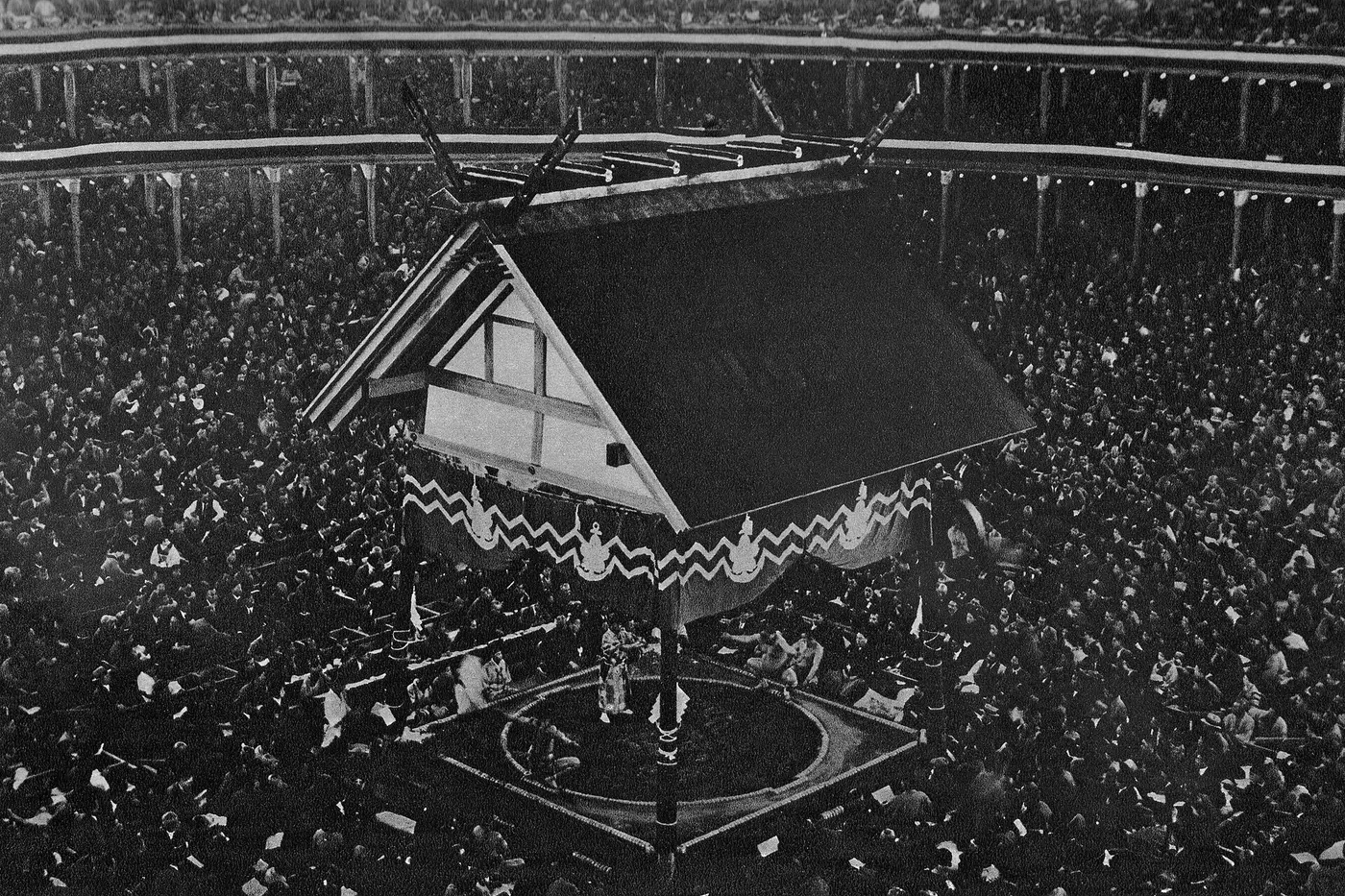

The turning point came in April 1931 (Shōwa 6), at a tournament held in the presence of the emperor. The inner circle was removed and the ring was changed to a single circle 15 shaku, or about 4.55 meters (15 feet), in diameter. Some say this was to accommodate wrestlers who had been getting bigger; others say it was to make bouts last longer, since in a cramped ring they were decided in an instant. In the November tournament of 1945, just after the end of the war, the diameter was widened to 16 shaku, but it was changed back after only one tournament.
The roof above the ring changed too. It used to be held up by pillars at the four corners of the ring, but partly because they blocked spectators’ view of the bouts, the pillars were abolished from the autumn tournament of 1952 (Shōwa 27), and the roof has hung from the ceiling ever since.
No corners
So, the crucial question: why round? The truth is, no records survive that clearly explain it, and several theories are told.
One is that it’s a holdover from the human enclosure. When people gather around something naturally, they form a circle, and perhaps that circle was later replaced with straw bales. Another theory focuses on fairness. In a square ring, the distance from the center to the edge differs by direction, and a wrestler driven into a corner is at a disadvantage. In a circle, the distance to the edge is the same whichever way you push. There is also an explanation that likens the sight of a round ring set on a square platform to the old Chinese cosmology in which “heaven is round and earth is square.”
A circle without corners is a stage for a head-on contest, with nowhere to escape and nowhere to trap.
Look closely at a round ring, and you’ll see that at just four points, north, south, east and west, the bales are set slightly outward. These are called tokudawara, “benefit bales,” and they are said to have been designed to let rainwater drain off in the days when sumo was held outdoors. A wrestler who can hold his ground there gains a tiny advantage, which is where the name comes from.
A ring reborn for every tournament
A dohyō isn’t built once and left at that. Before every official tournament, the yobidashi, the ring attendants, turn out in full force and spend about three days rebuilding it. This is called dohyō-tsuki, “ring building.” At the Ryōgoku Kokugikan in Tokyo, the base is kept and the surface is remade, while at tournaments held elsewhere the ring is built from scratch.
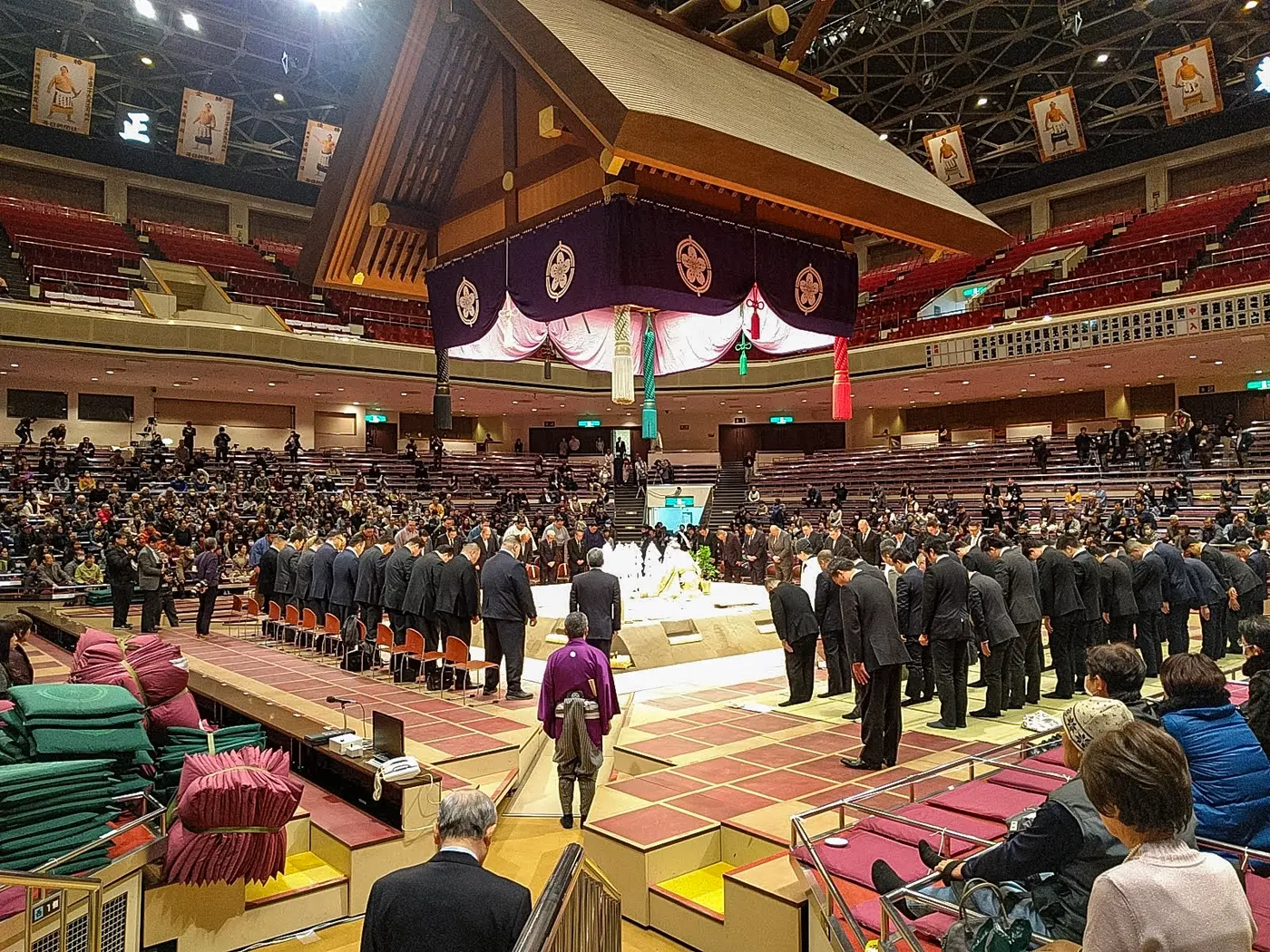

Once the ring is complete, the dohyō matsuri is held on the day before the opening day. It is a Shinto ritual, led by the highest-ranking referee, praying for safety during the tournament and for abundant harvests. The ring is not simply a place to compete but a special space, purified anew for every tournament.