Where do the colors of judo belts come from?
Kanō Jigorō introduced the white and black belts; the rainbow of colored belts spread later in Europe.
“Black belt” has become such a symbol of mastery that people use it far outside judo to mean an expert in almost anything. You join as a white belt, train for years, and one day tie on a black belt. That journey is the martial-arts story many of us imagine.
Yet showing skill through the color of a belt is not an ancient custom. Dig into judo’s history and you find that the white and black belts were born in Japan during the Meiji era (1868–1912), while the yellow, green, blue and other colored belts grew up far across the sea, in Europe.
The man who invented ranks and the black belt
Judo began in 1882, when Kanō Jigorō opened the Kōdōkan in Tokyo. Having studied a number of different schools of jūjutsu, Kanō sorted through them and shaped judo as a form of education for training both body and mind.
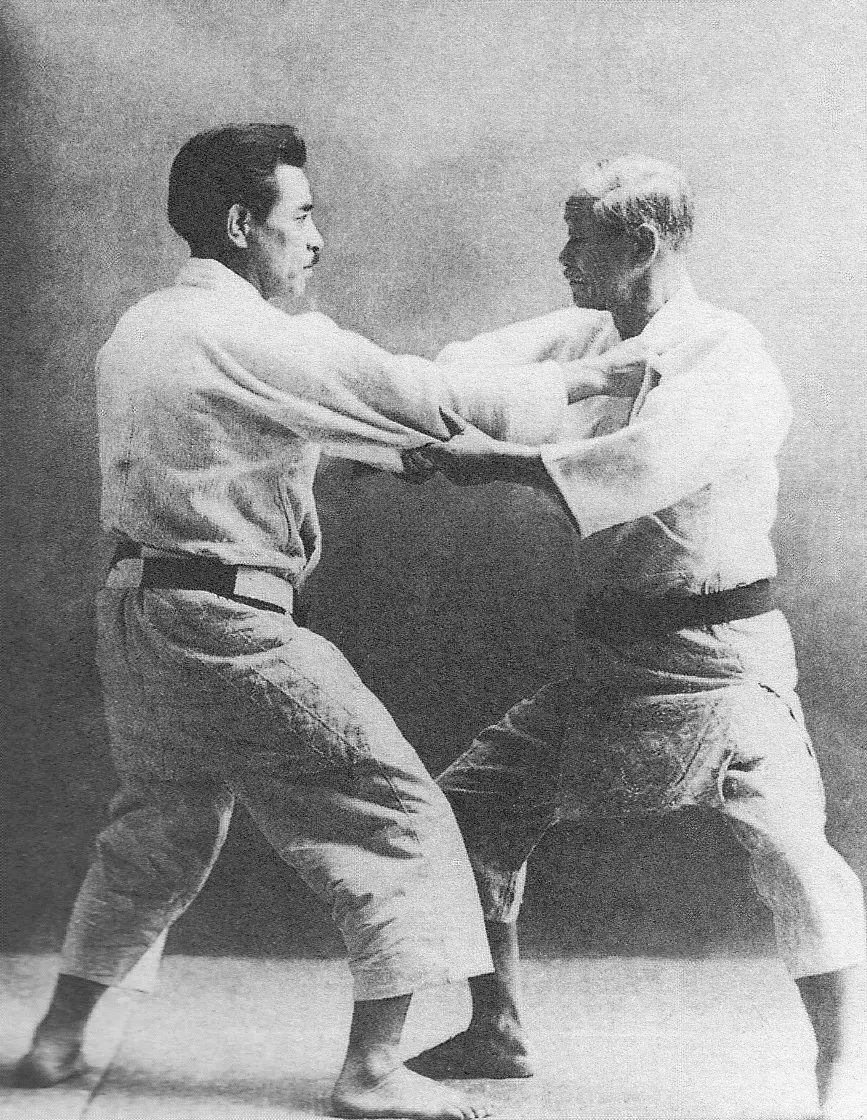

The following year, 1883, Kanō awarded the rank of shodan, or first dan, to his students Saigō Shirō and Tomita Tsunejirō. He is said to have borrowed the idea of dan ranks from the board games go and shōgi, and this is often described as the start of the dan ranking system in the martial arts.
Then, around 1886, he began having students who held a dan rank wear a black belt. At the time, however, his students still trained in kimono, and this black belt is thought to have been the wide sash worn with a kimono, not the narrow belt we know today. The combination of a white training uniform much like today’s with the rule that dan holders wear black and everyone else wears white took shape around 1907.
Did belts really turn black from dirt?
There is a story often told about the origin of the black belt. Everyone starts out with a white belt, the story goes, but over years of training, sweat and grime slowly darken it. So a black belt is proof of long, hard practice.
It is a charming tale that sounds entirely plausible. But no historical record has been found to back it up, and it is thought to be a folk explanation invented later. The black belt was something Kanō deliberately chose as the mark of a dan holder.
Colored belts from London and Paris
So where did the yellow, green, blue and other colored belts come from? The answer lies not in Japan but in Europe.
In Britain, Koizumi Gunji opened a judo club called the Budokwai in London in 1918. The club’s records note that colored belts were used at a demonstration in 1926. Then, in the 1930s, Kawaishi Mikinosuke, who had moved to France, spread a system that divided the grades finely by belt color: white, yellow, orange, green, blue, brown and black. Kawaishi had visited the Budokwai in London in 1928, and it is believed he may have encountered the idea of colored belts there.
Why did colored belts catch on in Europe? One reason often given is that breaking progress into smaller goals made it easier to keep beginners motivated. The colored-belt system later spread to karate and other martial arts as well.
White and black were born in Japan; the rainbow of belt colors was born in Europe.
In Japan, on the other hand, a fairly simple scheme built around white, brown and black belts is still the norm. The Kōdōkan also rules that holders of the higher ranks, sixth to eighth dan, may wear a red-and-white belt, and ninth and tenth dan a red one.
Not just belts: uniforms got color too
The story of color doesn’t stop at belts. At the Olympics and other international competitions today, one athlete wears a white judo uniform and the other a blue one.
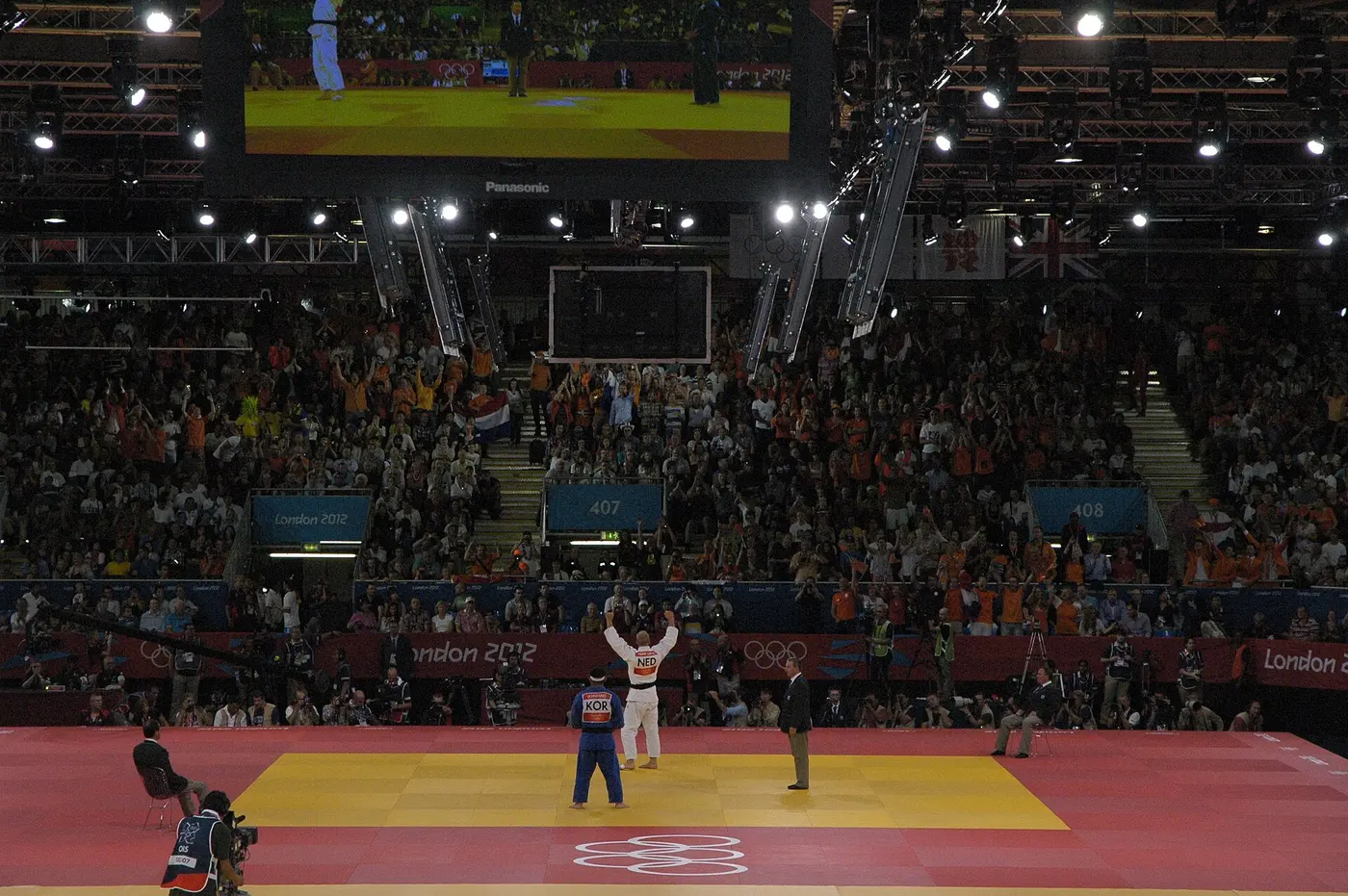

The blue uniform is said to have been proposed by Anton Geesink of the Netherlands, who won a gold medal at the 1964 Tokyo Olympics. The aim was to help spectators and referees tell the two athletes apart. There was opposition from those who felt a judo uniform should be white, and the debate dragged on, but in 1997 the International Judo Federation decided to adopt it, and blue uniforms began appearing at international events from the late 1990s.
From the Meiji-era picture of a white training uniform and a black belt, to colored belts, to the blue uniform: as judo spread around the world, it gradually picked up more colors.