Was basketball really born from peach baskets?
Yes. In the first game in 1891, peach baskets nailed to a gym railing served as the goals.
3.05m
A basketball hoop hangs 3.05 meters above the floor. That holds in an elementary school gym and in an NBA arena alike. Why not a tidy 3 meters? Why the extra 5 centimeters? It turns out the number is simply the height of one particular gym’s railing, passed down unchanged.
And the first thing fastened to that railing was not a metal ring or a net. It was a basket for carrying peaches. Basketball, quite literally, began as a ball game played with baskets.
A new game for a winter gym
In the winter of 1891, at a YMCA training school in Springfield, Massachusetts (today’s Springfield College), a Canadian-born physical education instructor named James Naismith had a problem on his hands.
New England winters are harsh, and outdoor sports were out of the question. Indoors there was little but gymnastics and marching drills, and the energetic young men in his class were thoroughly bored. The head of physical education, Luther Gulick, asked Naismith to come up with a new indoor game: something fun, easy to learn and easy to play in winter. He is said to have had about two weeks.
After several failed attempts to bring football and rugby indoors, Naismith settled on an idea. To cut down on collisions, players would not be allowed to run with the ball. And so that the ball could not simply be hurled in by force, the goal would be placed high overhead. It would be a game of accuracy rather than strength.

Peach baskets instead of boxes
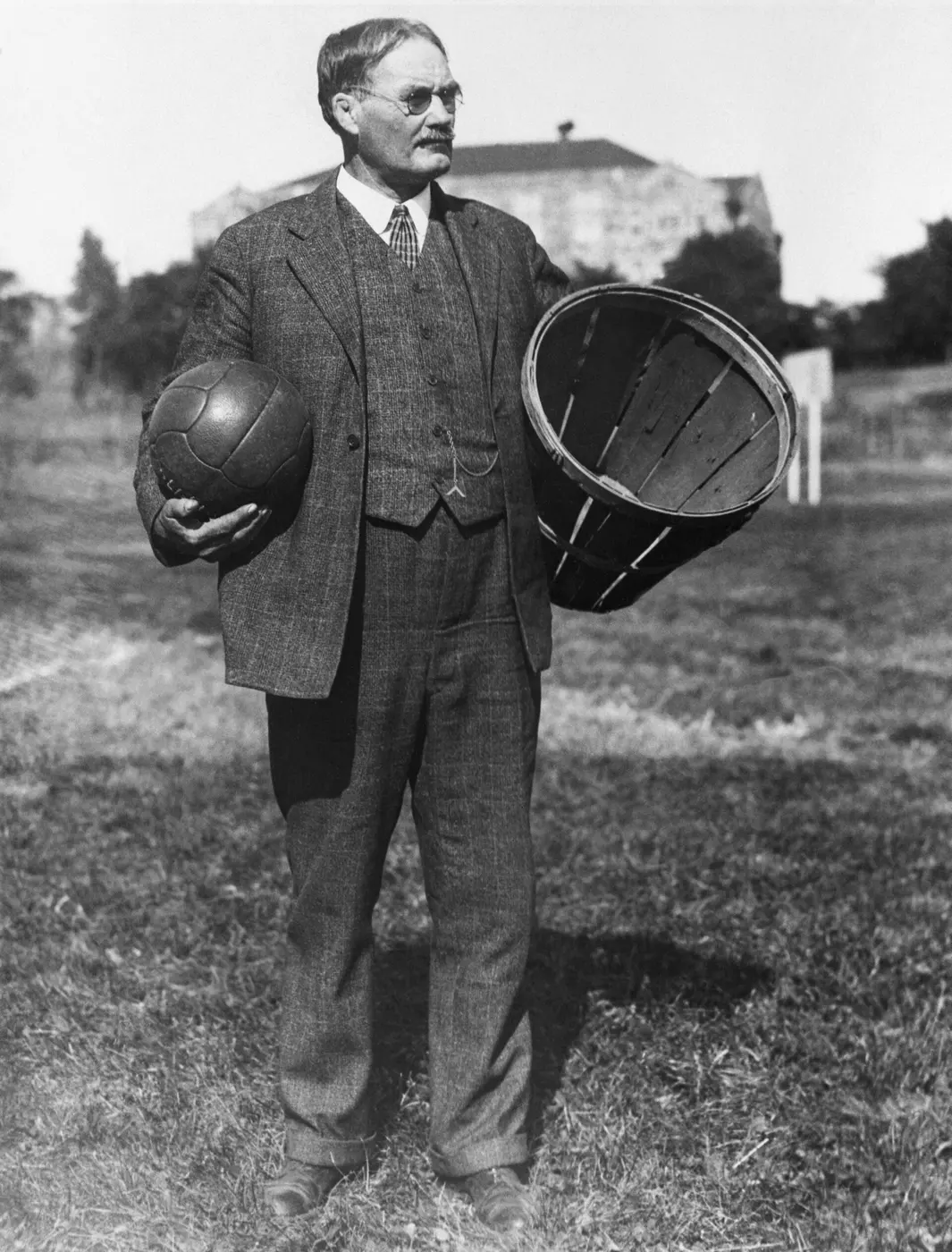
For goals, Naismith asked the school janitor for two boxes about 45 centimeters (18 inches) square. What the janitor brought back instead were two peach baskets. Naismith nailed them to the railing of the gym’s balcony, one at each end.
That railing happened to be 10 feet, or about 3.05 meters, off the floor. The height that was settled by chance that day is still the height of every hoop in the world.
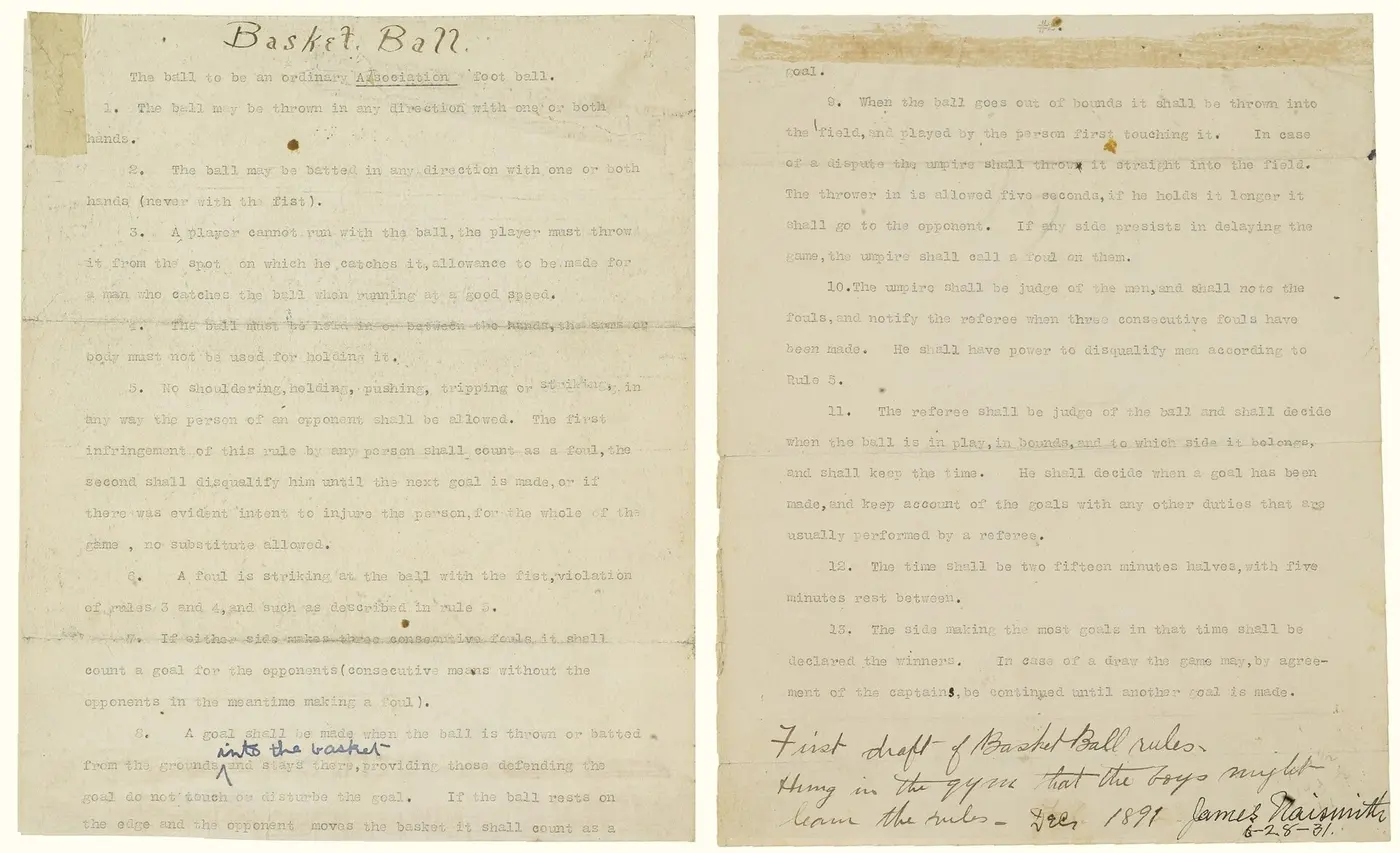
Naismith wrote up the game in 13 rules, which his secretary typed and pinned to a bulletin board. In January 1892 the rules were printed in the school magazine, The Triangle, and spread to YMCAs across the United States.
The first game is said to have been played on December 21, 1891. Eighteen students split into two teams of nine, and they used a soccer ball. The final score was 1–0, and the historic first basket was scored by a student named William Chase.
A ladder after every basket
Peach baskets, of course, have bottoms. When the ball went in, it stayed in. So in the earliest games, play stopped after every score while someone fetched a ladder to retrieve the ball. Naismith’s rules even made it a condition of scoring that the ball go into the basket and “stay there.”
Before long, someone thought of cutting a small hole in the bottom of the basket so the ball could be poked out with a stick, and the baskets were gradually replaced by metal rings and nets. For some time, though, the nets were still closed at the bottom, and a cord or chain had to be pulled to drop the ball out. The net became fully open, letting the ball fall straight through to the floor as it does today, around 1912.
Once the game no longer stopped after every basket, its tempo picked up dramatically. You could say the fast-paced basketball we know today was born when the bottom fell out of the basket.

Two sheets of paper worth $4.3 million
The original typescript of those rules went up for auction at Sotheby’s in New York in 2010 and sold for about $4.33 million. It was said to be the highest price ever paid for a piece of sports memorabilia at the time.
The skeleton of today’s rules is already visible in the 13 originals. The ball may be thrown in any direction with one or both hands. A player may not run with the ball. No shoving, holding or striking an opponent. More than 130 years later, basketball still rests on Naismith’s first idea: don’t run with the ball, and aim for a basket high overhead.