What is actually shown in Hokusai’s “Great Wave”?
Three boats and their rowers tossed by a huge wave—and, far in the distance, a tiny Mount Fuji.
It turns up on T-shirts, posters and even coffee mugs: Katsushika Hokusai’s great blue wave, probably one of the most reproduced Japanese images in the world. Its proper title is Under the Wave off Kanagawa, from the series Thirty-six Views of Mount Fuji. It is a woodblock print, a type of ukiyo-e (popular prints of the Edo period, 1603–1868), that Hokusai published around 1831, when he was about 70. It measures only about 25 by 38 centimeters (10 by 15 inches).
The image is so famous that you recognize “that wave” the moment you see it. But have you ever looked closely at what lies beneath the wave, or beyond it?
Three boats beneath the wave
The first thing to look for is the long, narrow boats being tossed about by the waves. There are three of them, and in each one rowers crouch low, clinging on. About eight figures can be made out in each boat. Rather than fighting the waves, they seem to be holding still and riding it out.
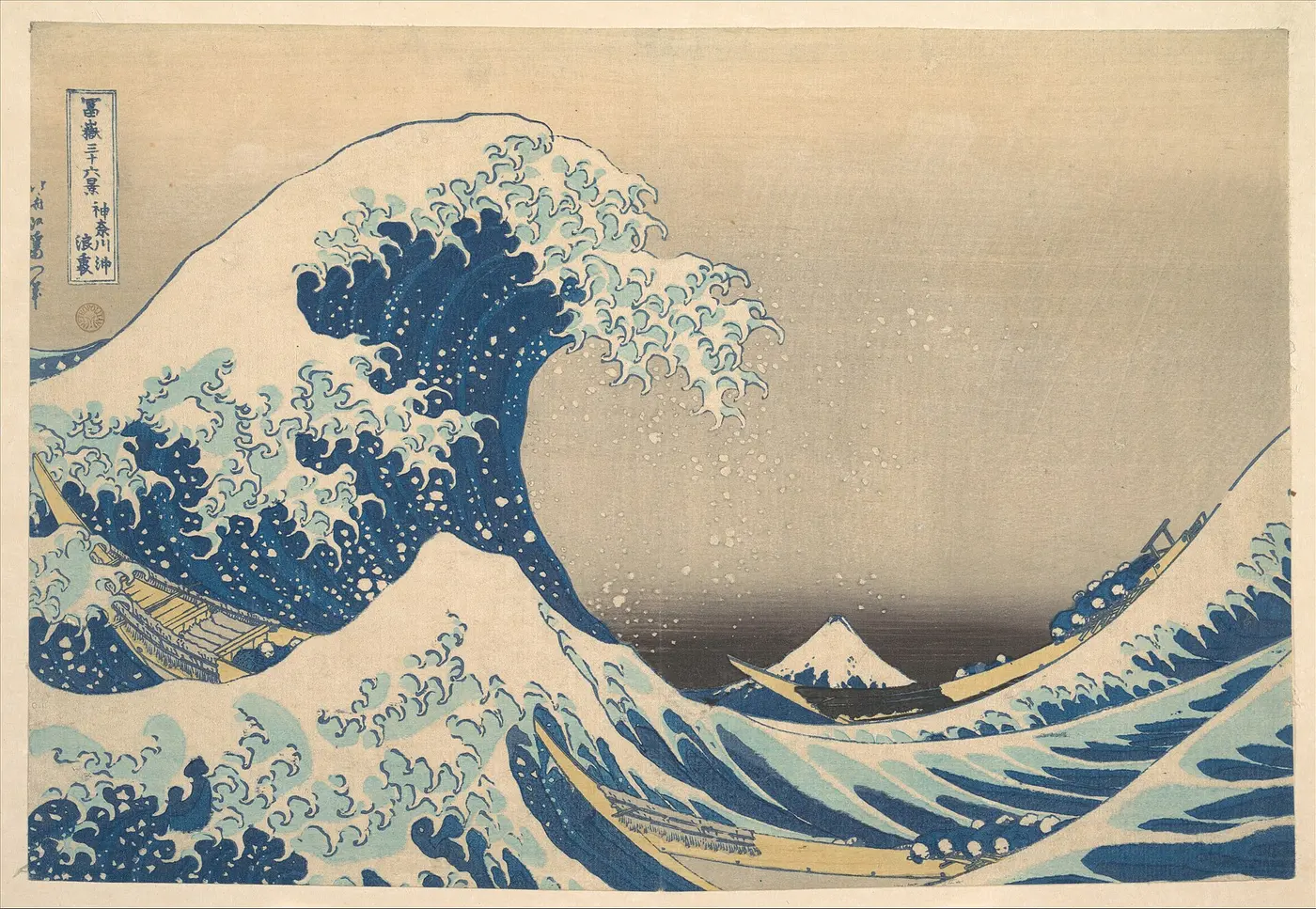

These boats are thought to be oshiokuri-bune (押送船), fast boats that rushed fresh fish caught off the Izu and Bōsō peninsulas to the fish market in Edo, as Tokyo was then called. So the picture is not only about the terrors of the sea. It is also a scene from the working lives of the people who kept Edo’s dinner tables supplied.
Some have tried to estimate the size of the wave from the length of the boats, and one estimate puts its height at more than 10 meters (33 feet). Outside Japan the print is sometimes presented as a picture of a tsunami, but as the title suggests, it is thought to show a great wave rising off the coast of Kanagawa.
The star is the smallest Mount Fuji
As the series title Thirty-six Views of Mount Fuji tells you, the theme of these prints is Mount Fuji. Yet in this picture, the mountain sits far in the background, drawn so small it is almost lost in the spray.
That is Hokusai’s trick. Placing the huge wave in the foreground beside the distant mountain creates an extreme sense of depth, so that the nearby wave looks bigger than the mountain. What’s more, the small wave swelling up in the foreground forms a triangle much like snowcapped Fuji. The wave mimics the mountain, and the mountain looks like part of the waves. The longer you look, the more of the composition’s cleverness you notice.
This bold use of perspective is thought to owe something to the Western copperplate engravings and paintings Hokusai had studied.
Still, the composition didn’t appear overnight. More than 20 years earlier, Hokusai had already drawn pictures combining oshiokuri-bune with big waves, but the waves there were far tamer. He arrived at the dramatic form we know, with its breaking crest splitting into fine branches like the claws of a beast, only around the time he turned 70.
An imported blue
What makes this picture so striking is its deep, vivid blue. The pigment used was a European synthetic known in Japan as bero-ai. This was Prussian blue, discovered in Germany in the early 18th century, and the name is said to come from Berlin.
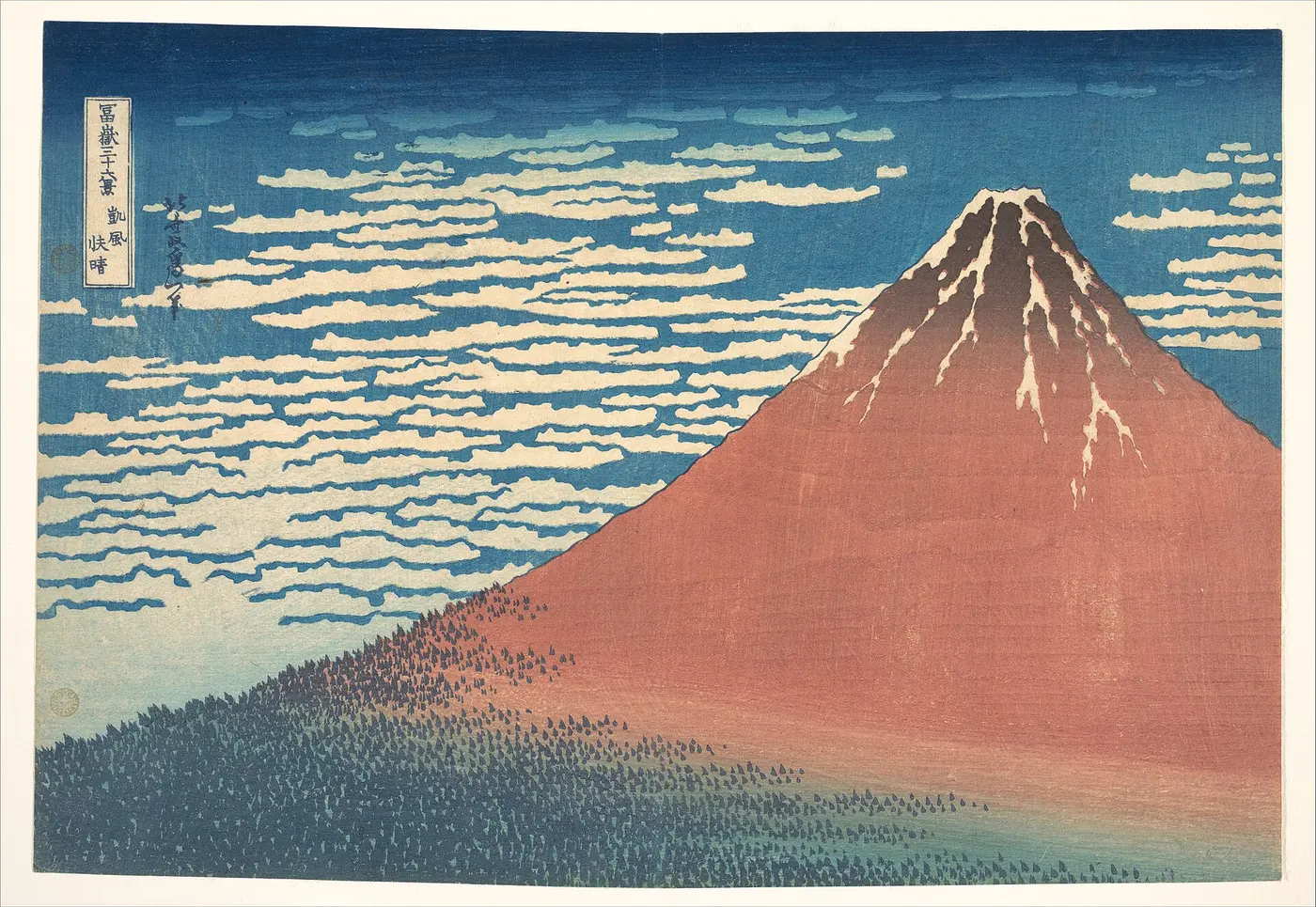

Bero-ai became easier to obtain in Japan from around the 1820s. Because it resisted fading and could be laid down in any shade from pale to deep, it grew popular among ukiyo-e artists. Thirty-six Views of Mount Fuji was so well received that ten more prints were later added, so the series actually runs to 46 pictures.
A wave that crossed the sea
Many sheets can be printed from the same set of woodblocks. Under the Wave off Kanagawa was printed in large numbers, and museums around the world each hold their own impression today.
In the late 19th century, ukiyo-e made its way to Europe and set off a craze for Japanese art known as Japonisme. The great wave became widely known as part of that wave of enthusiasm, and the cover of the score of La Mer, the symphonic work Claude Debussy published in 1905, used a design based on the print. A great wave printed on a small sheet of paper crossed the sea and went on to influence even music.