Why did ukiyo-e become so popular in Europe?
Japan’s opening sent its art abroad, and painters found its flat colors and bold compositions strikingly new.
231prints
Ukiyo-e, the woodblock prints of the Edo period (1603–1868), showed kabuki actors, beautiful women, famous scenic spots and more. They were everyday printed goods that ordinary townspeople bought without a second thought. Yet in the latter half of the 19th century these prints were greeted with enthusiasm in Europe, influencing the Impressionists so strongly that they changed how those painters worked. This craze for Japanese art is called Japonisme, a word the French critic Philippe Burty was using by 1872.
Still, why did woodblock prints from faraway Japan become so popular in Paris, the capital of art?
Did it all start with packing paper?
A well-known story goes like this: ukiyo-e prints were used as wrapping paper for ceramics exported from Japan, and the Europeans who found them were amazed by their beauty. The story is often told to make the point that it was Westerners who discovered the true worth of ukiyo-e.
The evidence for it, however, is shaky. When a curator at the Ota Memorial Museum of Art in Tokyo looked into it, he found that the story traces back to an anecdote written in 1905 by a French art historian. In 1856, it says, the French printmaker Félix Bracquemond found a small book at the workshop of a printer he knew, where it had been used as padding in a crate of porcelain. The book was Hokusai Manga, a collection of sketches by Katsushika Hokusai.
What was found there was a bound book, not single-sheet ukiyo-e prints. Some scholars point out that the anecdote itself is mere hearsay, and others doubt the 1856 date. At the very least, no record has been confirmed showing that ukiyo-e prints crossed the sea in large numbers as wrapping for ceramics.
A window called the World’s Fair
Behind ukiyo-e becoming widely known in Europe lay a much larger current. Japan opened up in the 1850s, and after it signed commercial treaties with Western powers in 1858, Japanese goods began making their way to Europe. Japanese crafts were introduced at the 1862 International Exhibition in London and drew public interest.
The decisive moment was the 1867 Exposition Universelle in Paris. It was the first world’s fair in which Japan officially took part, with exhibits from the Tokugawa shogunate as well as separate ones from the Satsuma and Saga domains. Alongside porcelain, bronzes and other objects, the shogunate’s display included ukiyo-e by Hokusai, Utagawa Kunisada and others. At a teahouse set up on the grounds, geisha from Edo’s Yanagibashi district spinning tops and puffing on long pipes were said to be more popular than the official exhibits.
Afterward, dealers in Japanese art began to flourish in Paris. The German-born dealer Siegfried Bing and Tadamasa Hayashi, a Japanese dealer who opened a shop in Paris, introduced ukiyo-e and crafts to Europe one after another.
What astonished the painters
Painters were drawn to ukiyo-e because the prints followed completely different rules from Western painting. Since the Renaissance, European painting had prized modeling with light and shadow to create volume, and perspective to create depth. Ukiyo-e, by contrast, used crisp outlines and flat areas of color without shadows. Asymmetrical compositions that pushed the main subject to the edge or boldly cropped objects in the foreground, along with high, bird’s-eye viewpoints, also struck Western painters as fresh.
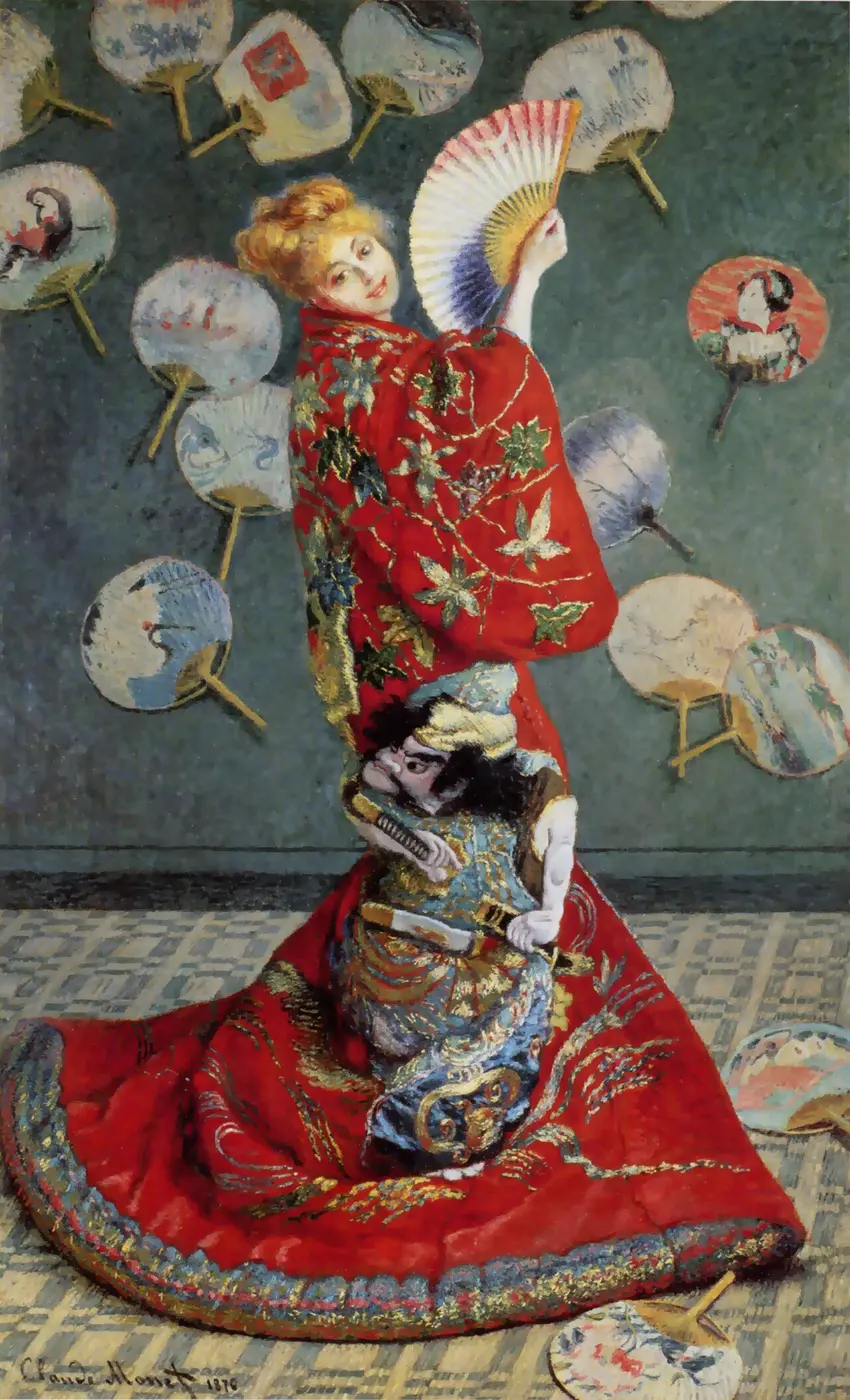

Claude Monet was one of those painters. In 1876 he painted La Japonaise, dressing his wife in a Japanese outer kimono and scattering round fans across the wall behind her. Monet was also a keen collector of ukiyo-e: by his death in 1926, he had gathered 231 Japanese prints. Many of them, centered on Hokusai, Hiroshige and Utamaro, still hang on the walls of Monet’s house in Giverny, in northwestern France.
Van Gogh copies Hiroshige
The painter most deeply absorbed in ukiyo-e was surely Vincent van Gogh. He began collecting prints while in Antwerp, Belgium, and in Paris he and his brother Theo bought more than 600, mostly from Bing’s shop.
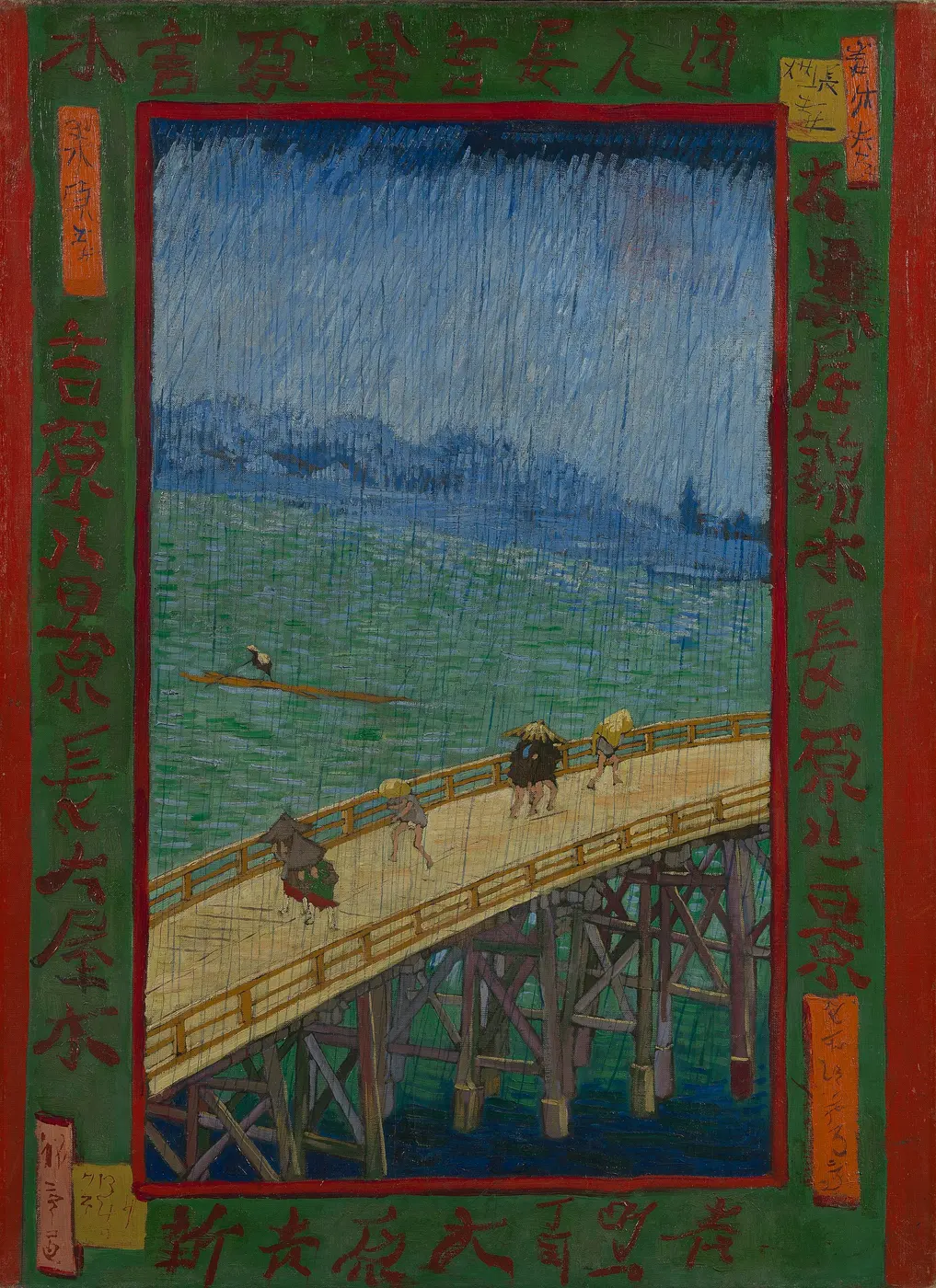
In 1887 he made oil copies of two prints from Utagawa Hiroshige’s One Hundred Famous Views of Edo: “Plum Park in Kameido” and “Sudden Shower over Shin-Ōhashi Bridge and Atake.” He even added decorative borders of Japanese characters that do not appear in the originals, suggesting that he enjoyed even unfamiliar Japanese writing as design.

Ukiyo-e, everyday items in the streets of Edo, became a new kind of “textbook” for European painters, one that shook their assumptions about what a picture could be. Their popularity came not just from curiosity about exotic goods, but from the way they answered exactly the thirst for new forms of expression that those painters felt.