Was the Sahara once green?
Yes. Between about 11,000 and 5,000 years ago, the Sahara was rainy, with grasslands and lakes, and hippos and crocodiles lived there.
Say “Sahara,” and most of us picture endless dunes and stony plains. In the western Sahara today, annual rainfall is only around 35 to 100 millimeters (1.4 to 4 inches). Tokyo gets about 1,600 millimeters a year, so that is a mere fraction, somewhere between a sixteenth and a fortieth.
Yet all across this desert, people have found fish bones, hippo teeth, crocodile bones and signs of human settlement. The Sahara was once a green land.
Lakes and savanna
Researchers call the period from roughly 11,000 to 5,000 years ago the “Green Sahara.” In 2017, Jessica Tierney of the University of Arizona and her colleagues analyzed plant compounds preserved in seafloor mud off the coast of the Sahara to estimate how much rain fell back then.
They found that during the Green Sahara, annual rainfall was around 640 millimeters (a median value), roughly ten times today’s amount. Some places got even more, and wet conditions reached as far north as about 31 degrees north latitude.
Grasslands and wooded savanna covered the Sahara, dotted with lakes. Lake Mega-Chad, the ancestor of today’s Lake Chad, is thought to have covered about 400,000 square kilometers (150,000 square miles) at its largest, an area bigger than Japan.
Traces of life in the desert
In 2000, a dinosaur-hunting expedition led by the American paleontologist Paul Sereno came across something unexpected in the desert of Niger: an ancient lakeside site now known as Gobero.
About 200 human burials were found there, including the oldest known cemetery in the Sahara, dating back some 9,500 years. Refuse heaps contained the bones of Nile perch, a freshwater fish that can grow up to 2 meters (6.5 feet) long, along with catfish, hippos, crocodiles and turtles. The people here fished in the lake and hunted animals for a living.
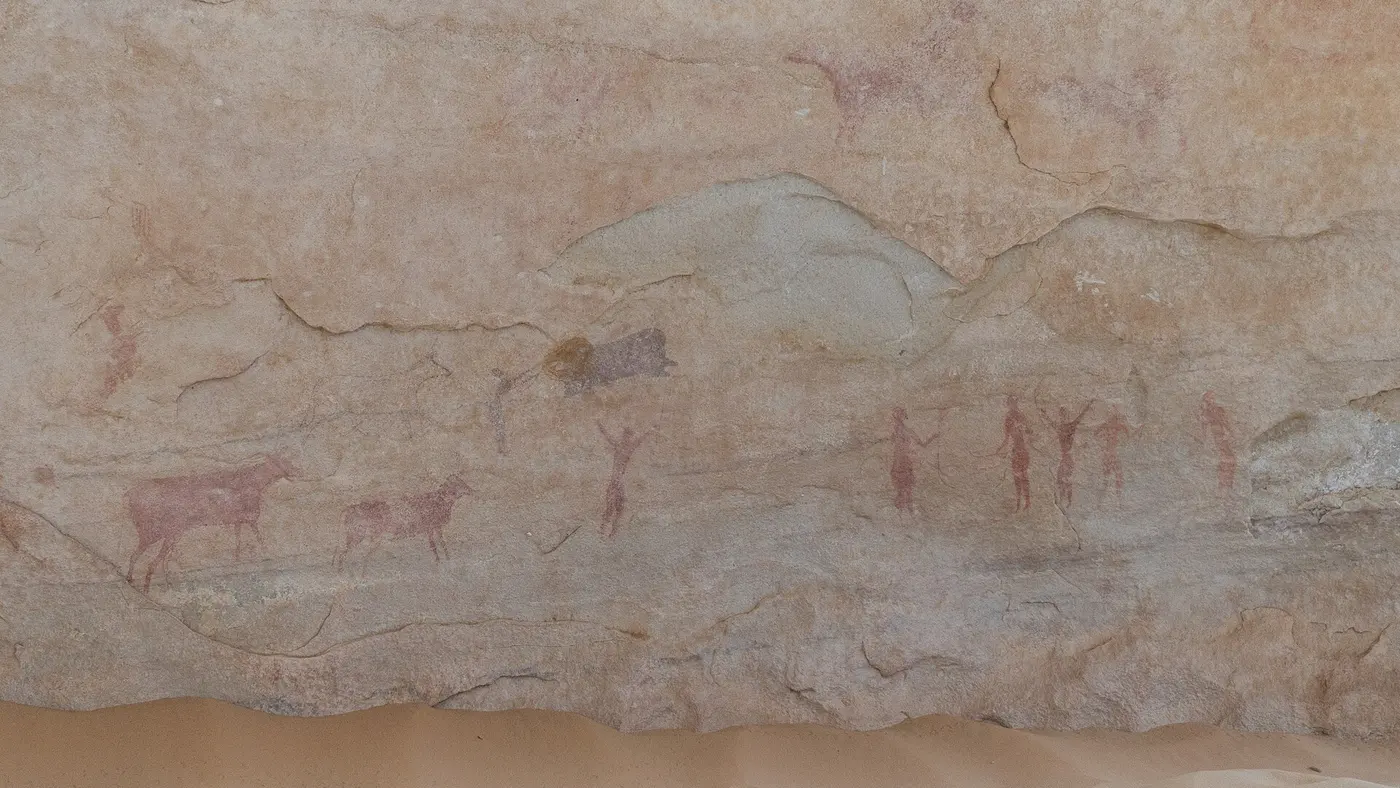

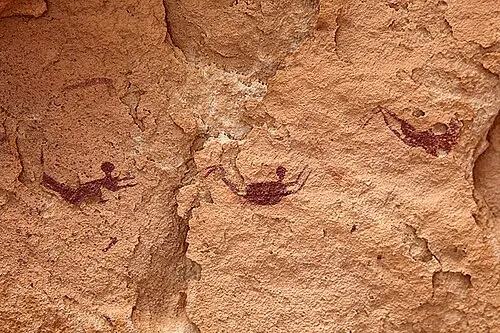
Pictures on the rocks tell the same story. At Tassili n’Ajjer, a World Heritage Site in Algeria, some 15,000 rock engravings have been identified, showing wild animals such as antelopes and crocodiles, herds of cattle, and people hunting and dancing.
A wobble that turned the desert green
How did such a dry land become green, and why did it turn back into desert? The key is precession, a slow wobble of Earth’s axis of rotation.
Because of this wobble, there are periods when Earth makes its closest approach to the Sun during the Northern Hemisphere’s summer. About 10,000 years ago was one of those times, and summer sunshine in the Northern Hemisphere was stronger than it is now. As the land heated up strongly, the African summer monsoon, which draws moist air in from the ocean, grew stronger, and rain clouds reached farther north than usual, into the Sahara.
Plants then amplified the effect. Vegetation darkens the ground so that it absorbs more heat, and it also reduces dust, both of which encourage more rain. Without these effects of plants and dust, researchers say, such heavy rainfall cannot be explained. The wobble repeats roughly every 20,000 years, and the Sahara has swung between green and desert phases many times before.
The end of the green age
As the summer sunshine slowly weakened, the Green Sahara came to an end. According to Tierney and her colleagues, the end was probably abrupt, with the land drying out within a few hundred years. That happened about 5,000 years ago.

Even the green age had its dry spells. About 8,000 years ago, rainfall dropped sharply for around a thousand years, and at about that time the people of Gobero abandoned the site. When the wet climate returned, a different group of people arrived, catching fish and clams and keeping cattle. Climate change shaped the lives of the people who lived there in a big way.