Why do geysers erupt?
Water heated past 100°C but kept from boiling by pressure flashes into steam the moment the pressure drops.
Every so often, as if it had just remembered, a hole in the ground blasts out hot water and steam. That is a geyser. The Japanese word for it, kanketsusen (間欠泉), means roughly “intermittent spring”: something that starts and stops at intervals. Unlike an ordinary hot spring that wells up continuously, a geyser alternates between quiet spells and violent eruptions.
Why should hot water bother to erupt at intervals? The answer involves some surprising physics of pressure and boiling.
Water doesn’t always boil at 100°C
The key is that water’s boiling point changes with pressure. When we say “water boils at 100°C (212°F),” we mean at the air pressure found at ground level. Where the pressure is lower, such as on the summit of Mount Fuji, water boils before it even reaches 90°C. Conversely, under high pressure, as in a pressure cooker, water can exceed 100°C without boiling.
Beneath a geyser, exactly this kind of pressure cooker forms. Water seeps deep underground and is heated by hot rock warmed by magma. But on top of that water sits a column of water reaching all the way to the surface. The deeper you go, the greater the pressure from the weight of that water, so water underground can get far hotter than 100°C and still not boil. At Old Faithful, the famous geyser in Yellowstone National Park in the United States, a water temperature of 118°C (244°F) has been measured about 22 meters below the surface.
What happens the moment it erupts
The channels where the hot water collects are thought to be narrow and twisting. That makes it hard for convection to carry hot water upward to cool off, so heat keeps building up.
Eventually, the hottest water starts to boil, and the resulting bubbles of steam push the water above them upward. When water spills out of the opening at the surface, the weight pressing on the water below suddenly lightens. At that moment, a large mass of water that had been held above 100°C without boiling turns to steam in an instant. Water expands more than a thousandfold when it becomes steam, and that force sends hot water and steam shooting high into the air.
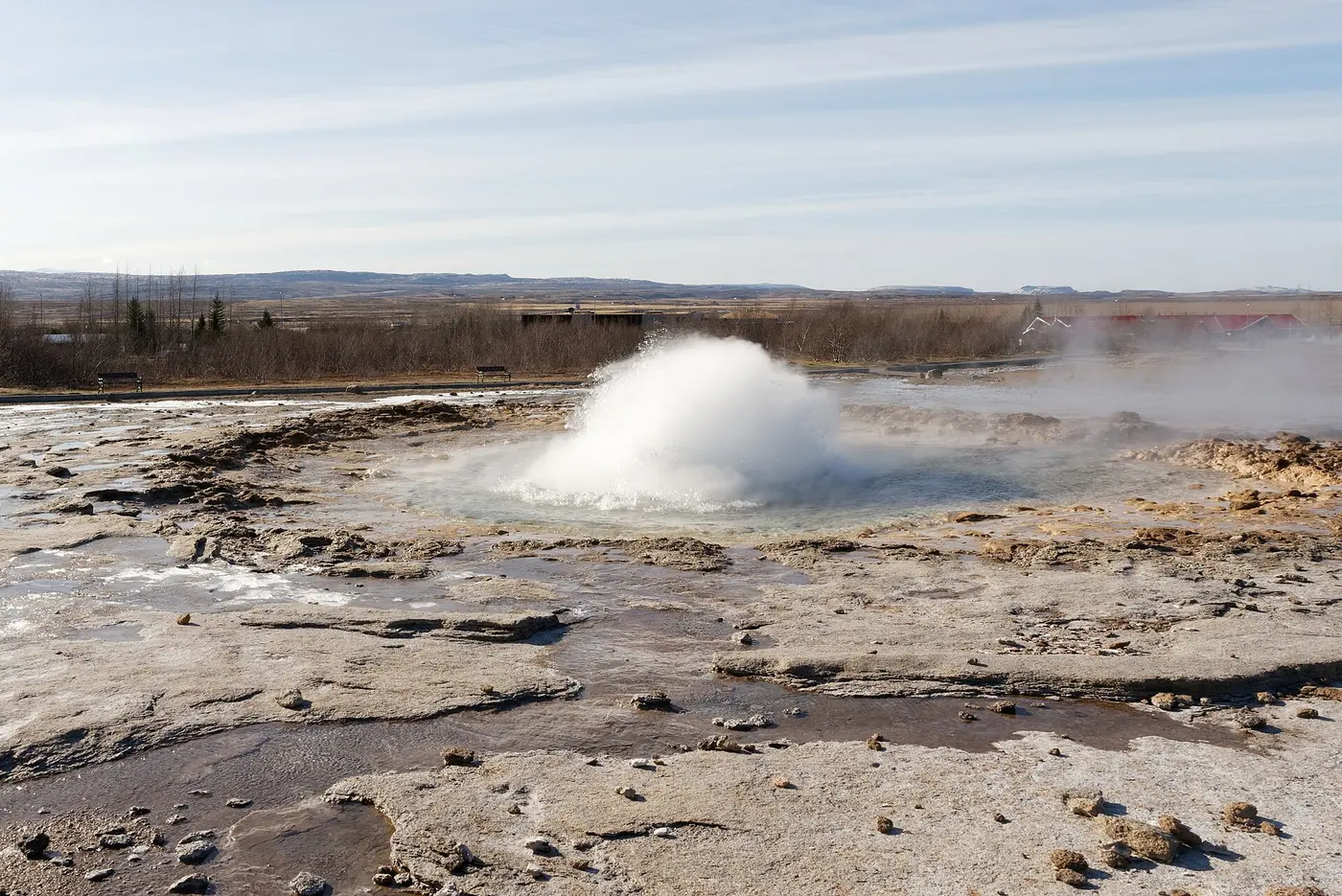

Once an eruption empties the channel, groundwater begins to collect again and is slowly heated. When it gets hot enough, the geyser erupts once more. That is why geysers erupt “at intervals.” The basic idea is said to have been proposed in 1847 by the German chemist Robert Bunsen after he studied geysers in Iceland.
About half the world’s geysers are in Yellowstone
A geyser needs three things to come together: plenty of groundwater, intense heat underground, and a sturdy plumbing system that can hold in the pressure. That is why geysers are rare worldwide; there are said to be only about 1,000 on Earth.
About half of them are gathered in Yellowstone National Park in the United States. The National Park Service says the park has nearly 500 geysers, close to 60 percent of the world’s total. With a vast magma chamber beneath it, this land is truly a kingdom of geysers.
The most famous of them all is Old Faithful. Named by an expedition in 1870, it was the first geyser in the park to be given a name, and true to its name, it erupts regularly about every one to two hours. It shoots water about 30 to 50 meters (100 to 165 feet) high. How long one eruption lasts affects how long the wait is until the next, and the park uses this to predict eruption times.
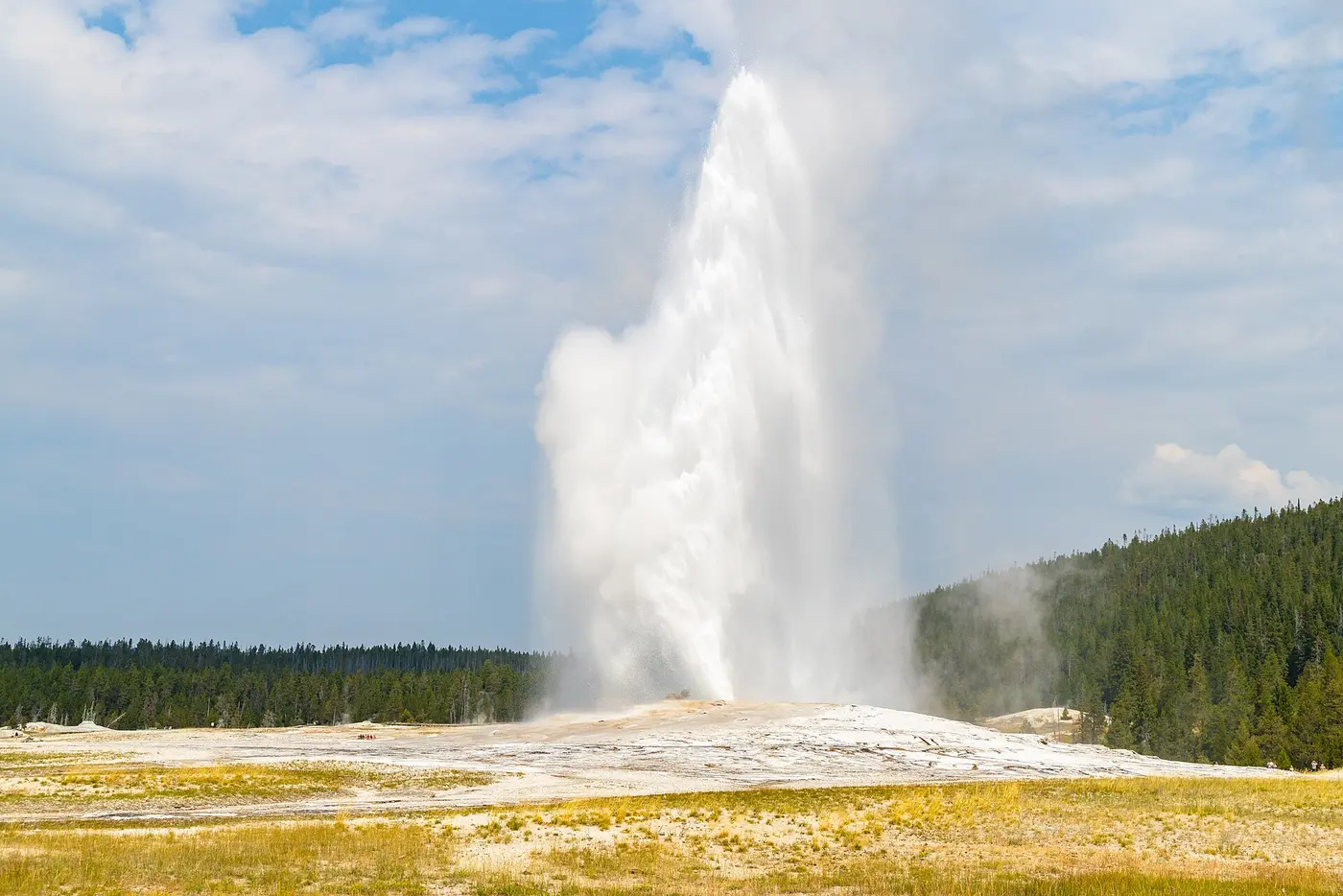

The English word “geyser” comes from Geysir, the name of a geyser in Iceland; in Icelandic it means “gusher.” Japan has geysers too, such as Tatsumaki Jigoku (“Tornado Hell”) in Beppu, Ōita Prefecture, and the geysers of Onikōbe hot springs in Ōsaki, Miyagi Prefecture. Tatsumaki Jigoku erupts every 30 to 40 minutes, and because it has the force to shoot water tens of meters high, a stone roof is used to hold it down.