What kind of piece is 4′33″?
A piece in which the performer plays nothing at all. Whatever sounds fill the room in that time are the music.
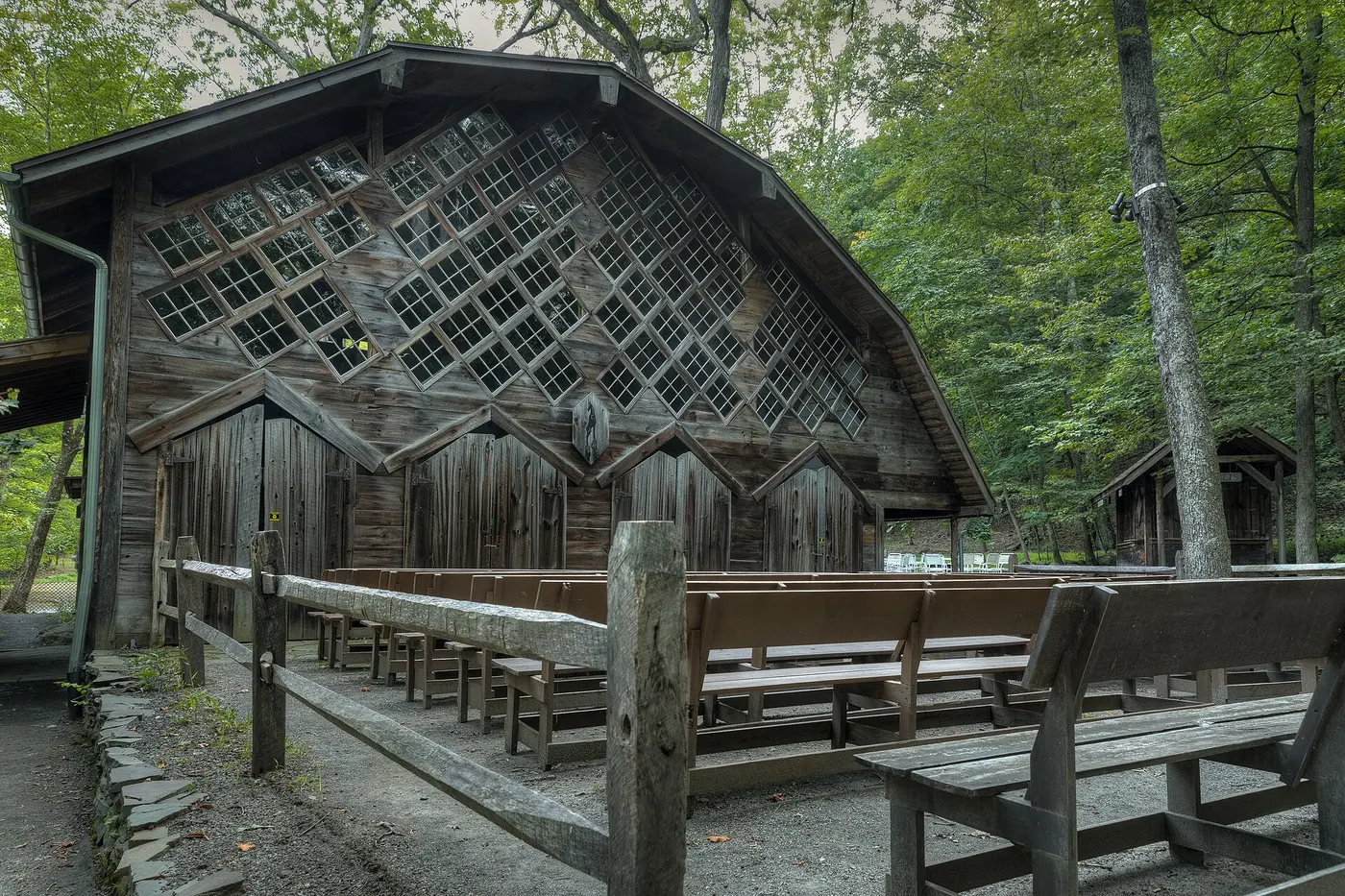
On August 29, 1952, in a wooden concert hall in the woods near Woodstock, New York, the pianist David Tudor sat down at a piano and closed the keyboard lid. Then, with a stopwatch in view, he sat perfectly still without playing a thing.
This was the premiere of 4′33″ by the American composer John Cage. Known as “the piece where nothing is played,” it is often talked about as a joke or a prank. But what Cage wanted his audience to hear was not silence.
A score made of rests
4′33″ is in three movements. At the premiere the first lasted 30 seconds, the second 2 minutes 23 seconds and the third 1 minute 40 seconds, adding up to exactly four minutes and thirty-three seconds. Tudor marked each movement by closing the keyboard lid at the start and opening it at the end.
In the version of the score published later, each movement is marked simply “TACET,” the word used in orchestral parts to tell a player to stay silent for a while. As Cage himself explained, it is not really a piano piece at all: it can be performed on any instrument, or any combination of instruments.

“There’s no such thing as silence”
Much of the premiere audience took the piece as either a joke or an insult, and in the discussion afterwards, bewilderment is said to have turned to anger. Yet to Cage, the hall had never been silent. As he later recalled in an interview:
They missed the point. There’s no such thing as silence. What they thought was silence, because they didn’t know how to listen, was full of accidental sounds. You could hear the wind stirring outside during the first movement. During the second, raindrops began pattering the roof, and during the third the people themselves made all kinds of interesting sounds as they talked or walked out.
In other words, 4′33″ works by having the performer stop making sound, so that listeners turn their ears to the sounds that were there all along: the hum of the air conditioning, someone’s cough, a car passing outside. What you hear changes with every performance.
Two sounds in a silent room
One of the experiences that led Cage to this idea came in 1951, when he entered an anechoic chamber at Harvard University. Its walls and floor soak up almost all sound, so there are no echoes at all, and Cage expected to experience total silence.
Instead, he heard two sounds, one high and one low. When he described them to the engineer in charge, he was told that the high one was his nervous system at work and the low one his blood circulating. As long as we are alive, Cage concluded, we can never hear true silence.
Another push came from his friend, the painter Robert Rauschenberg, whose White Paintings of 1951 were nothing but blank white canvas. With nothing painted on them, they pick up the light in the room and the shadows of passers-by. Seeing them, Cage said, made him feel that he had to do the same thing in music.

An idea years in the making
Cage had in fact been nursing the idea of a silent piece since the late 1940s. In a college lecture around 1948, he said he wanted to compose a piece of uninterrupted silence and sell it to Muzak, the background-music company, and that it would be called Silent Prayer.
He did not act on it right away. He later explained that he did not want it to seem like something easy to do, or like a joke; he wanted to mean it completely. The anechoic chamber, the white paintings and the Zen Buddhist thought he was studying closely at the time all came together, and in 1952 the idea finally became a work.
In a 1982 interview, and on many other occasions, Cage called 4′33″ his most important work.