What was the first photograph?
A view Nicéphore Niépce took from his window in France around 1827 is the oldest surviving photograph.
1827
Today anyone can take a photo in an instant. Point your phone, tap the screen, and you’re done. You can even send it to a friend on the other side of the world on the spot.
Yet until about 200 years ago, there was no way to preserve the scene in front of your eyes just as it was. How could you fix an image drawn by light so that it wouldn’t fade away? The first person to take on that puzzle, and succeed, was a French inventor.
The view from a second-floor window
His name was Joseph Nicéphore Niépce. At his home in Saint-Loup-de-Varennes, a village in Burgundy in central France, he spent years experimenting with ways to capture images using light.
Niépce turned to a natural asphalt known as bitumen of Judea. When exposed to light, it hardens and becomes harder to dissolve. Coat a polished metal plate with it, place it in a camera, and expose it to light; then wash away the parts that didn’t harden, and the differences in light are left behind as an image. He called the technique heliography, from the Greek for “drawing with the sun.”
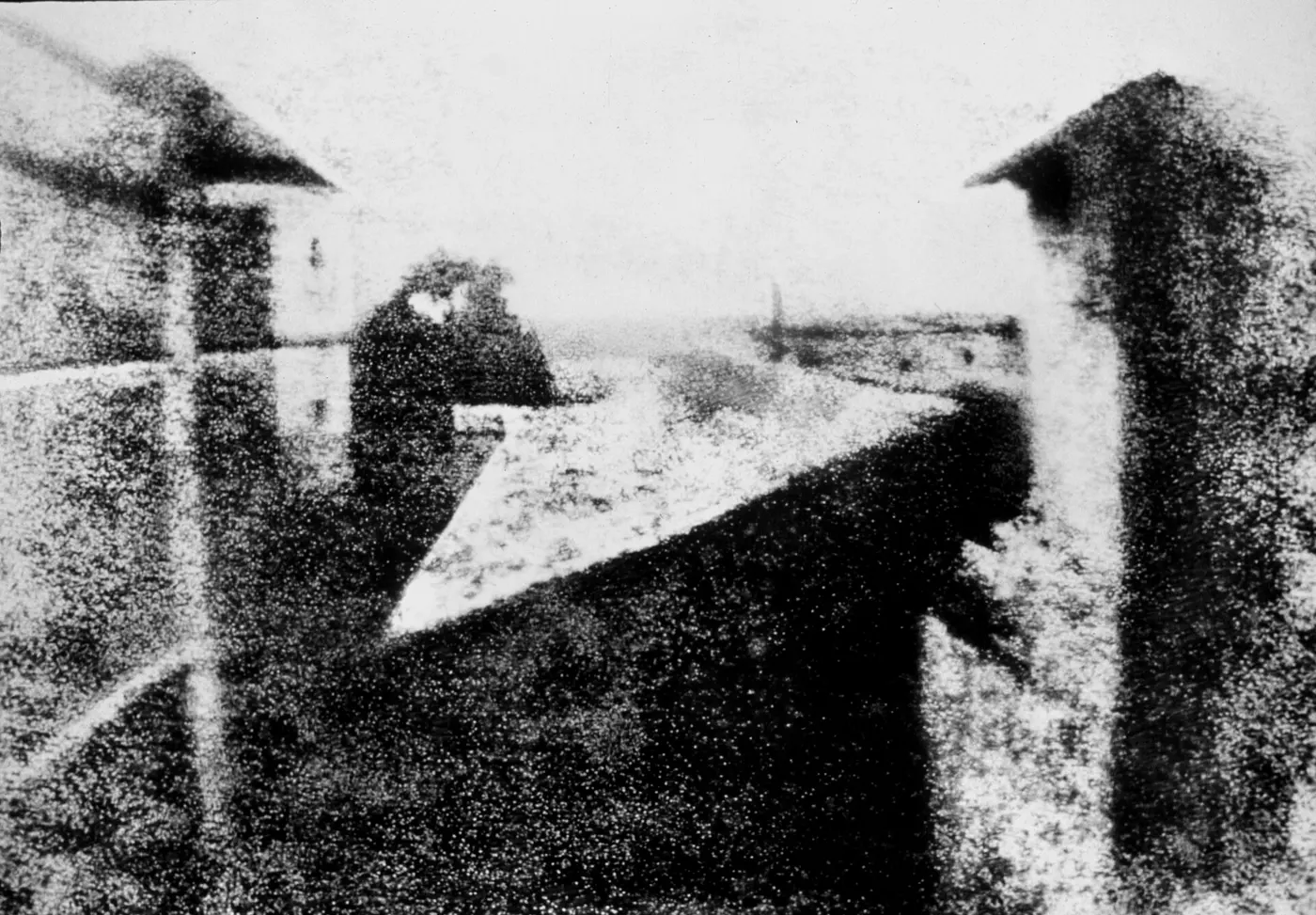

Around 1827, Niépce used this method to record the view from a second-floor window of his house. On a pewter plate (an alloy made mostly of tin) about 16.7 by 20.3 centimeters, you can make out a courtyard, outbuildings, and trees. This is View from the Window at Le Gras, the oldest surviving photograph in the world.
Between 1825 and 1829, Niépce made twenty-some heliographs. Most were copies of engravings and the like; this is said to be the only one that survives of a real scene taken with a camera.
Hours? Or days?
How long did it take to make this picture? For many years, the exposure was thought to have been about eight hours. More recent research, however, suggests it may have lasted several days.
The institution that holds the plate also says it was exposed to sunlight for “several days.” What now takes the instant of a shutter click took that long.
Niépce died in 1833, and for a time the photograph’s whereabouts were lost. In 1952 the photo historians Helmut Gernsheim and his wife, Alison, rediscovered it, and since 1963 it has been carefully preserved in a special oxygen-free case at the Harry Ransom Center at the University of Texas at Austin.
Down to a few minutes
Niépce’s work was carried on by the French painter Louis Daguerre, who had been his partner since 1829. Daguerre developed a new method using silver-plated copper plates and cut exposure times to a few minutes. The agreement he signed with Niépce’s son describes it as “60 to 80 times as rapid” as Niépce’s asphalt method. This “daguerreotype” was announced on August 19, 1839, at a meeting that included the French Academy of Sciences, and the French government bought the rights and released the process to the world free of charge.
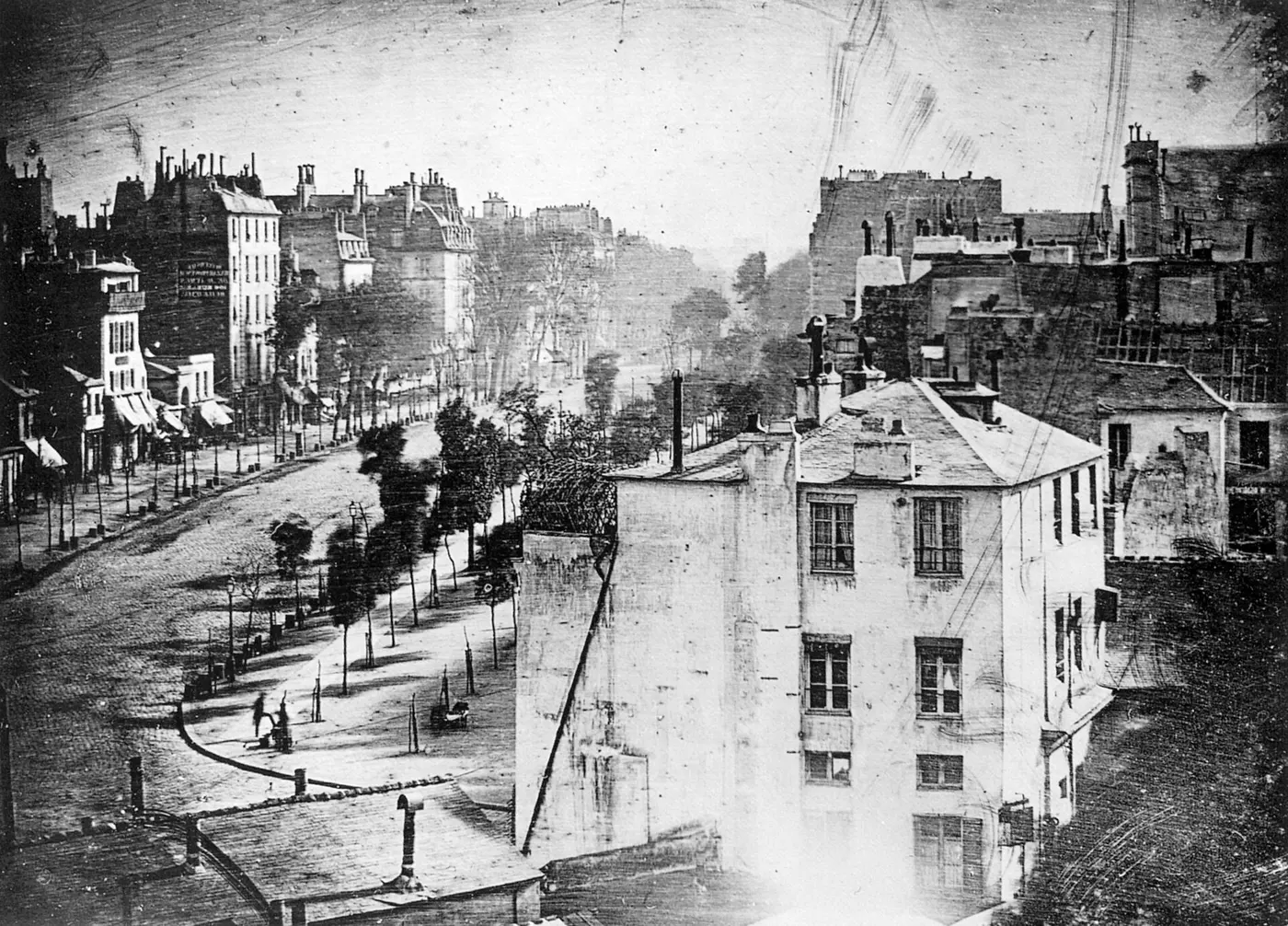

The photograph of the Boulevard du Temple that Daguerre took in Paris around 1838 holds a curious secret. It should be a bustling street, yet it is almost empty. Because the exposure took four to five minutes, the passing pedestrians and carriages didn’t register. But at the lower left you can faintly make out a man having his boots polished, and the bootblack doing the work. Because they stayed still, they became some of the first people ever to appear in a photograph.