When were eyeglasses invented?
In late 13th-century Italy. A sermon from 1306 says the art of making them was found less than 20 years earlier.
1306
For many people, the first thing they reach for in the morning is their glasses. Can’t read the small print? Can’t see into the distance? Two lenses solve the problem just like that.
For most inventions, we can’t say exactly when they were made or by whom. Eyeglasses are different: an unusual record survives that tells us roughly when they were born. It comes from a sermon a friar preached more than 700 years ago.
“Not yet twenty years”
On February 23, 1306, in Florence, Italy, the Dominican friar Giordano da Pisa delivered a sermon. In it, he said:
It is not yet twenty years since there was found the art of making eyeglasses, which make for good vision, one of the best arts and most necessary that the world has.
Counting back from those words, eyeglasses were born around the mid-1280s, somewhere in northern Italy, it is thought. The inventor’s name, however, is unknown. Records also tell of another friar from Pisa, Alessandro della Spina, who worked out for himself how to make the glasses that someone else had kept secret, and then generously shared the knowledge.
Before that, people had used “reading stones,” lens-like pieces laid on top of a text to magnify it. Pairing two lenses and setting them in front of the eyes was the great leap that made eyeglasses.
The first eyeglasses in a painting
The oldest known painting of someone wearing eyeglasses is a fresco painted in 1352 by the Italian artist Tommaso da Modena in Treviso, in northern Italy. A cardinal sits writing at his desk with two round lenses perched neatly on his nose.
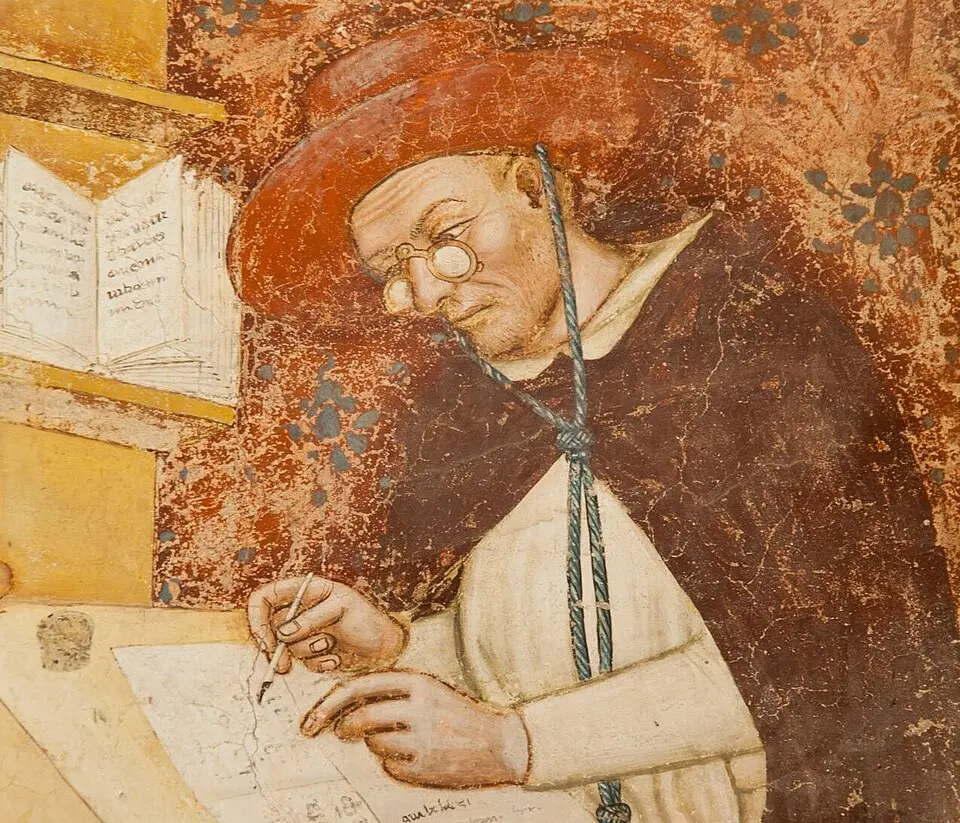

Early eyeglasses all used convex lenses; they were what we would now call reading glasses. For scholars and monks whose eyes could no longer make out nearby text, they must have been a godsend. Glasses with concave lenses to correct nearsightedness didn’t appear until the mid-15th century. The scientific explanation of why lenses can correct vision came from the astronomer Johannes Kepler in 1604. In other words, people had been wearing eyeglasses for more than 300 years before anyone understood how they worked.
Glasses of the time also had no arms. People balanced them on the nose or held them in the hand. Glasses with arms that hook over the ears didn’t catch on until the 18th century.
Did Francis Xavier bring them to Japan?
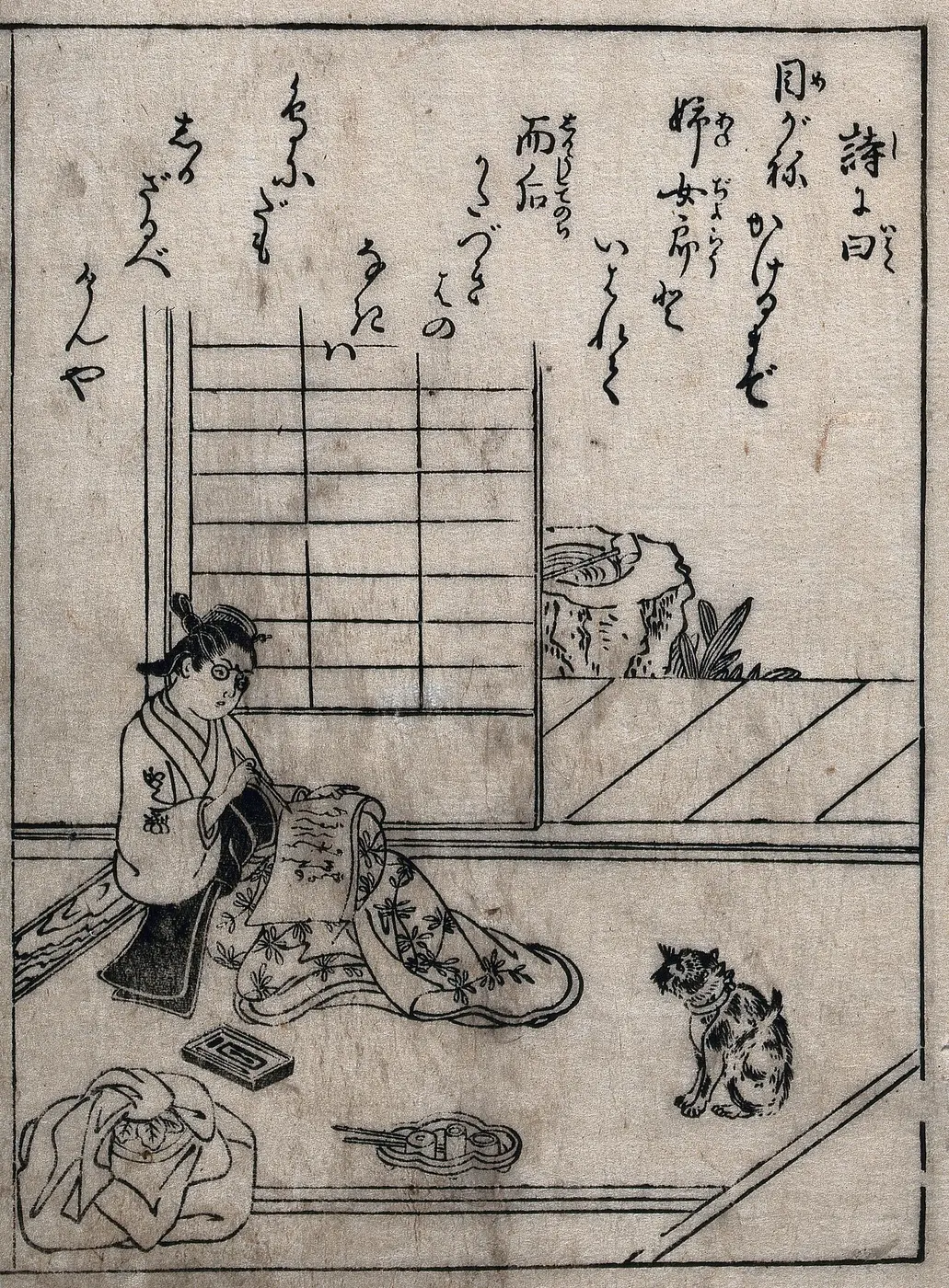
Eyeglasses reached Japan during the Warring States period. The first are said to have been a gift from the Christian missionary Francis Xavier, who presented a pair, among other presents, when he met Ōuchi Yoshitaka, lord of Suō Province (in today’s Yamaguchi Prefecture), in 1551. Those glasses no longer survive, however.
The best-known early pair still in existence is kept at Kunōzan Tōshōgū, a shrine in Shizuoka Prefecture, and is said to have been used by Tokugawa Ieyasu in his later years. It consists of two lenses in a tortoiseshell frame, and it seems to have been perched on the nose or held in place by hand. The glasses are designated an Important Cultural Property of Japan.
Some say Ieyasu’s glasses were a gift from Spain or Portugal, while another theory holds that they were made in Japan, with lenses ground by a craftsman in Kyushu. A Kyoto court noble also wrote in his diary that he received a pair of glasses from Ieyasu in 1593, so it seems Ieyasu sometimes gave glasses as gifts. There is also a pair said to have belonged to Ashikaga Yoshiharu, a shogun of the Muromachi shogunate, and according to one theory it is older still.
By the middle of the Edo period (1603–1868), shops selling eyeglasses had appeared in big cities such as Edo and Osaka, and people wore glasses that pinched the nose or hooked over the ears with strings.