What was the world’s first car?
It is said to be Cugnot’s steam vehicle, built in France in 1769. The first gasoline car was Benz’s, in 1886.
1769
Ask people who invented the car, and many will think of Germany’s Karl Benz or Gottlieb Daimler. Both men’s names live on in carmakers that are still with us today.
But trace the history of the vehicle that moves under its own power, and you end up more than 100 years before Benz’s car, in the French army.
A steam wagon for hauling cannons
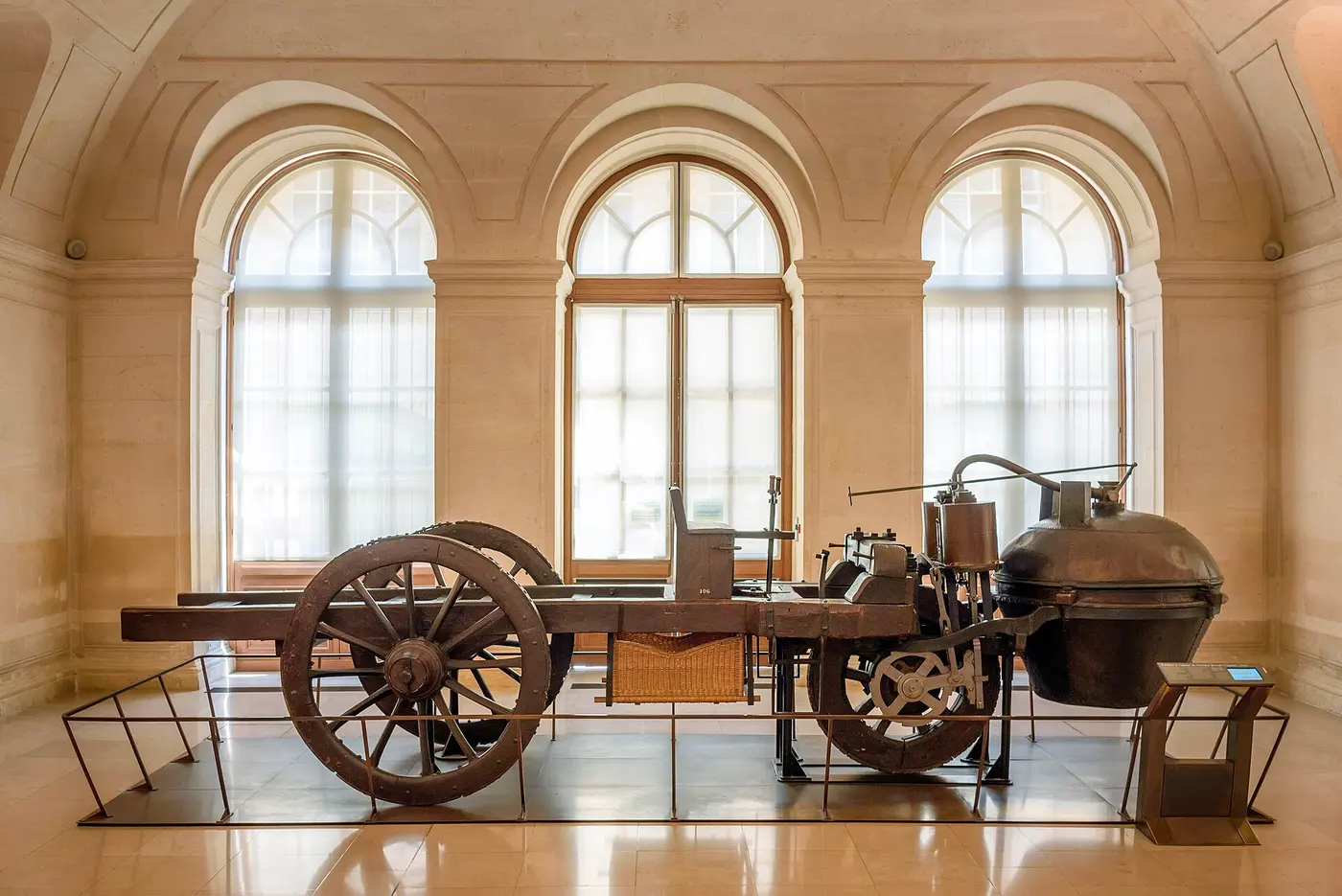
In 1769, Nicolas-Joseph Cugnot, an engineer in the French army, built an experimental vehicle driven by a steam engine. Its purpose was to haul heavy cannons in place of horses. The next year, 1770, a full-size version was built and named the fardier à vapeur, or “steam-powered heavy hauler.”
It was a three-wheeler, with one wheel in front and two behind, and a huge copper boiler jutting out ahead of the front wheel. It weighed about 2.5 tonnes. To steer it, the driver swung the boiler and its two cylinders left or right together with the front wheel, a bold design to say the least.

A “world first” slower than walking
Its performance was, to put it kindly, unimpressive. Its top speed is estimated at under 4 kilometers per hour (2.5 mph), hardly faster than a person walking. The boiler was too weak to keep the vehicle going for long, and with that heavy boiler hanging out in front, steering seems to have been quite a struggle.
There is a famous story that Cugnot’s vehicle crashed into a wall, causing “the world’s first car accident.” But the tale first appears in writing more than 30 years after the crash supposedly took place, so it is unclear whether it ever really happened.
In the end, partly because Cugnot’s powerful patron fell from favor, the project was abandoned before the vehicle was ever put to use. Even so, the machine itself is still carefully preserved at the Musée des Arts et Métiers, a museum of science and industry in Paris.
Benz’s “patent motorcar”
In the 19th century, steam-powered buses began running through the streets of Britain. Still, big, heavy steam engines were poorly suited to a light, convenient vehicle.
What changed things was the internal combustion engine, which burns its fuel inside the cylinder. In Germany, Karl Benz built a three-wheeler carrying a small gasoline engine and applied for a patent on January 29, 1886. The patent for this Benz Patent-Motorwagen, number 37435, is often called the “birth certificate of the automobile.” Its single-cylinder engine produced less than 1 horsepower, and its top speed was about 16 kilometers per hour (10 mph). Even so, a vehicle that needed neither horses to pull it nor a heavy steam boiler on board was a breakthrough. In the same year, 1886, Daimler also drove a four-wheeled vehicle made by fitting an engine to a horse carriage.
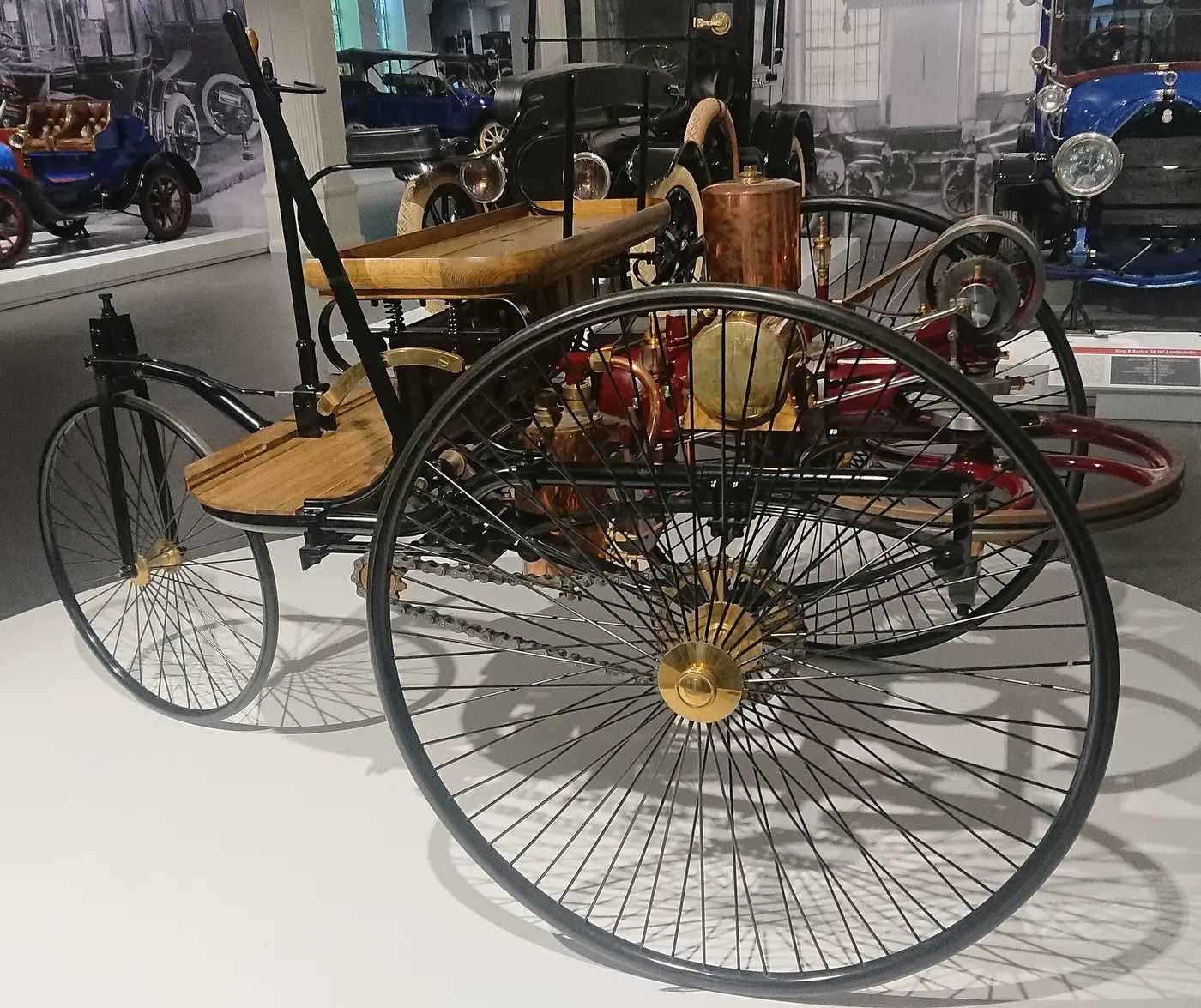

So the answer to “What was the world’s first car?” depends on what you count as a car. The usual way to sort it out is this: the first vehicle to run under its own power was Cugnot’s steam wagon, while the first gasoline car, the direct ancestor of today’s automobiles, was Benz’s. Incidentally, experiments with battery-powered electric vehicles began in the first half of the 19th century, earlier than gasoline cars.
A 100-kilometer drive, without telling her husband
The person who introduced Benz’s car to the world was his wife, Bertha. In August 1888, without telling her husband, Bertha set out with their two teenage sons on a drive of about 100 kilometers (60 miles), from Mannheim to her family home in Pforzheim.
According to the story, when fuel ran low along the way, she bought a solvent at a pharmacy to use as fuel; she cleared a clogged fuel line with a hatpin; and she had a shoemaker fix the worn-out brakes by fitting them with leather. The journey caused a sensation and showed that the automobile could handle long trips. Today the route has been set up as the Bertha Benz Memorial Route.