How do fireworks get their colors?
Metal compounds mixed into the powder give off light whose color is set by each element: strontium for red, barium for green.
A boom, and then a flower of light spreads across the whole night sky. In Japan, aerial fireworks that shift from red to green to blue before they fade are one of the great sights of summer.
Coloring that light does not involve filters or dye. The color of a firework is the light given off by metals mixed into the powder, glowing as they burn.
The secret is the flame test
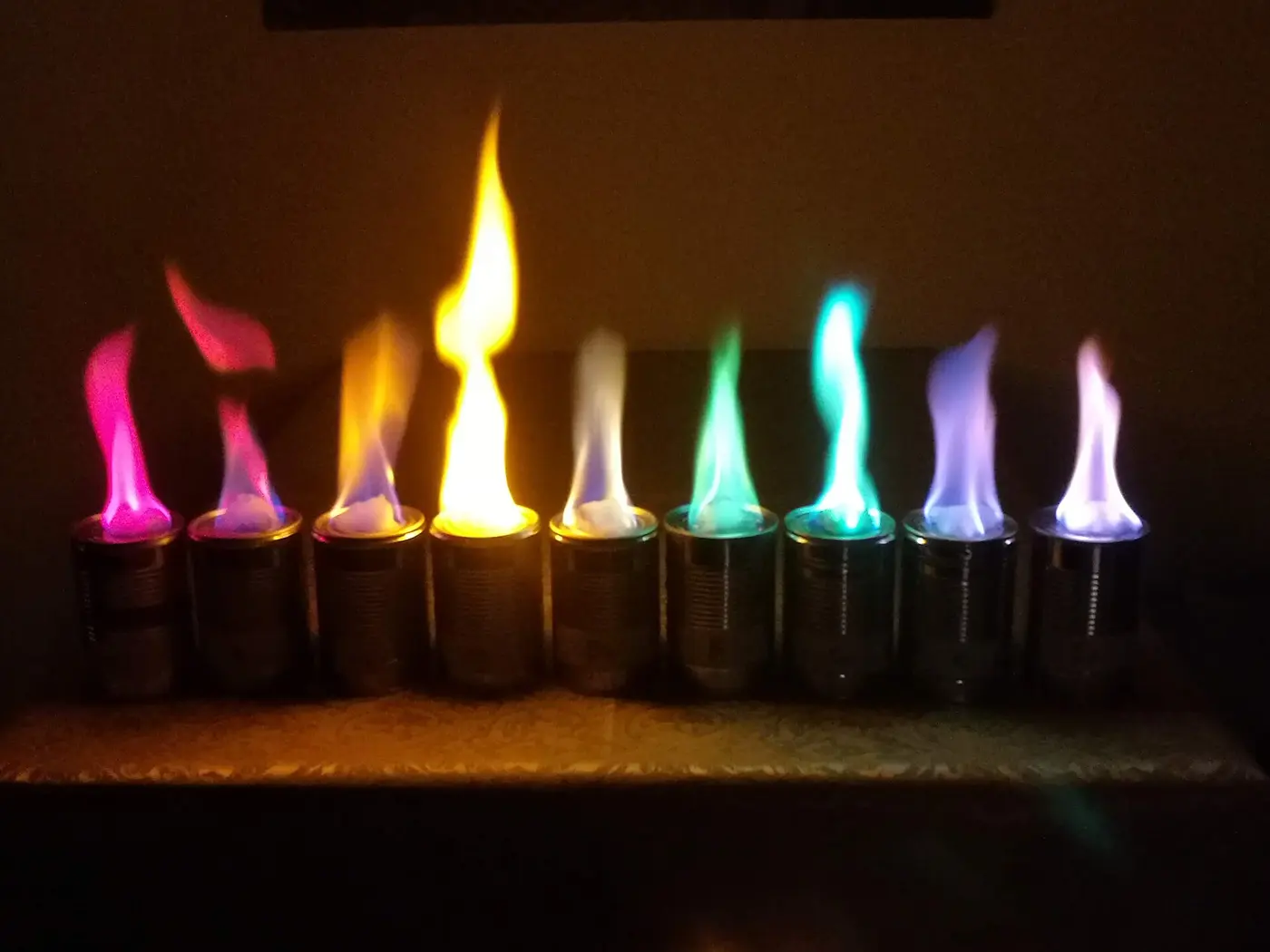
You may have seen a science class experiment in which a liquid containing a metal is held in a flame and the flame changes color. Chemists call this a flame test.
When a substance is heated strongly, electrons inside its atoms absorb energy and jump to a higher energy state. When they fall back, they release the extra energy as light. The color, or wavelength, of that light is more or less fixed for each element: deep red for strontium, yellow for sodium, orange for calcium, yellowish green for barium, and blue or blue-green for copper.
Fireworks makers mix compounds of these metals into the powder as colorants. To make the colors deeper and richer, they often add a chemical containing chlorine as well. In the flame, the metal and chlorine combine into small molecules that give off especially pure reds, greens and blues.

Stars that change color
An aerial firework shell is packed with pellets of composition called stars. When the shell bursts in the sky, the burning stars fly out in every direction, each one tracing a point or streak of light, and together they draw a round flower.
Stars are also how fireworks change color in mid-air. A small pellet is coated again and again with a different colored composition, drying between coats, until it has layers like an onion. Because a star burns from the outside in, a red outer layer over a green core will glow red and then switch to green. All that coating and drying takes time: for a large shell, making the stars alone can take around three weeks.
Blue is the hardest
Compared with red or green, a crisp blue is famously difficult. Blue light comes from a molecule made of copper and chlorine, and that molecule does not like heat. If the flame gets too hot, it breaks apart before it can glow blue.
Yet a firework has to burn hot and fast to shine brightly. Too cool and it is dim; too hot and the blue disappears. Pyrotechnicians have spent a long time fine-tuning their mixtures to hit that narrow temperature window. Purple, by the way, is made by combining red strontium with blue copper.
Edo’s fireworks were orange
Kagiya, said to be Japan’s oldest fireworks maker, traces its origins to 1659, when its founder, Yahei, began selling toy fireworks in Edo, the city now called Tokyo. In 1808 a senior employee set up his own business, Tamaya, and the two houses competed over the Sumida River. The cries of “Tamaya!” and “Kagiya!” still heard at Japanese fireworks shows are the names of those two shops. But the fireworks of that era had none of the reds, greens and blues we know today.
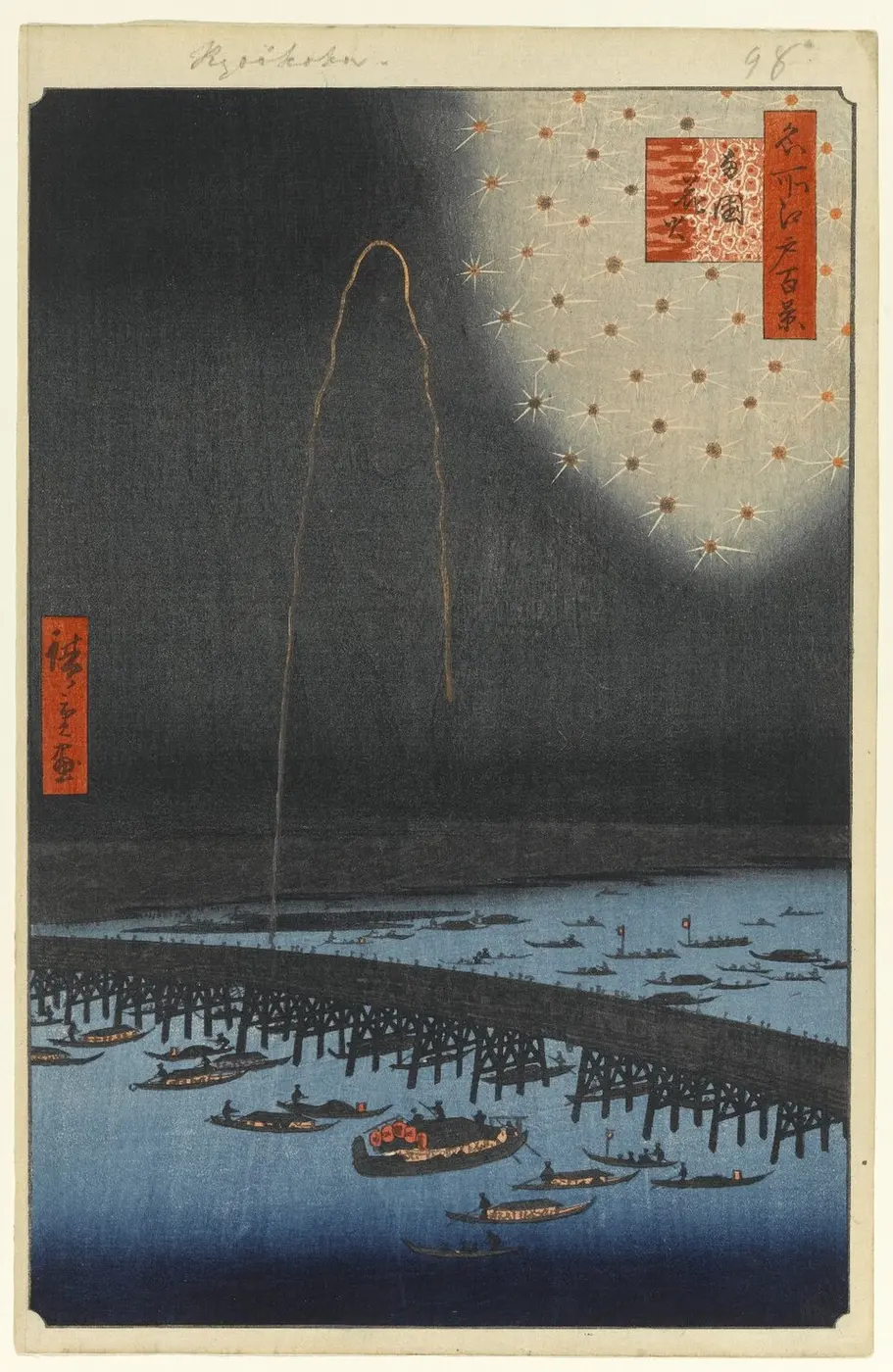

Fireworks then were what is now called wabi, “Japanese fire,” made with black powder, a mixture of saltpeter, sulfur and charcoal. They could only show shades of charcoal-like orange. Think of the color of the sparks from a senkō hanabi, the small Japanese sparkler held in the hand.
Change came in the Meiji era, after Japan opened up to the West. Between 1879 and 1887, chemicals such as potassium chlorate, strontium carbonate, barium nitrate, aluminum and magnesium arrived from abroad in stages. Fireworks that used them to produce bright colors and strong light became known as yōbi, “Western fire.” The Japan Pyrotechnics Association describes this period as the greatest leap forward in the history of Japanese fireworks.