Why do soap bubbles shimmer with rainbow colors?
Light reflected off the front and back of the film overlaps, and certain colors are reinforced depending on its thickness.
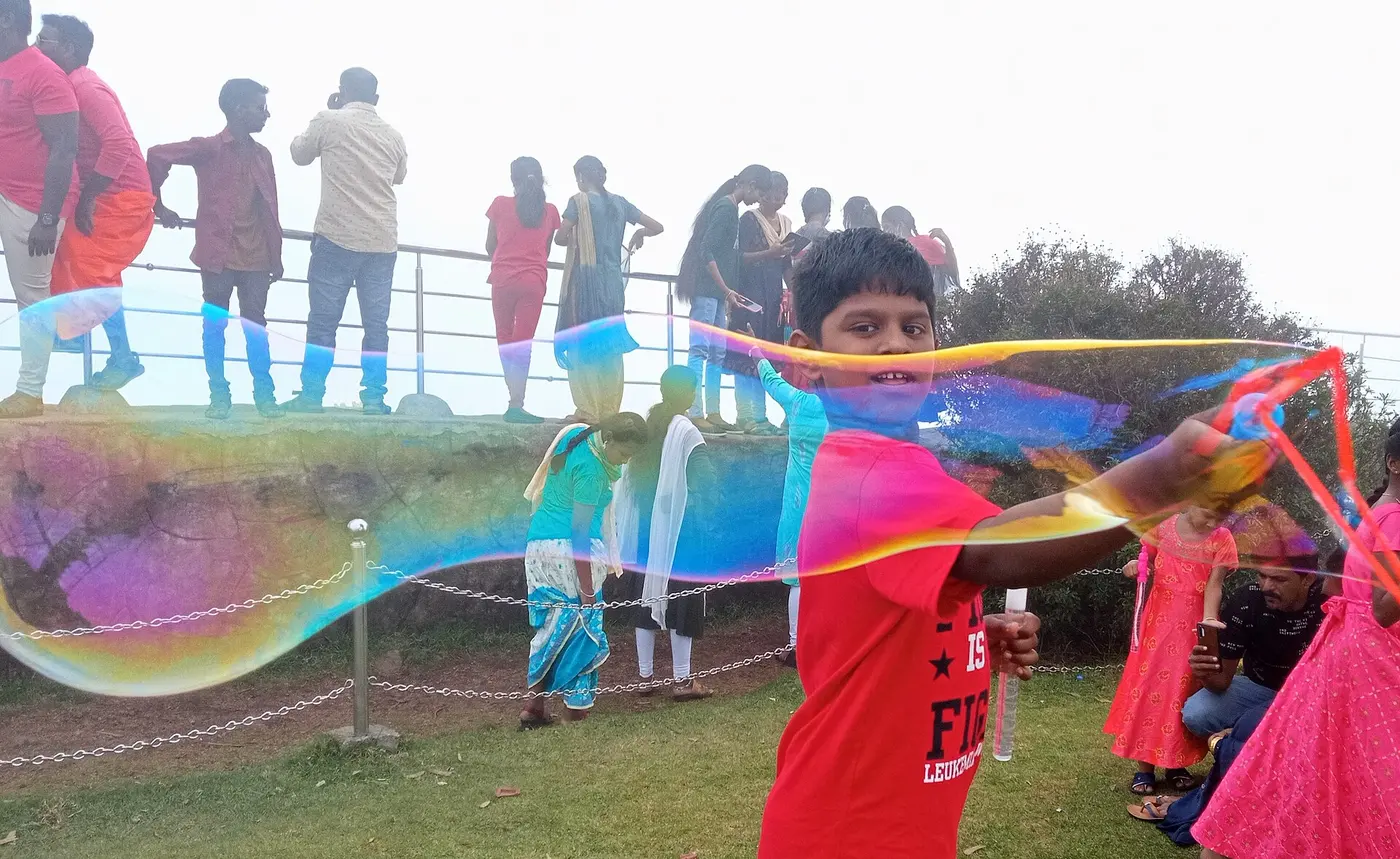
A soap bubble floats gently away from the end of a straw. Look closely, and patterns of red and green, blue and purple are flowing across its surface. Yet the soapy water it came from has no color at all. There is no paint or dye in it, so where do those colors come from?
It is a different mechanism from a rainbow, where raindrops sort light into its colors, and different from a glass prism, too. The answer lies in how thin the bubble’s film is.
A film far thinner than a hair
A soap bubble’s film is made of an extremely thin layer of water sandwiched between soap molecules. Its thickness varies from place to place and moment to moment, but it is mostly a few hundred nanometers. A nanometer is one millionth of a millimeter, so the film is even thinner than one hundredth the width of a human hair.
The crucial point is that this thickness is about the same as the wavelength of visible light (roughly 380 to 780 nanometers). Light behaves as a wave, and it is precisely at this scale that its wave nature comes clearly into view.

When two reflections overlap
When light hits a soap bubble, some of it reflects off the outer surface of the film, and some passes into the film and reflects off the inner surface. What reaches our eyes is these two reflections overlapping.
The light reflected from the inner surface has traveled farther, by the round trip through the film. Because light is a wave, that difference in path length matters: where the crests of the two waves line up, they reinforce each other; where a crest meets a trough, they cancel out. This is called interference.
White light from the Sun or a lamp is a mixture of light of many colors. At a given thickness of film, some colors are reinforced and others are weakened. As a result, particular colors stand out from the white light. Change the thickness of the film, and the reinforced colors change too. The colors also shift with your viewing angle, because the distance the light travels through the film changes. The colors of a soap bubble are something like a map of the film’s thickness.
Swirling patterns, and the black before the pop
A bubble’s colors are always on the move because the liquid in the film is flowing. Gravity slowly draws the liquid downward, so the film near the top grows steadily thinner. Air currents and evaporation make the thickness uneven as well, and the patterns of color swirl and change.
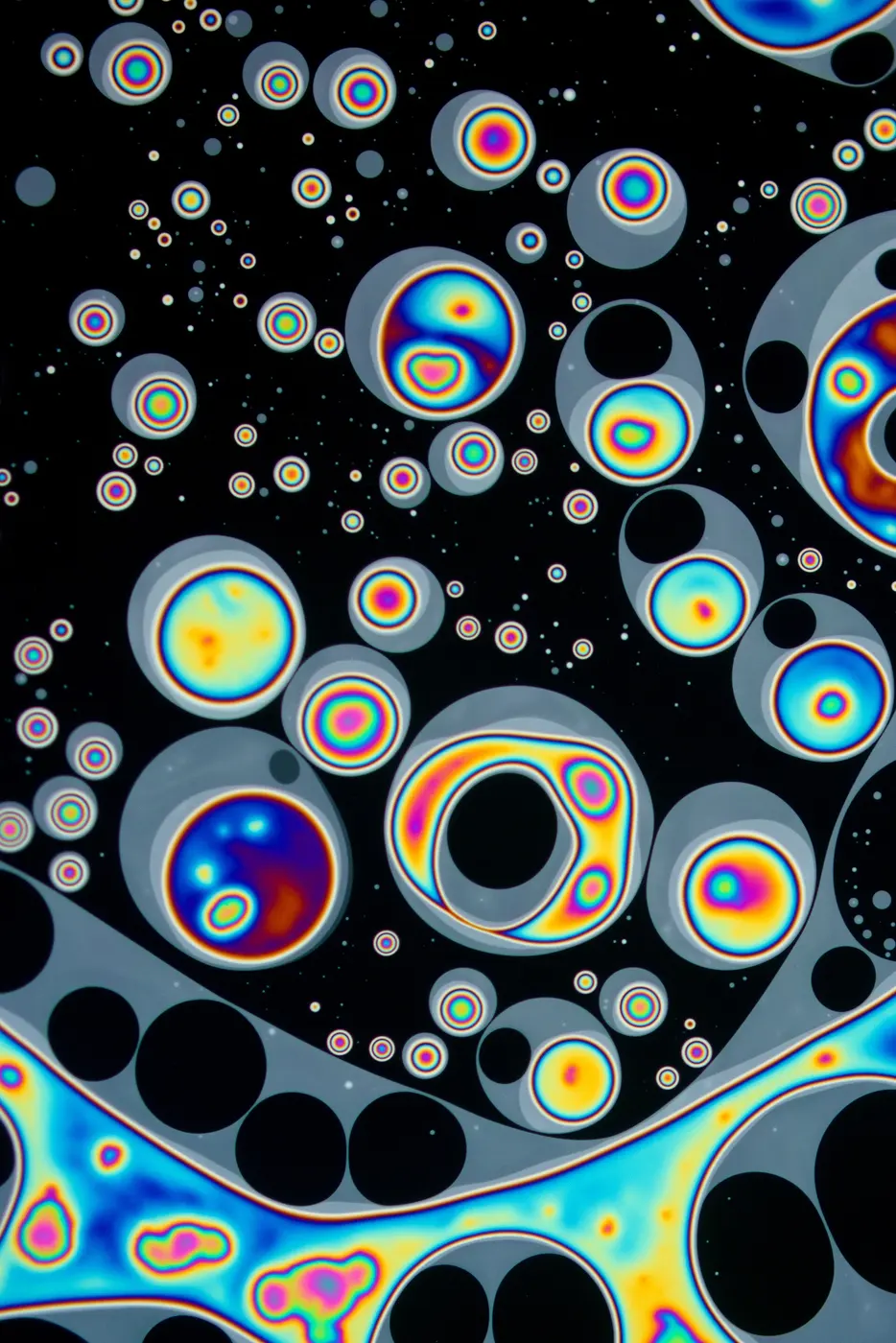
As the film gets thinner and thinner, the colors eventually disappear and dark-looking patches appear. Once the film becomes much thinner than the wavelength of light, the light reflected from the outer and inner surfaces almost completely cancels out, so almost no light comes back. When light reflects off the outer surface, its crests and troughs swap places, so when the path difference all but vanishes, the two reflections end up exactly out of step. These black patches are also a sign that the bubble is about to burst.

Colors that fascinated Newton
The colors that appear in thin films have long piqued the curiosity of scientists. Isaac Newton, famous for discovering universal gravitation, studied in detail the sequence of colors that appears in soap bubbles and other thin films, and discussed them in his book Opticks, published in 1704.
The rainbow sheen of an oil film floating on a puddle is the same thin-film interference. The oil itself has no color; it is the thickness of the thinly spread film that creates the colors.
This property is put to work in everyday objects as well. The surfaces of eyeglass and camera lenses are sometimes coated with an extremely thin film. It works by making the light reflected from the front and back of the film cancel out, reducing glare. Look at such a lens from an angle, and you may notice a faint green or purple tint.