How hot is the center of the Earth?
An estimated 5,000 to 6,000°C—about as hot as the surface of the Sun.
5000–6000°C
Far below the ground we stand on lies the center of the Earth, about 6,400 kilometers (4,000 miles) down. That is roughly the distance from Tokyo, heading due west, to somewhere around India.
The deepest hole humans have ever dug goes down only a little over ten kilometers, a mere 0.2 percent or so of the way to the center. Even so, scientists can say with considerable confidence how hot the center of the Earth is. And the answer is hotter than you might imagine.
As hot as the surface of the Sun
The inside of the Earth is layered, a bit like a boiled egg. The thin outer shell is the crust; beneath it lies the thick, rocky mantle; and from a depth of about 2,900 kilometers down is the core, made mostly of iron. The core itself is split into a liquid outer core and a solid inner core within it.
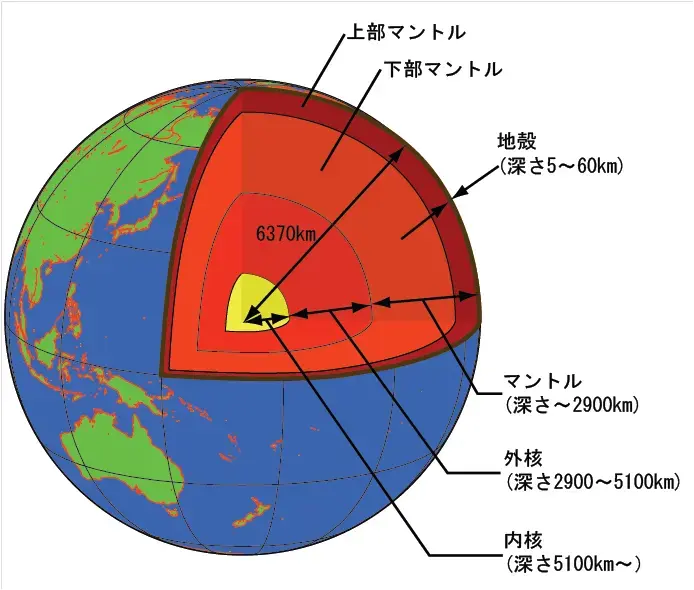

The temperature at the center is estimated at roughly 5,000 to 6,000°C (about 9,000 to 11,000°F). The surface of the Sun is about 6,000°C, so the two are almost equally hot.
One clue to this temperature is the boundary between the inner and outer core. Liquid iron is freezing solid there, so the temperature at that boundary should be about the same as the melting point of iron at that pressure. In 2013, a research team from France and elsewhere used powerful X-rays to watch iron melt under ultra-high pressure, and estimated the temperature at the boundary at about 6,000°C, give or take around 500°C. That was some 1,000°C higher than previously thought. Results still vary depending on the experimental and computational methods used, however, and research continues.
Hot, but not melted
Here something puzzling comes up. At the surface, iron melts at about 1,500°C. At 6,000°C, you would expect the center to be a molten soup. Yet the inner core is thought to be a solid ball of iron.
The reason is the staggering pressure. The pressure at the center of the Earth is about 3.6 million times that of the atmosphere at sea level, the combined weight of all the rock and iron stacked above it bearing down. Under high pressure, atoms are squeezed together and can hardly move, so a higher temperature is needed to melt them. The outer core doesn’t have enough pressure for its temperature and stays liquid; in the inner core, pressure wins and the iron is solid.
That liquid outer core is not sitting still. Slowly churned by heat, its flowing, electrically conductive iron is thought to generate the magnetic field that surrounds the whole planet. So when a compass needle points north, it ultimately owes a great deal to the heat at the center of the Earth.
How do we know, if no one can go there?
So how did scientists study an interior no one has ever seen? Their most powerful tool is the earthquake.
When an earthquake strikes, its shaking travels through the Earth as waves and reaches seismometers around the world. Those waves change speed and direction depending on how hard the material they pass through is, and what state it is in. Waves that shake from side to side, for example, known as S waves, cannot travel through liquid. That property revealed that the outer core is liquid.


The person who saw that a solid inner core lay deeper still was the Danish seismologist Inge Lehmann. Combing carefully through earthquake records, she noticed faint waves arriving at places they should never have reached. In 1936, she published the idea that within the core there was another boundary that changed the path of seismic waves. From records gathered by hand, she had deduced the existence of a ball at the very center of the Earth.
Where does the heat come from?
One reason the center of the Earth is so hot is that heat from the planet’s birth still lingers. When the Earth formed from small bodies smashing into one another, the energy of those collisions, along with the energy released as heavy iron sank toward the center, turned into an enormous amount of heat.
The other source of heat is the slow decay of radioactive elements such as uranium and thorium in the rocks. In 2011, KamLAND, a detector deep underground in the Kamioka mine in Gifu Prefecture, Japan, caught subatomic particles called neutrinos streaming out of the Earth’s interior and estimated that about half of the heat leaving the planet comes from radioactive elements. Over 4.6 billion years, the Earth has been slowly cooling, and yet it is still warming itself from within.