Why do auroras glow?
Electrons pouring in from space strike oxygen and nitrogen high in the air, and that energy makes the air itself glow.
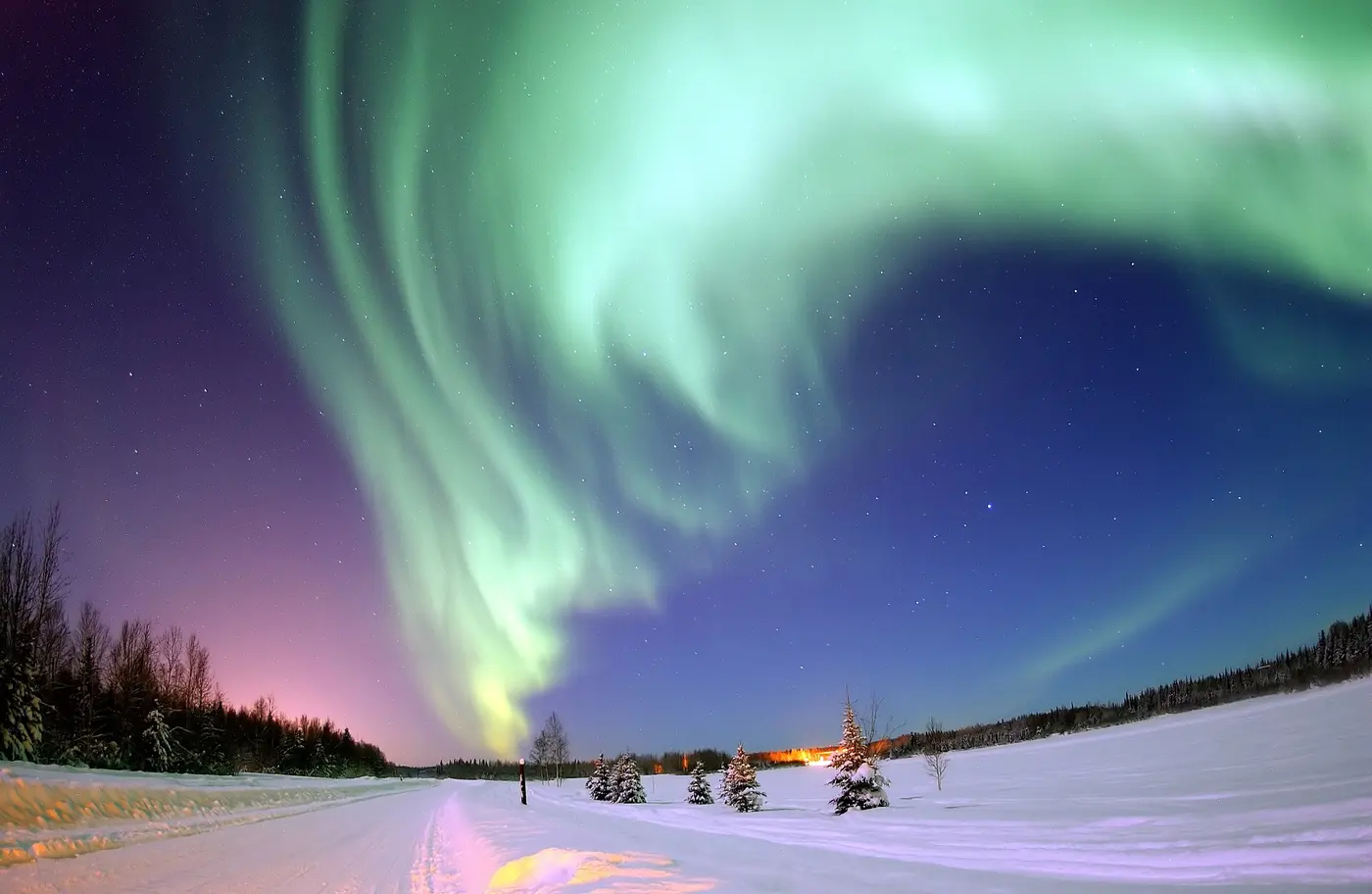
In the night skies near the Arctic and Antarctic, green curtains of light sway and ripple, sometimes shifting to red or purple as they spread from one horizon to the other. Of all the spectacles nature puts on, the aurora is among the most otherworldly.
That light is not cloud or moonlight being reflected back at us. More than 100 kilometers (60 miles) overhead, the air itself is glowing. So what sets it alight?
It begins with a wind from the Sun
Besides light and heat, the Sun constantly blows a stream of electrically charged particles out into space. This is called the solar wind, and it travels at several hundred kilometers per second.
Earth, however, does not take the solar wind full in the face. Our planet behaves like a giant magnet, and the magnetic field around it deflects the wind’s particles like a shield. But the solar wind sweeps that field back, stretching it out into a long tail on Earth’s night side, where energy builds up. When something triggers the release of that stored energy, electrons are accelerated and come streaming down along the magnetic field lines into the skies around the North and South Poles.
That is why auroras are a polar phenomenon. The places where they appear most often form a doughnut-shaped band around each of Earth’s magnetic poles, known as the auroral oval.

The color depends on what glows, and how high
The incoming electrons collide with oxygen atoms and nitrogen molecules in the upper atmosphere and hand over some of their energy. Having absorbed that energy, the atoms and molecules are left in an excited state, and when they settle back down they release the extra energy as light. That light is the aurora. It works much the same way as a neon sign.
The color depends on what gets struck and at what height. The familiar green, the most common shade, comes from oxygen atoms at around 100 to 200 kilometers up. Higher still, above roughly 200 kilometers, the same oxygen atoms give off red light. Nitrogen produces blues, purples and pinks, and the lower edge of a curtain is sometimes trimmed in pink. In other words, an aurora’s colors double as a guide to what is glowing, and at which altitude.
Auroras over Japan
Auroras are occasionally seen even in places like Hokkaido, Japan’s northernmost main island. When a large eruption such as a solar flare hurls a powerful burst of solar wind at Earth, it can set off a geomagnetic storm, a major disturbance of Earth’s magnetic field, and the zone where auroras appear spreads toward the equator.
Seen from lower latitudes like Japan’s, auroras are usually red. That is because only the red upper portion of an aurora shining far to the north peeks above the horizon. In May 2024, an exceptionally strong geomagnetic storm, said to be the strongest in about 20 years, turned skies red and pink not only over Hokkaido but across many parts of Honshu, Japan’s main island.
Records of such sights go back a very long way. The Nihon Shoki, one of Japan’s oldest chronicles, describes a night in the twelfth month of the 28th year of Empress Suiko’s reign (620 CE) with this line:
In the sky there was a red vapor, more than one jō long, shaped like a pheasant’s tail.
A red glow resembling a pheasant’s tail, in other words. In 2020, a research group including Japan’s National Institute of Polar Research announced that it was most likely a fan-shaped aurora. The passage is considered the oldest astronomical record in Japan.
Looking down on auroras from space
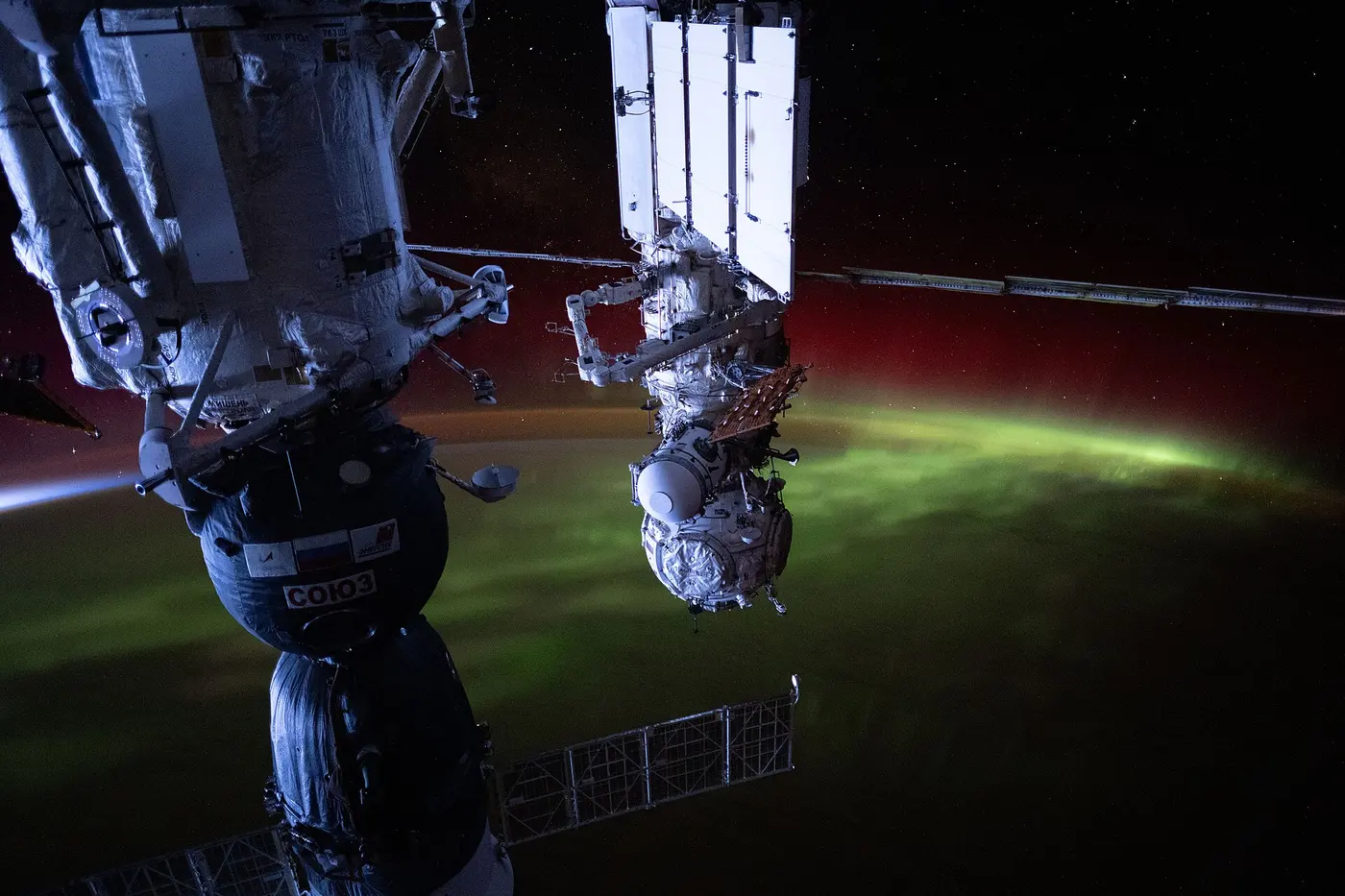
Auroras can also be watched from space. The International Space Station orbits at an altitude of about 400 kilometers (250 miles), roughly level with or above the height where auroras shine, so astronauts can look down on ribbons of green and red light flowing along the edge of the Earth.

Nor are auroras unique to Earth. The same thing happens on any planet with a magnetic field and an atmosphere. The Hubble Space Telescope and other instruments have captured enormous auroras ringing the poles of Jupiter and Saturn.