What happens if you cry in space?
Your tears don’t fall. They collect on your eye as a ball of water that keeps growing.
At the climax of a film, a single tear runs down the hero’s cheek. For us, tears are things that flow. Once they spill out of the eye, gravity pulls them down the cheek until they drip from the chin.
So what happens if you cry aboard a space station, where you barely feel gravity at all? In 2013, one astronaut answered that simple question by trying it himself.
Tears still come in space
First, let’s be clear: you can cry in space. The tear glands keep working regardless of gravity. Just as on the ground, the surface of the eye is constantly kept moist by a thin film of tears, and if something gets in your eye or your emotions run high, tears well up.
The difference is what happens next. On the ground, overflowing tears run downward thanks to gravity. On a space station, though, everything is falling around Earth together, so there is effectively no force pulling the tears down.
That is where surface tension takes over. Water tends to pull itself together into a single blob, keeping its surface area as small as possible. On Earth, gravity overwhelms this force, but in space it becomes the strongest player. That is why water spilled on a space station turns into floating, wobbling spheres.
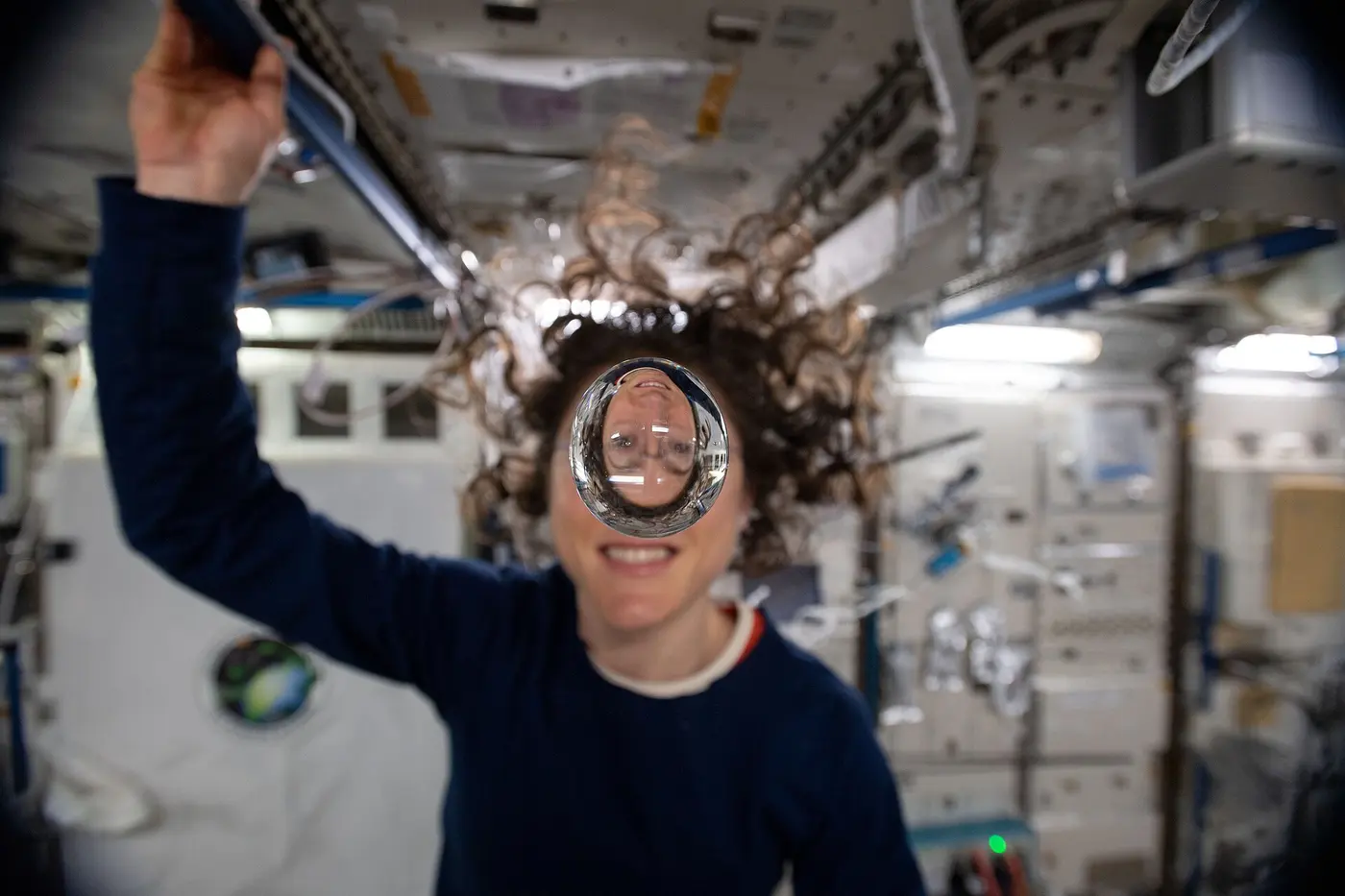

Commander Hadfield shows how to cry
In 2013, Chris Hadfield—the first Canadian to command the International Space Station—posted a series of videos about everyday life in orbit. One of them showed what happens when you cry in space.
Of course, it’s not easy to cry on cue in front of a camera. So he squirted water from a bottle into his own eye as a stand-in for tears. Instead of running down his cheek, the water formed a jiggly blob around his eye and stuck there.
As Hadfield explained, if you keep crying, the ball of water on your eye just gets bigger and bigger. Eventually it either crosses your nose into your other eye, evaporates, spreads over your cheek, or you wipe it off with a towel. In other words, in space tears don’t “flow”—they “pile up.”
The spacewalk where tears blinded him
Hadfield had actually learned how troublesome this can be years earlier. In April 2001, on a space shuttle mission, he became the first Canadian to make a spacewalk.
Partway through the work, he felt a sudden, sharp pain in one eye. Some of the anti-fog solution that had been wiped on the inside of his helmet visor had gotten into it. His eye reflexively filled with tears, but they would not run away. The ball of tears grew and grew until it crossed over his nose and into his other eye. There, in the middle of space, he was temporarily left almost unable to see out of either eye.
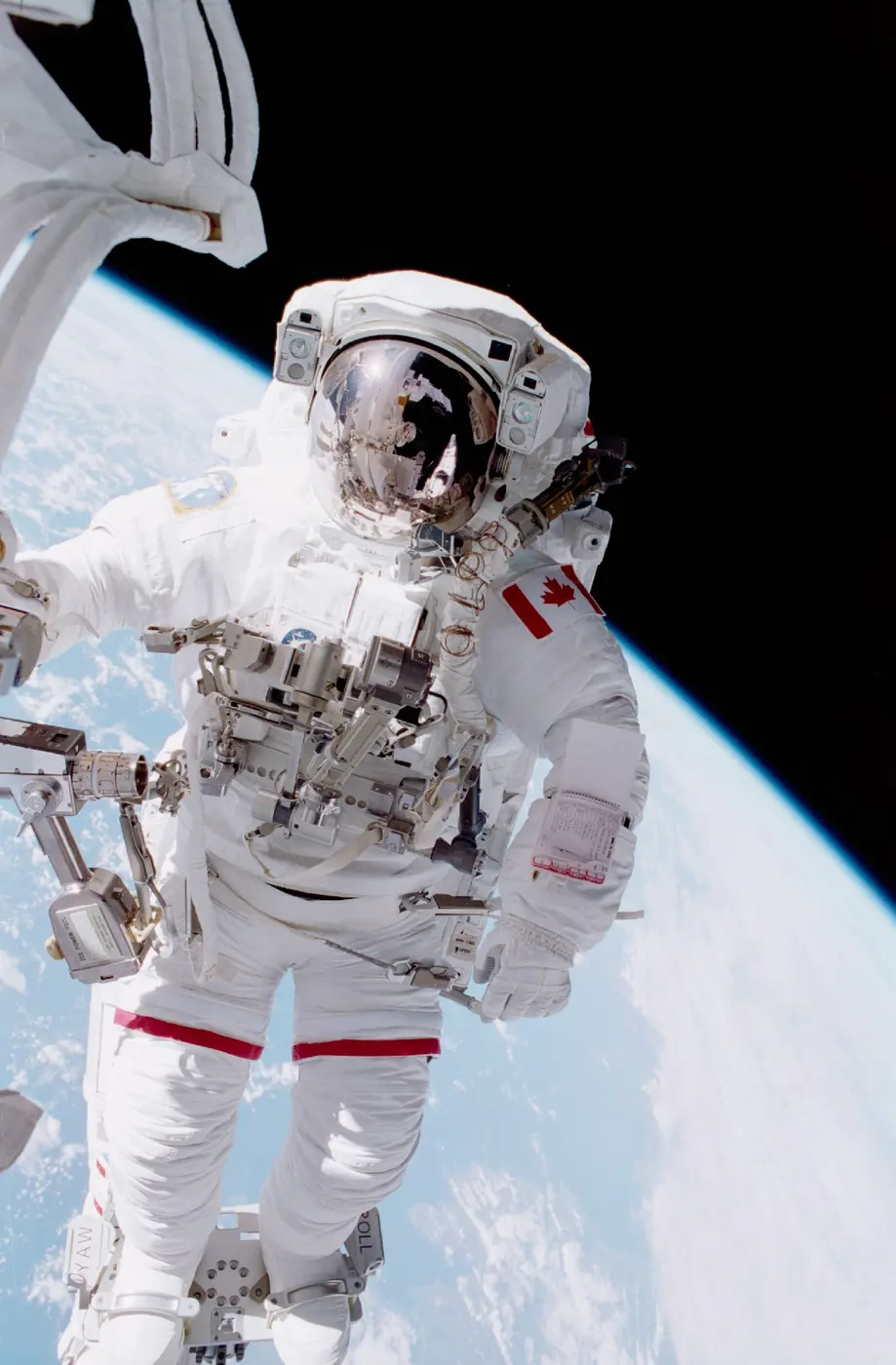

Hadfield stayed calm, kept in contact with ground control, and let oxygen from his suit vent out a little at a time to flush the air inside his helmet. Eventually his tears diluted the irritant, his sight returned, and he finished the planned work. In a later talk about the experience, he said that baby shampoo that doesn’t sting the eyes is now used as the anti-fog solution, and that it probably should have been used from the start.
On the ground, a quick rub of the eye would have solved the problem. Inside a spacesuit helmet, though, you can’t even touch your face. Without gravity, a few tears can become a serious problem.