Do cows really have four stomachs?
Yes, in a sense: not four separate stomachs, but one stomach divided into four chambers.
80%
Look closely at the menu in a yakiniku restaurant, where diners grill bite-size pieces of meat at the table, and you may find some unfamiliar cuts: mino, hachinosu, senmai and giara. They could hardly differ more in texture and appearance, yet all four are parts of a cow’s stomach.
People often say that cows have four stomachs. That isn’t wrong, but it needs a little clarification.
One stomach, four rooms
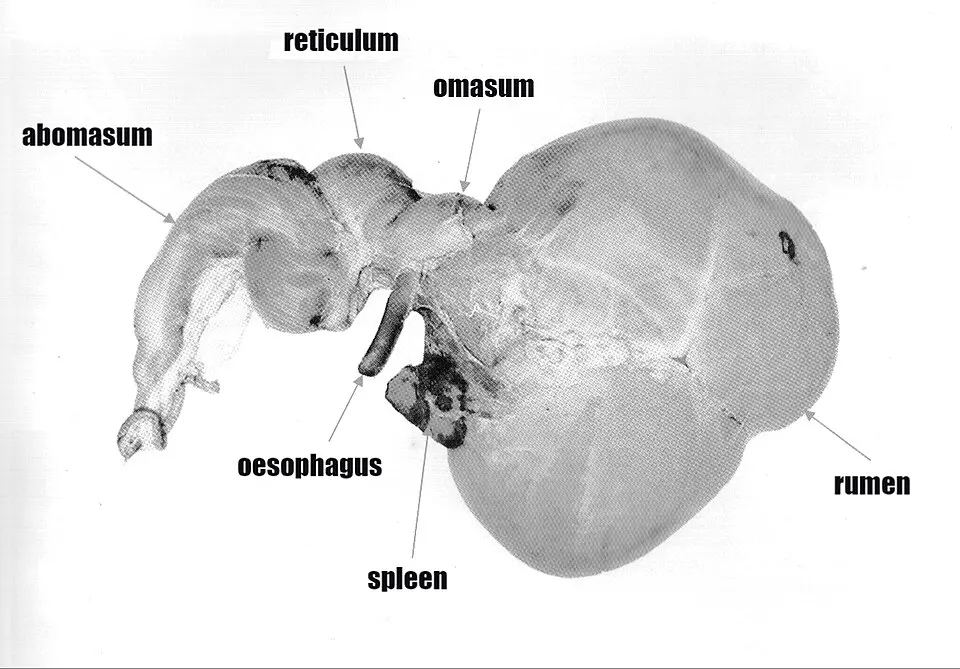
A cow does not have four independent stomachs lined up in a row. It is more accurate to say that a single stomach, connected to the esophagus, is divided into four chambers with different jobs.
The largest is the first chamber, the rumen. It accounts for about 80 percent of the total volume of the four chambers and, in an adult cow, is said to hold more than 100 liters, or by some accounts around 200 liters (roughly 26 to 53 gallons). This is the cut called mino, a name said to come from the way it looks when sliced open, like a mino, a traditional Japanese straw raincoat.
The second chamber, the reticulum, has a honeycomb-like mesh pattern on its inner surface, which is why it is called hachinosu, or “beehive.” It works together with the rumen, sending food back up to the mouth and passing finer material on to the next chamber.
Inside the third chamber, the omasum, folds of tissue are stacked like the pages of a book. Those many folds give it the name senmai, “a thousand sheets.” Its main job is absorbing water and minerals.
The fourth chamber is giara (there are several theories about where this name comes from). It secretes stomach acid and digestive enzymes to digest food, and because it is the chamber most similar to the human stomach, it is sometimes called the “true stomach.”

Microbes do the heavy lifting
Cows need such a complicated stomach because their main food is grass. Cellulose, the main component of grass, is extremely tough, and cows have no enzymes of their own to break it down.
That is where the enormous population of microbes in the rumen comes in. A single milliliter of rumen contents is said to contain 10 to 50 billion bacteria alone, plus around a million protozoa, and with the help of fungi as well, these microbes ferment and break down the grass on the cow’s behalf. The cow absorbs the fatty acids produced in the process through the stomach wall and uses them as fuel. The rumen is essentially a giant fermentation tank.
Once the microbes have done their work, they travel with the food to the fourth chamber, where they are digested in turn as nourishment for the cow. A cow may look like it lives on grass, but it is also eating the microbes it raised on that grass. Fermentation also produces methane, which the cow releases by belching.
Hours of chewing every day
Cows in a pasture are often seen working their jaws even when they aren’t grazing. This is rumination, or chewing the cud. The cow brings grass it has already swallowed back up from the rumen to the mouth, chews it again and swallows it, over and over.
A cow is said to spend about 6 to 10 hours a day ruminating, chewing each mouthful about 50 times in roughly a minute. Chewing breaks the grass down so the microbes can work on it more easily, and the copious saliva helps neutralize the stomach contents, which tend to turn acidic during fermentation. A cow is said to produce more than 100 liters of saliva a day.
In calves, the fourth chamber rules
A newborn calf doesn’t eat grass yet. Its stomach is built differently from an adult’s: the fourth chamber, which digests milk, makes up about 70 percent of the whole stomach. As the calf grows and starts eating grass, the rumen develops dramatically.
The four chambers do not come in fixed proportions from the start; they grow to suit what the animal eats. All four are present from birth, but the balance between them shifts completely as the diet changes from milk to grass.