Why does eating ice cream give you a brain freeze?
It’s thought the brain reads sudden cold on the roof of the mouth or back of the throat as pain in the head.
Picture a cup of kakigōri, Japanese shaved ice drenched in syrup, bought from a stall at a summer festival. Beaten by the heat, you shovel spoonful after spoonful of the icy mound into your mouth. A few seconds later, a piercing pain shoots through the space behind your forehead or at your temples. Plenty of people know the moment: eyes squeezed shut, head in hands.
The cold thing is touching the inside of your mouth, yet for some reason it is your head that hurts. This peculiar pain has a proper medical name, and researchers have been working out how it happens.
A headache with an official entry
In everyday speech it is called “ice cream headache” or “brain freeze.” The name sounds like a joke, but the pain has a genuine entry in the International Classification of Headache Disorders, the system doctors around the world use to categorize headaches. There it is listed as “headache attributed to ingestion or inhalation of a cold stimulus.”
Its hallmark is pain in the forehead or temples that begins right after something cold touches the roof of the mouth or the back of the throat. By the classification’s definition, it fades within 10 minutes after the cold stimulus is removed, but in practice it nearly always disappears within a few seconds to a few tens of seconds.
There has even been an experiment on how eating style makes a difference. In a study published in a British medical journal in 2002, 145 middle-school students were split into two groups: one ate ice cream quickly, the other slowly. Headaches struck about 27 percent of the fast eaters and about 13 percent of the slow eaters, a roughly twofold difference.
A case of mistaken location
So how does cold in the mouth turn into pain in the head? The key is the trigeminal nerve, which carries sensation from the face to the brain.
As its name suggests, the trigeminal nerve splits into three large branches, which handle sensation from the forehead and around the eyes, the cheeks, the jaw, the inside of the mouth and more. When the roof of the mouth or the back of the throat is suddenly chilled, that intense signal travels along this nerve to the brain. But the brain is thought to be unable to tell precisely where the signal came from, so it ends up feeling pain around the forehead and temples, which are served by the same nerve.
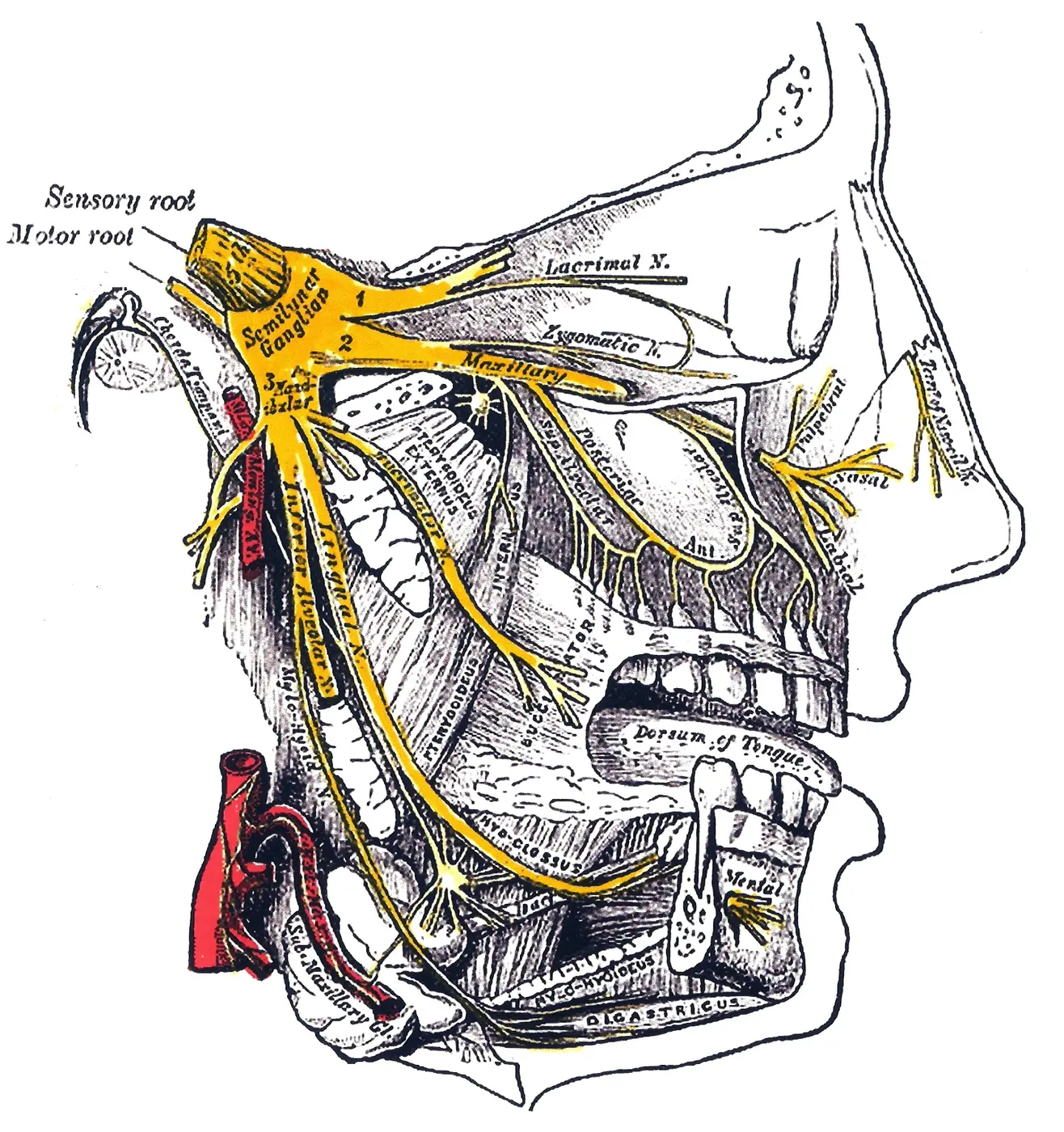

Feeling pain somewhere other than where the stimulus actually is has a name: “referred pain.” The ache in the left shoulder or arm that can come with heart trouble is a well-known example of the same phenomenon.
Do blood vessels in the head suddenly widen?
Another line of research focuses on changes in the brain’s blood vessels. In 2012, a team of American researchers reported an experiment in which 13 adults sipped ice water through a straw aimed at the roof of the mouth while their brain blood flow was monitored.
Right as the headache began, they found, a blood vessel supplying the front of the brain suddenly widened and blood flow increased; when the vessel returned to normal, the pain went away too. The team suspects that blood flow rises in an attempt to warm the suddenly chilled brain, and that the pain comes along with it. But it was a small experiment, and the mechanism is not yet fully understood.
It is also known that people who get migraines tend to be more prone to brain freeze. How easily you get headaches, it seems, partly depends on your constitution.
Living with it
The best prevention, as the 2002 experiment showed, is to eat slowly. Instead of cramming in a big mouthful, let it melt a little at the front of your mouth before swallowing. That keeps the roof of your mouth and the back of your throat from getting chilled all at once.


If the pain hits anyway, commonly suggested remedies include pressing your tongue against the roof of your mouth to warm it, or drinking room-temperature water. Either way, brain freeze usually goes away on its own in a short time. If you have a severe, lasting headache without having eaten anything cold, something else may be the cause, so it is worth seeing a doctor.