Would your blood vessels really wrap around the Earth two and a half times?
That “100,000 km” comes from a rough calculation made a century ago. Recent estimates are far shorter.
“Join up all the blood vessels in the human body and they would stretch about 100,000 kilometers, enough to go around the Earth two and a half times.” Many people have come across this claim in science books or on health programs. The Earth is about 40,000 kilometers around, so 100,000 kilometers would indeed be two and a half laps.
But the figure comes from a very rough calculation made about 100 years ago. And the model for that calculation was a heavily muscled person weighing more than 140 kilograms (over 300 pounds), the kind of body you would rarely meet in real life.
A Nobel laureate’s number
The first person to put forward the 100,000-kilometer figure was the Danish physiologist August Krogh, who won the 1920 Nobel Prize in Physiology or Medicine for his research on how capillaries in muscle regulate blood flow.
Krogh sliced animal muscle thinly, looked at it under a microscope, and counted how many capillaries there were per square millimeter of cross-section. Using that density, he estimated the total length of capillaries in all the muscles of the human body. In a book published in 1922, he put the length at 100,000 kilometers.
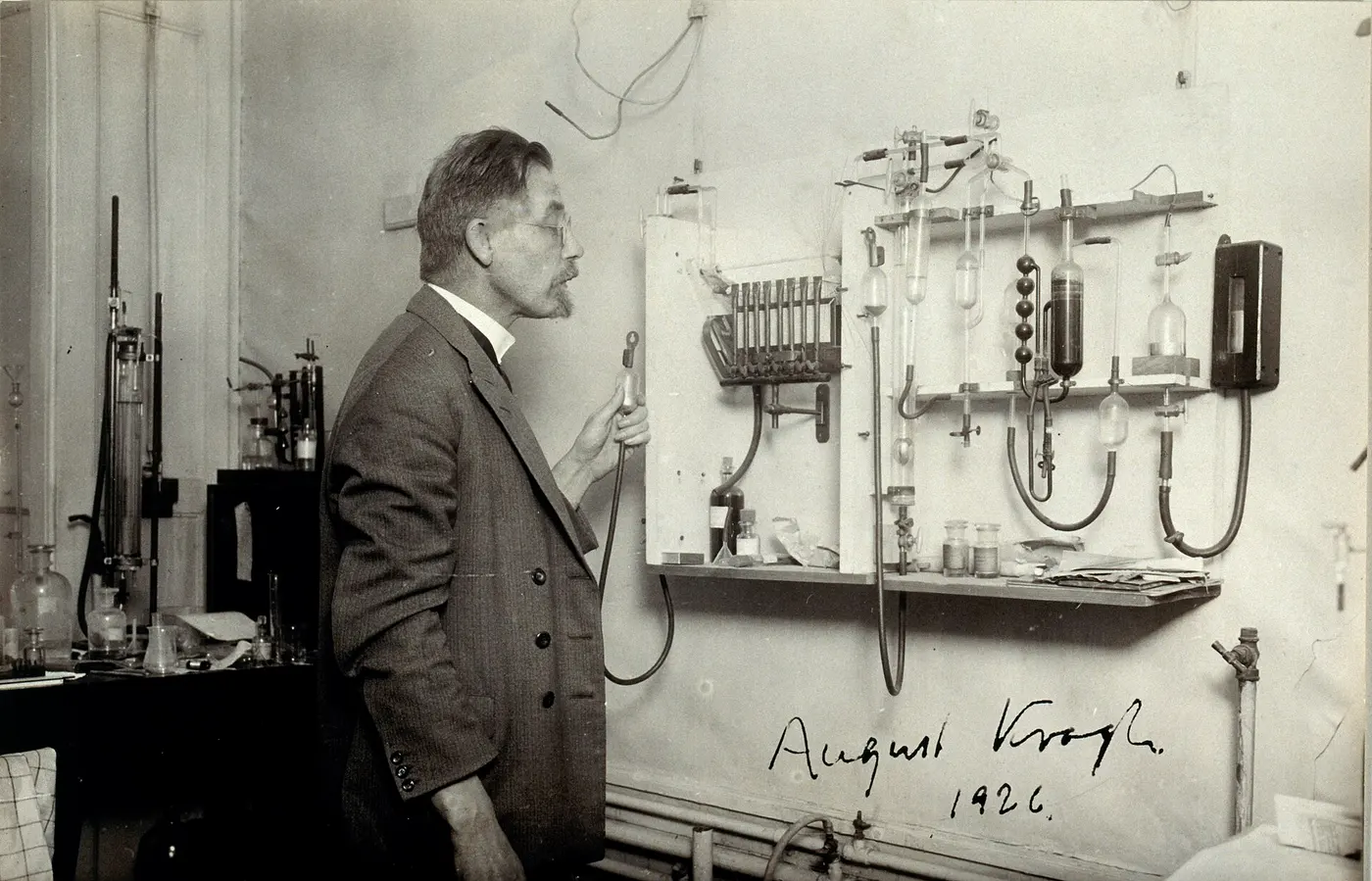

In fact, Krogh himself was troubled by how large this number was. Filling that many capillaries with blood would mean about a third of all the body’s blood sitting in the muscles. His solution was to propose that in resting muscle most capillaries are closed, opening up during exercise. This idea of “capillary recruitment” went on to have a major influence on later research.
A 143-kilogram man with 50 kilograms of muscle
In 2020, the physiologist David Poole of Kansas State University in the United States and his colleagues re-examined the calculation in a paper looking back on Krogh’s achievements.
They found a number of overestimates. Krogh had assumed a person with 50 kilograms of muscle alone. If muscle makes up about 35 percent of body weight, that person would weigh about 143 kilograms (315 pounds). On top of that, the capillary density used in the calculation, 2,000 per square millimeter, is several times higher than the values actually measured in human muscle.
So Poole’s team redid the calculation for a person weighing 70 kilograms with 24.5 kilograms of muscle, using a density of about 300 capillaries per square millimeter, a value measured in human thigh muscle. The result for the length of muscle capillaries: 9,000 to 19,000 kilometers. Far from two and a half laps of the Earth, that isn’t even halfway around.
Poole and his colleagues also note that blood flows through almost all capillaries even in resting muscle. If there are actually far fewer capillaries, the blood-volume problem that troubled Krogh never arises in the first place.
Most of the length is capillaries
Capillaries account for most of the total length of our blood vessels. The aorta, just as it leaves the heart, is about 2 to 3 centimeters (around an inch) across, but as the vessels branch again and again they grow ever narrower, until the capillaries are only about 5 to 10 micrometers in diameter. That’s around a hundredth of a millimeter, just wide enough for red blood cells to squeeze through in single file.
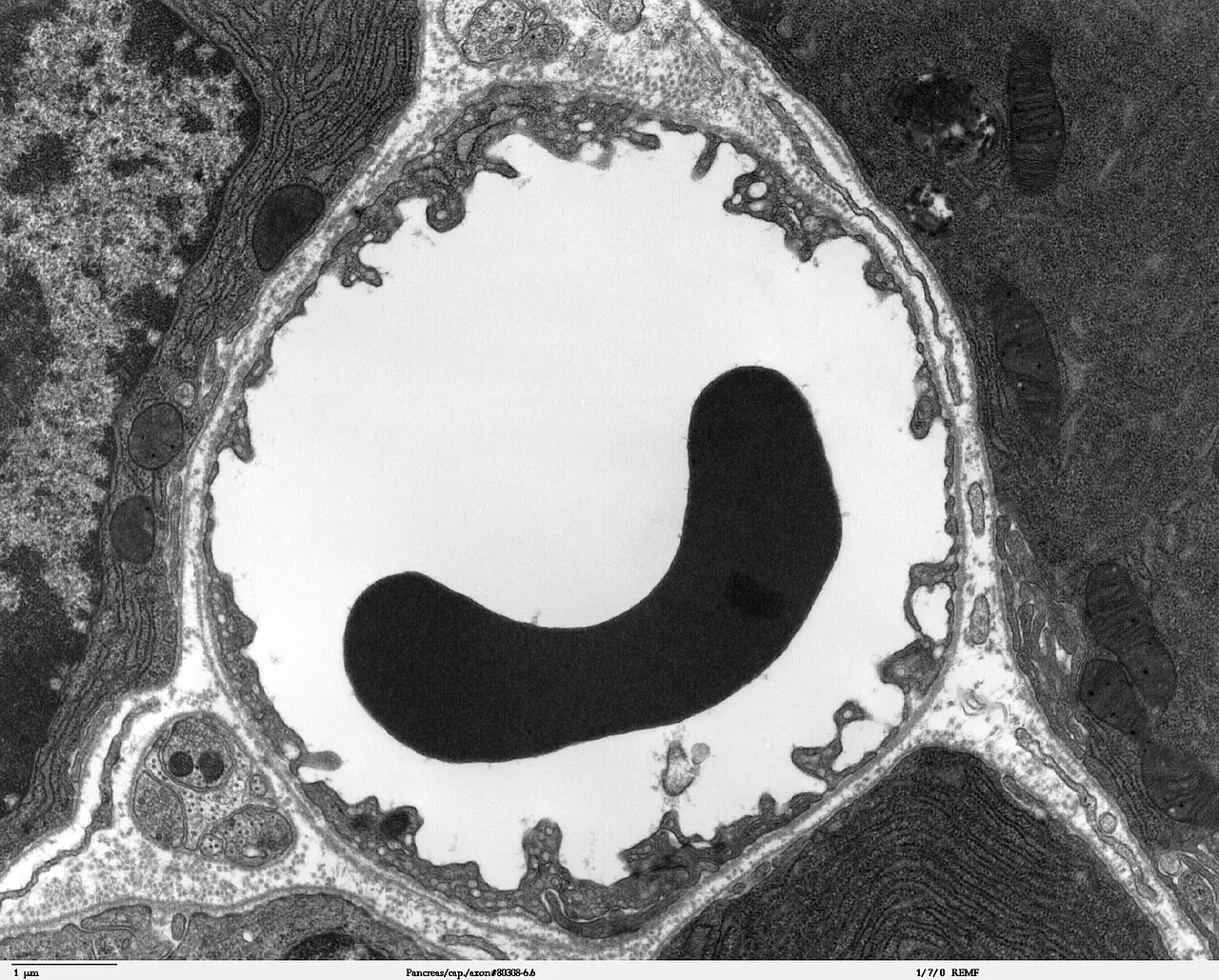

These fine tubes form a mesh that reaches right up to cells in every corner of the body, delivering oxygen and nutrients. Because there are vastly more of them than any other kind of vessel, they make up almost all of the length when everything is added together.
Note that Poole’s figure covers only the capillaries in muscle; the exact length of all the body’s blood vessels, including those in the lungs, liver, brain and elsewhere, is still not known. Even so, it seems safe to say that “two and a half times around the Earth” is an overestimate. And still, thousands of kilometers of blood vessels packed inside each of us is an astonishing length.