Is a baobab’s trunk full of water?
Not like a hollow tank. The water is held in the wood itself, which is soft and soaked like a sponge.
79%
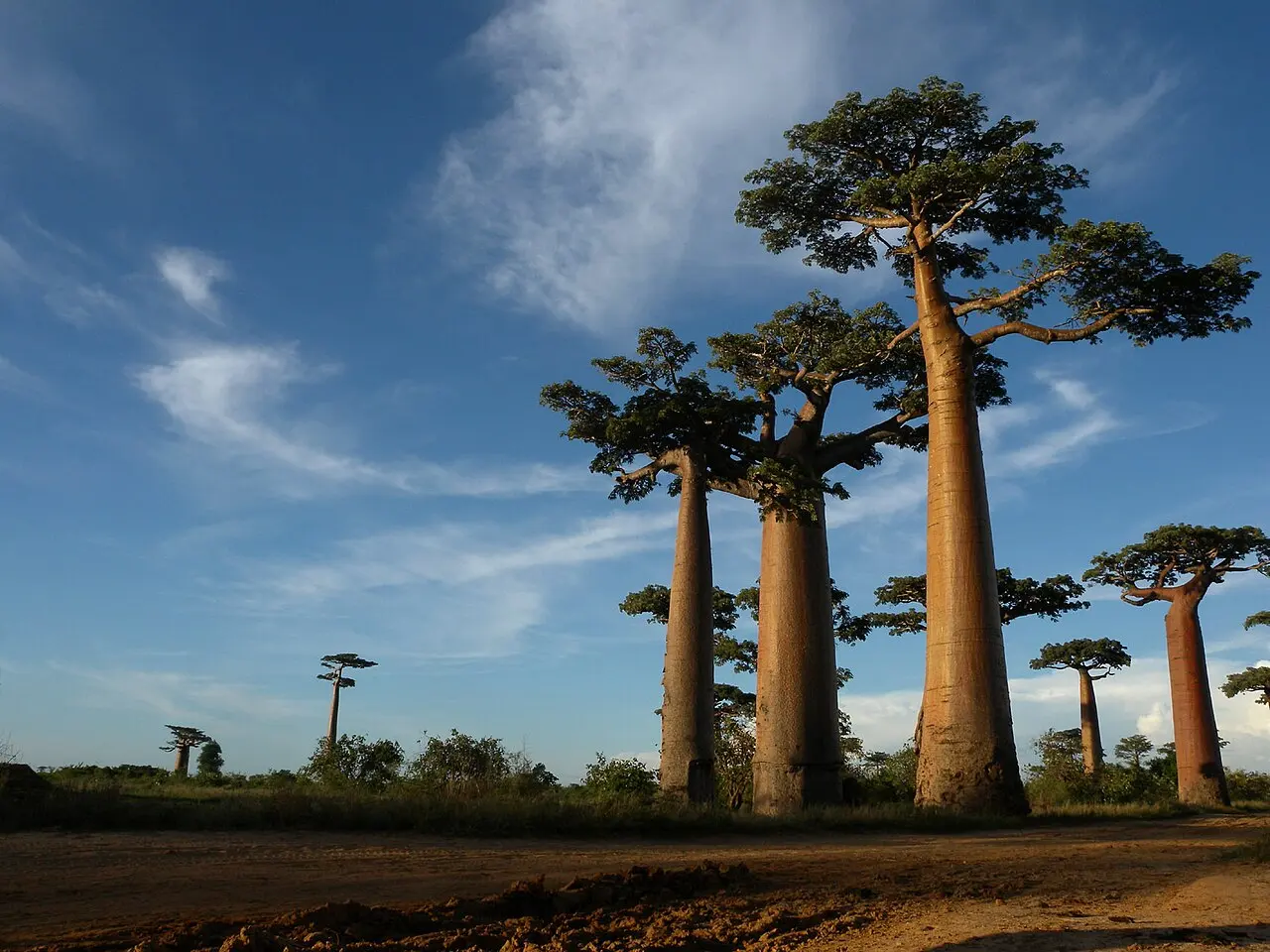
On the dry plains of Africa and Madagascar stand trees with trunks as stout as beer bottles. These are baobabs. With short branches spread only at the very top, they look as if someone had turned a tree upside down and planted it with its roots in the air.
You may have heard that these fat trunks are full of water. Baobabs certainly are famous as “water-storing trees.” But what is inside is a little different from the water tank we might imagine.
The tree planted upside down
Baobabs belong to the genus Adansonia in the mallow family, and eight species are known. Six grow only in Madagascar, one ranges from mainland Africa to the Arabian Peninsula, and one lives in Australia.
The African baobab drops all its leaves in the dry season and spends about eight months bare. With nothing but branches left, its crown looks even more like a set of roots. That is why it is also called the “upside-down tree,” and legends are said to survive in many places telling how an angry god planted it upside down, or something along those lines.

A trunk like a sponge
So what is inside the trunk? Contrary to a common misconception, a baobab’s trunk is not hollow with water sloshing around inside. The water is stored in the wood that makes up the trunk.
A research team from Harvard University in the United States studied the wood of the six baobab species native to Madagascar and reported its findings in 2006. The wood contained up to 79 percent water. Its density was just 0.09 to 0.17 grams per cubic centimeter, far lower than that of ordinary trees, and 69 to 88 percent of it consisted of parenchyma, soft cells that readily hold water. A baobab’s trunk is made of wood that is like a water-soaked sponge.
Large trees are sometimes said to store more than 100,000 liters (about 26,000 gallons) of water, but estimates vary widely. The trunk is also known to swell and shrink with rainfall, so there is little doubt that it does store water.
What is the water for?
When researchers looked at how the stored water is actually used, though, they found something unexpected.
The same team measured water use during the dry season in three baobab species in Madagascar. Near the end of the dry season, before the rains arrive, baobabs put out new leaves, yet at that time almost no water was flowing up from the roots. The new leaves were grown almost entirely on water stored in the trunk. During this period, the trunk’s water content dropped by as much as 12 percent.
On the other hand, the trees opened the pores on their leaves wide and began photosynthesizing in earnest only after substantial rain had fallen. The stored water was being used less to keep photosynthesis going through drought and more to prepare leaves for a running start when the rainy season began.
The team also thinks the water helps hold the tree up. They found that as baobab wood loses water, it becomes less stiff and bends more easily. Use too much water, and the tree might not be able to support its enormous bulk. A baobab’s water may be both a drinking supply and part of its skeleton.
Real hollows have another cause
Still, some baobabs really do have large hollows inside. Certain old African baobabs are thought to have grown from several stems fused together in a ring, leaving a space in the middle. One old tree in Namibia has a hollow big enough for about 35 people and has reportedly served as a chapel and a post office.
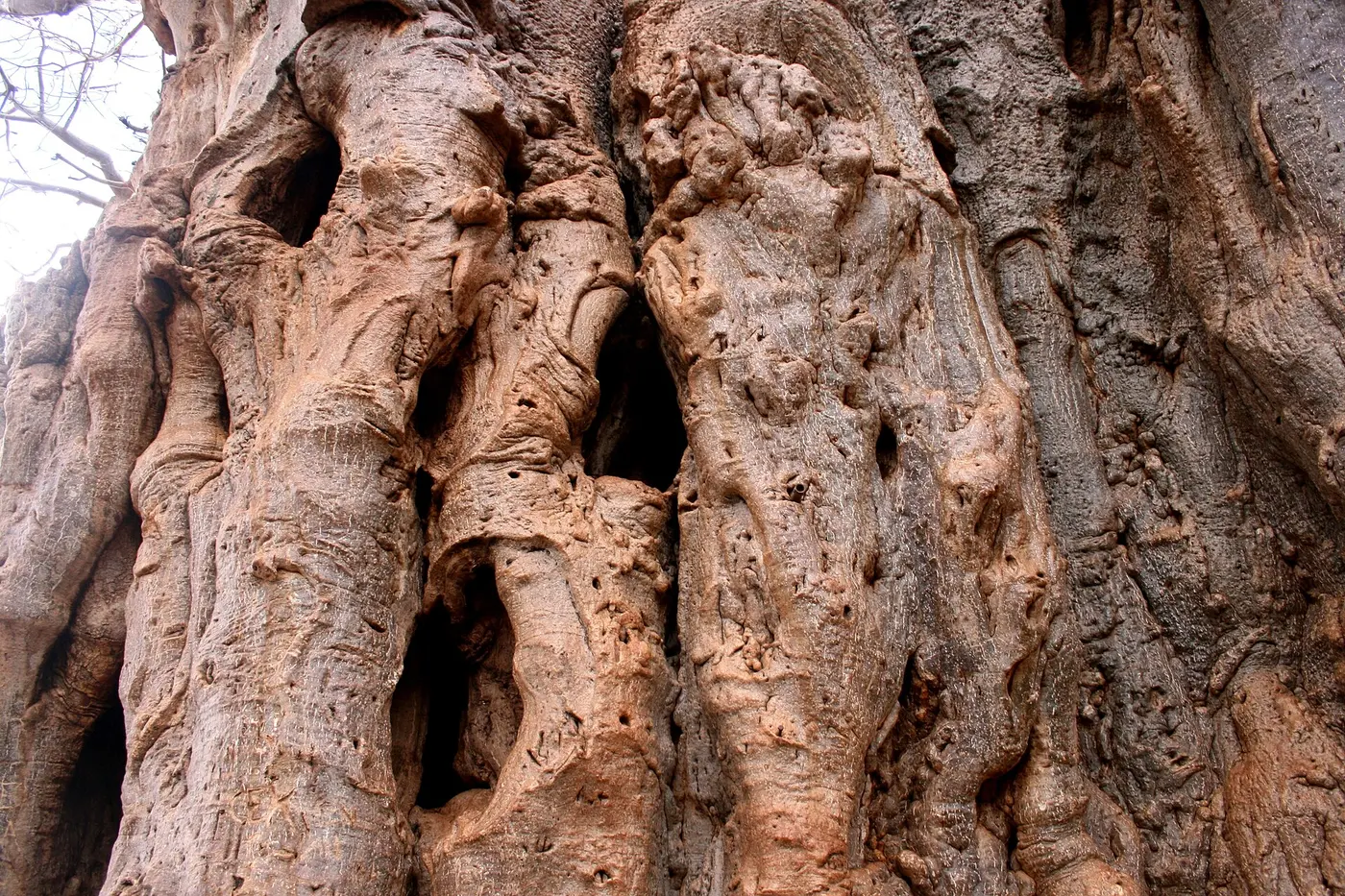

Baobabs live a very long time. A tree in Zimbabwe known as Panke is estimated to have been about 2,450 years old when it died in 2011. Since the start of the 21st century, however, many of Africa’s oldest and largest baobabs have been reported dying one after another, and researchers suggest drought and rising temperatures may be involved.