Why do some people’s faces turn red when they drink?
Because acetaldehyde, a substance produced as the body breaks down alcohol, builds up in their bodies.
40%
Some people turn red in the face and neck after a single celebratory beer. Others can drink glass after glass without the slightest change in color. Being able to “hold your liquor” is often treated as a matter of practice or willpower, but in fact an inborn trait plays a big part.
What’s more, the redness isn’t caused by alcohol itself. It’s the work of a substance produced partway through the body’s breakdown of alcohol.
The culprit: acetaldehyde
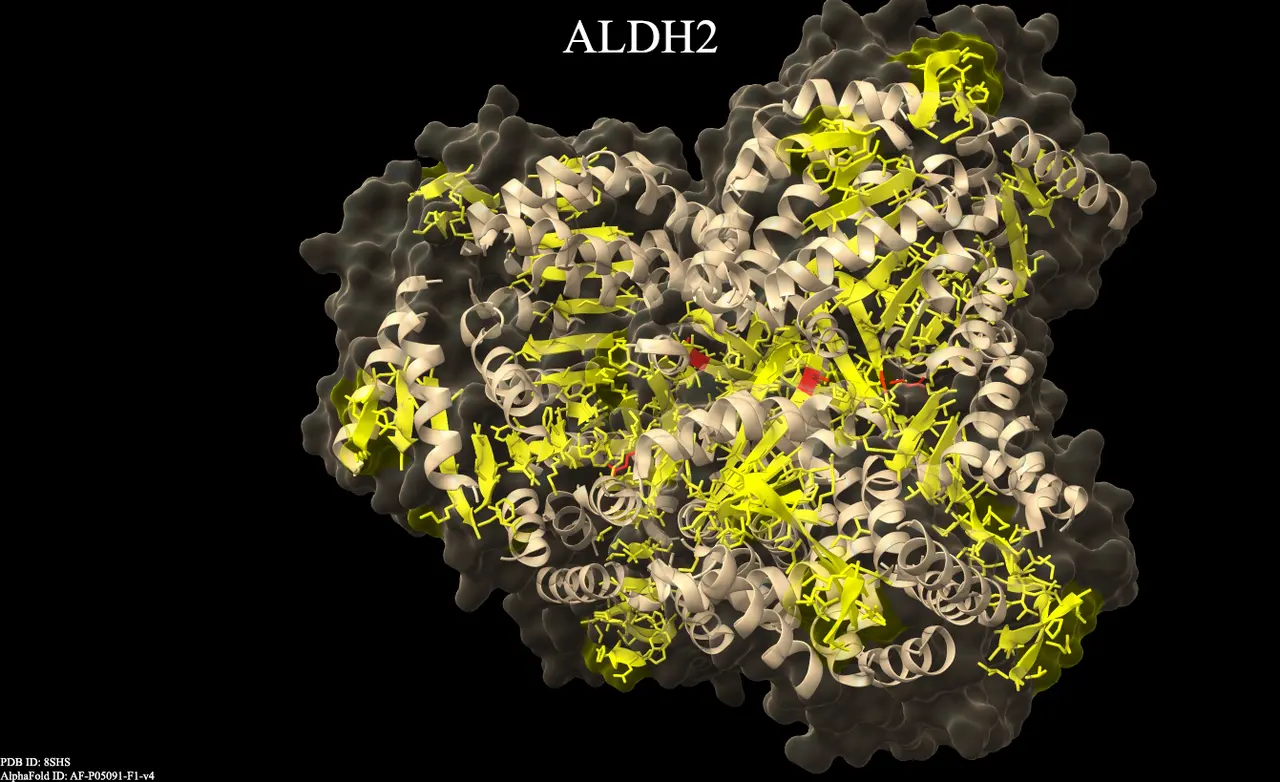
The alcohol we drink (ethanol) is broken down mainly in the liver, in two steps. First, enzymes such as alcohol dehydrogenase turn it into a substance called acetaldehyde. Then an enzyme called aldehyde dehydrogenase 2, or ALDH2 for short, turns that into acetic acid, the compound that gives vinegar its sourness.
The acetaldehyde produced along the way is highly toxic. Besides widening blood vessels and reddening the face, it causes a racing heart, nausea and headaches, and it is also thought to be one of the causes of hangovers.
When ALDH2 works properly, acetaldehyde is quickly converted to acetic acid. But in people whose enzyme is weak, acetaldehyde lingers and builds up in the body, so even a little alcohol turns their faces red. This is known as the alcohol flush reaction.

About 40 percent of Japanese people have the “weak” type
How well ALDH2 works is largely determined by a difference at a single spot in one gene. We inherit one copy of the gene from each parent. If both copies work, you have the “active” type; if one doesn’t, the “low-activity” type; and if neither does, the “inactive” type.
According to Dr. Akira Yokoyama of Kurihama Medical and Addiction Center, a specialist institution for alcohol-related medicine in Japan, a little over 50 percent of Japanese people have the active type, around 40 percent the low-activity type, and a few percent the inactive type. People with the inactive type can barely drink at all. Even for a low-activity person weighing 60 kilograms (about 130 pounds), a single glass of beer is said to push acetaldehyde to a peak five times higher than an active-type person reaches after drinking 1.5 liters of beer.
The non-working version of the gene is almost absent among Europeans and Africans and is concentrated in East Asia, in places such as China, Japan and Korea. It is especially common in southern China, and why it spread there, and whether it offered any advantage, is still unclear. It seems to have been brought to Japan from the mainland around the Yayoi period (an era that began in the first millennium BC), and its frequency varies within the country: people with a weak type make up around 50 percent of the population in northern Kyushu and the Kinki region around Osaka and Kyoto, but under 40 percent in the Tohoku region and southern Kyushu.
Flushers, take note
The flush reaction is the body’s way of signaling that it doesn’t handle alcohol well. One thing to watch out for is that some people with the low-activity type get used to drinking over time and stop feeling so uncomfortable. Even so, the enzyme itself does not become any stronger.
Acetaldehyde is carcinogenic. The International Agency for Research on Cancer, part of the World Health Organization (WHO), classifies acetaldehyde produced in the body from drinking alcohol in Group 1, “carcinogenic to humans.” Many studies have reported that when people with the low-activity type keep drinking heavily, acetaldehyde tends to accumulate in the esophagus, mouth and throat, and their risk of cancer in these areas rises sharply. Sixty to seventy percent of esophageal cancer patients in Japan are said to carry the low-activity version of the gene.


Besides genetic testing, there’s a simple way to get a rough idea of your type. According to Dr. Yokoyama, if you combine people whose faces turn red right after one glass of beer with people who don’t flush now but did during their first year or two of drinking, you can identify those with weak ALDH2 with about 90 percent accuracy.