Why does the winter sky have so many bright stars?
Clear air is only part of it. On winter nights we face a part of the sky that really is crowded with bright stars.
8stars
Step outside on a winter night, look south, and bright stars leap out at you: the hunter Orion with the three stars of his belt, Sirius, the brightest star in the night sky, and Procyon above and to its left. Even under light-polluted city skies, the winter constellations are easy to find.
The usual explanation is that cold winter air is especially clear. That helps, but there is a bigger reason. The winter night sky simply holds more bright stars than the skies of other seasons.
A third of the brightest stars
Astronomers in Japan traditionally call any star brighter than magnitude 1.5 a “first-magnitude” star, and there are 21 of them in the whole sky. Seven shine in the winter evening sky as seen from Japan: Betelgeuse and Rigel in Orion, Sirius in Canis Major, Procyon in Canis Minor, Pollux in Gemini, Capella in Auriga and Aldebaran in Taurus. From latitudes south of about 37 degrees north, Canopus in Carina joins them, just above the southern horizon.
Betelgeuse, Sirius and Procyon form the Winter Triangle. Trace a path from Sirius through Procyon, Pollux, Capella, Aldebaran and Rigel and you get a great six-sided figure, the Winter Hexagon, known in Japan as the “Winter Diamond.”
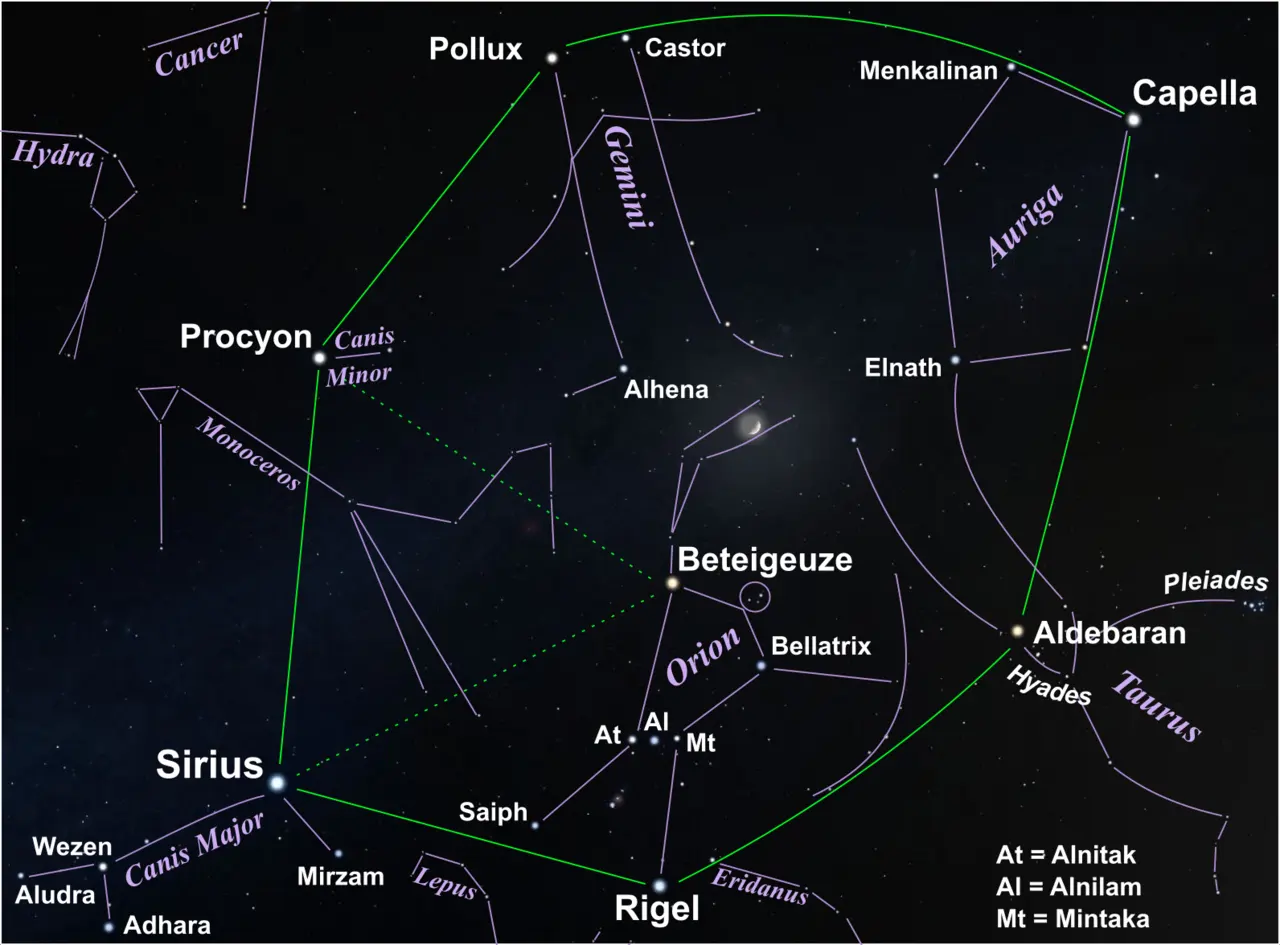

Yoshiya Watanabe, a curator at the Osaka Science Museum, used a star catalog to count stars season by season. Leaving out the areas near the celestial poles and dividing the rest of the sky into four seasonal slices, he found eight first-magnitude stars in the winter sky, four in summer, three in spring and just one in autumn.
Clear air doesn’t explain it
Winter air is certainly dry. According to the Japan Meteorological Agency’s 30-year averages, relative humidity in Tokyo averages 51 percent in January, compared with 76 percent in July. Winter on Japan’s Pacific coast also brings plenty of clear days, which is good news for stargazers.
Yet Watanabe points out that when it comes to sky clarity, autumn actually does better. Winter stars stand out, he says, because there are more bright stars to begin with. Counting every star down to magnitude 6, the faintest the naked eye can see, the same catalog puts about 2,060 stars in the winter sky, far more than autumn’s 1,420 or spring’s 1,350, and more than summer’s 1,850.
Close neighbors and distant superstars
Winter’s bright stars come in two kinds.
Some look bright simply because they are close. Sirius is about 8.6 light-years away and Procyon about 11, making both near neighbors of our solar system.
Others are genuine superstars that look bright despite being far away. Rigel is about 860 light-years away, and estimates for Betelgeuse range from roughly 500 to 700 light-years. Rigel’s radius is about 70 times the Sun’s, and a 2020 study put Betelgeuse’s at about 750 times. Watanabe notes that even our Sun, moved just 18 light-years away, would fade to an unremarkable star of magnitude 3.5. To shine at first magnitude from hundreds of light-years away, a star must be fantastically luminous.
In Watanabe’s survey, most of the winter stars bright enough to see from a city were hot, blue-white stars, and most were giants or supergiants, swollen far larger than the Sun.
A belt of young stars
Bright blue-white stars are massive and young. The more massive a star, the faster it burns through its fuel and the shorter its life; even Betelgeuse is thought to be no more than about 10 million years old. So stars like these are found in or near the places where stars are being born.
Orion is one of those places, and new stars are still forming there today. In the 19th century the astronomers John Herschel and Benjamin Gould noticed that bright blue-white stars line up along a band tilted about 20 degrees from the Milky Way. This Gould Belt runs from Orion through Taurus and Perseus and on into the southern sky through Scorpius, Centaurus and the Southern Cross. On a winter night, we are looking up at one of its busiest stretches.
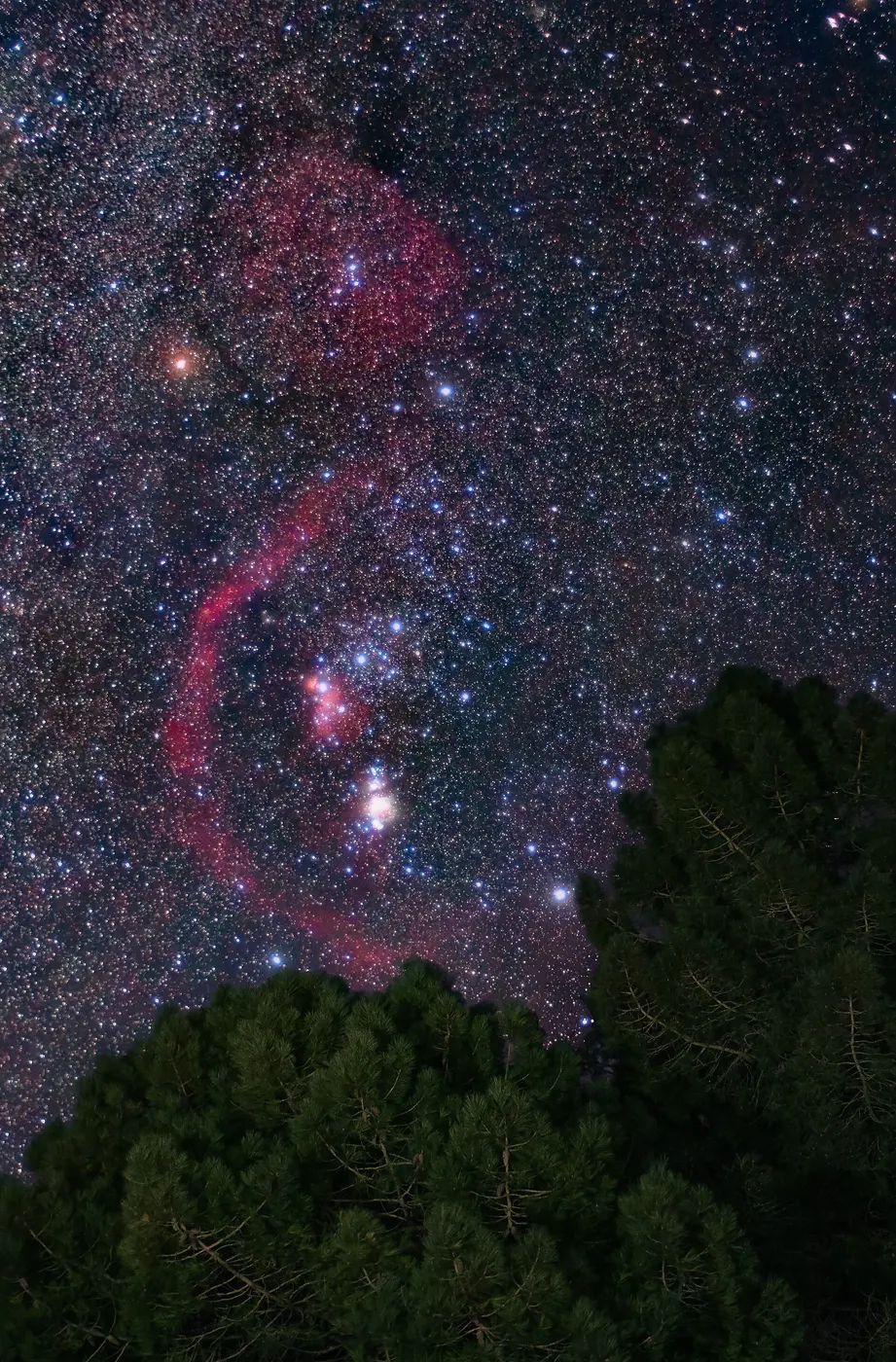

What the belt really is remains an open question. In 2020, astronomers using data from the European Space Agency’s Gaia satellite found the “Radcliffe Wave,” a long, undulating chain of star-forming regions near the Sun. Their work suggests the Gould Belt may be a section of that wave plus an unrelated clump of material, lined up so that together they look like a band.