How much would a spoonful of neutron star weigh?
NASA’s rule of thumb is about a billion tons per teaspoon. Change the assumptions and the figure shifts several-fold; using the star’s average density gives 2 to 3 billion metric tons.
1 billiontons
Neutron stars are among the densest objects in the universe, and almost every description of them comes with a comparison along the lines of “a spoonful would weigh a billion tons.”
Yet the figure varies wildly from one source to the next. The National Radio Astronomy Observatory’s “Ask an Astronomer” page has fielded a question from a reader who had read 100 million tons in one article and a billion in another and wasn’t sure what to believe. So let’s track down where the numbers come from and what they assume.
A star heavier than the Sun, the size of a city
A neutron star is the collapsed core of a massive star. When a star much heavier than the Sun runs out of fuel, its core can no longer support its own weight and caves in. As NASA explains, protons and electrons are crushed together into neutrons, and those neutrons halt the collapse, leaving a neutron star behind.
An ordinary atom is mostly empty space. In a neutron star, that space is gone, and the particles that make up atomic nuclei are packed directly against one another.
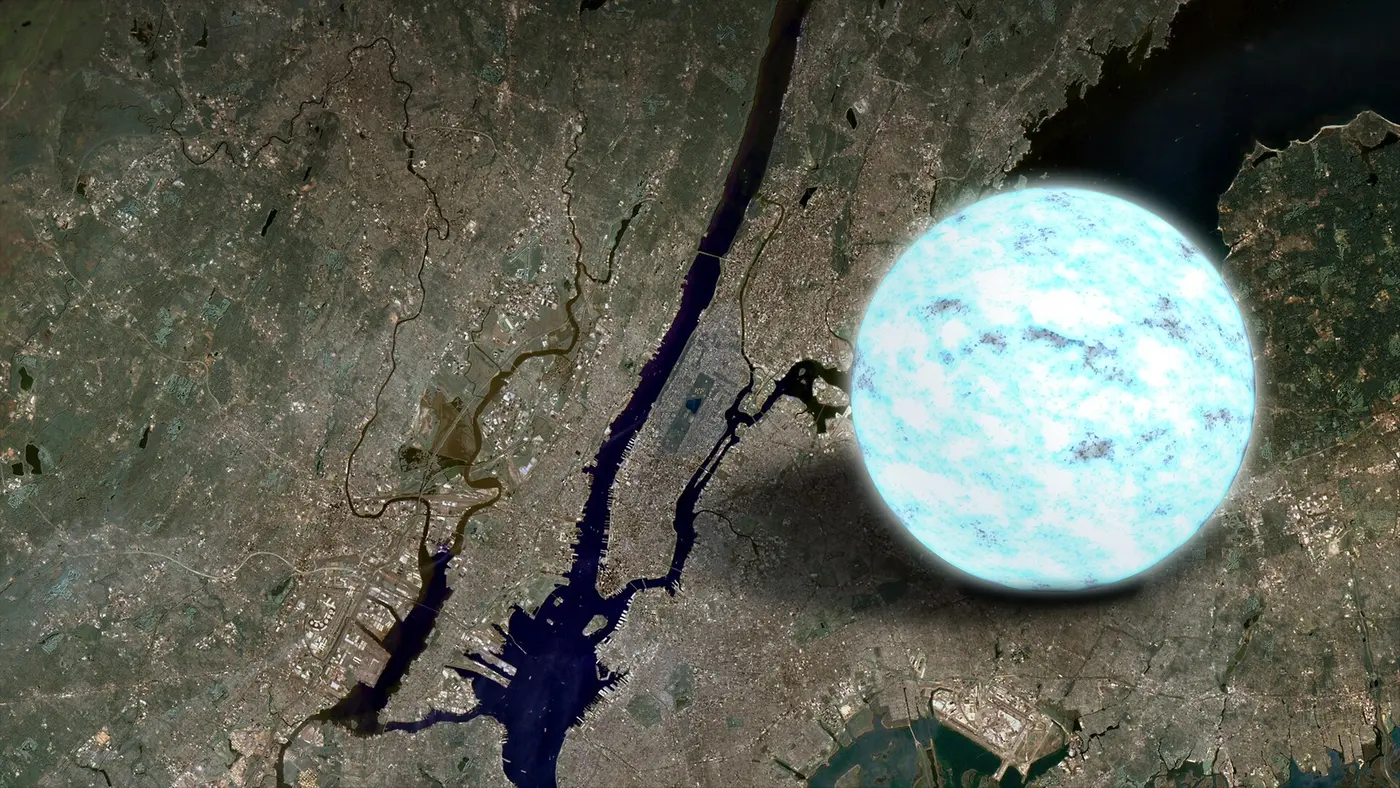
According to NASA, a neutron star measures about 20 kilometers (12.5 miles) across, roughly the size of a city, yet it holds about 1.4 times the mass of the Sun. Observations with NICER, a NASA X-ray telescope mounted on the International Space Station, put the radius of one nearby neutron star at about 11 km (7 miles) in a 2024 study. Other analyses of the same data come out somewhat larger, though, so the exact size is still being pinned down.
Even NASA uses different spoons
Start with NASA’s much-quoted figure. A 2017 NASA release marking NICER’s launch said that “one teaspoon of neutron star matter would weigh a billion tons” on Earth. In the same release, NICER’s principal investigator, Keith Gendreau, put it this way: “If you took Mount Everest and squeezed it into something like a sugar cube, that’s the kind of density we’re talking about.”
Another NASA explainer, however, says that one sugar cube of neutron star material would weigh about 1 trillion kilograms, or 1 billion tons. And a 2018 answer in Astronomy magazine says a tablespoon weighs more than 1 billion tons (900 billion kg). The containers differ in size several times over, yet the answer is always “about a billion tons.” These are order-of-magnitude rules of thumb, not precise calculations. (American tons, about 10 percent lighter than metric ones, muddy things a little further.)
Doing the math
So let’s work it out. Taking a mass of 1.4 Suns and a radius of 10 to 12 kilometers, and dividing mass by volume, gives an average density of roughly 400 to 700 million metric tons per cubic centimeter.
A kitchen teaspoon holds about 5 milliliters, or 5 cubic centimeters. Multiply, and a teaspoon comes to about 2 to 3 billion metric tons. A tablespoon (15 milliliters) would be 6 to 10 billion.
NASA’s “billion tons per teaspoon” is therefore on the modest side. The density of an atomic nucleus is about 230 million metric tons per cubic centimeter, which works out to roughly 1.2 billion tons per teaspoon. NASA’s figure is close to what you get by assuming the star is about as dense as an atomic nucleus.
The density isn’t the same all the way through, either. The outer crust is far lighter, while the core is thought to be squeezed to several times the density of a nucleus. Where you dip your spoon changes the answer several-fold. And according to Astronomy, if you did bring a spoonful to Earth, the matter, no longer held down by the star’s immense gravity, would expand violently in a giant explosion.
A lighthouse spinning 30 times a second
Neutron stars were discovered thanks to a strangely regular radio signal. In 1967, Jocelyn Bell (now Bell Burnell), a graduate student at the University of Cambridge, spotted an odd signal in her radio telescope records. According to the American Physical Society, it repeated precisely every 1.3 seconds or so, and Bell and her supervisor, Antony Hewish, jokingly called the source LGM-1, for “Little Green Men.”
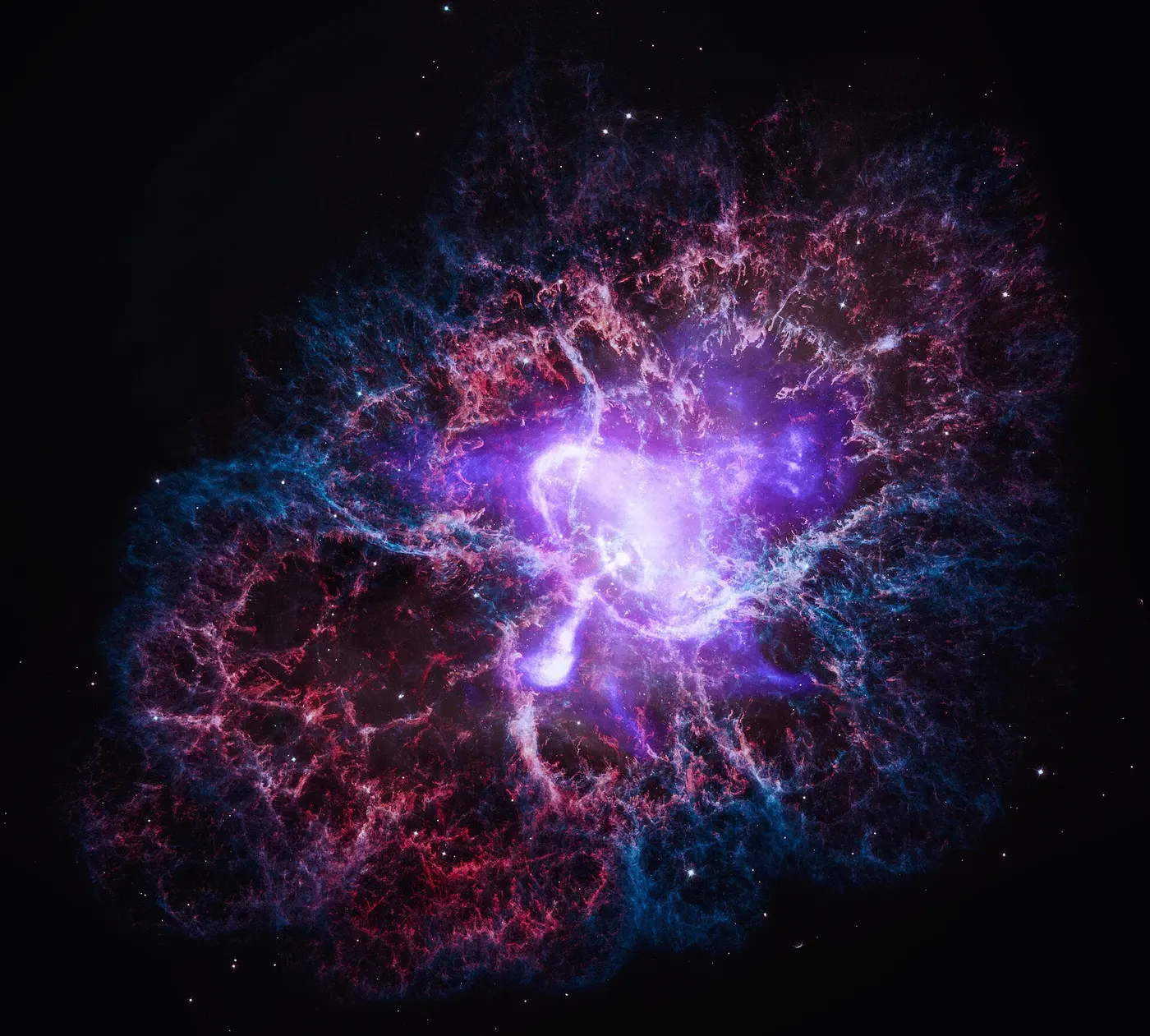

The source turned out to be not aliens but a rapidly spinning neutron star. Beams of radio waves streaming out along its magnetic field sweep past Earth like a lighthouse beam, arriving as pulses. Such objects are called pulsars. The pulsar at the heart of the Crab Nebula, monitored for decades by Jodrell Bank Observatory in England, spins about 30 times a second, and it is the size of a city. In 1974, Hewish shared the Nobel Prize in Physics, honored for his role in the discovery of pulsars, but Bell was not among the laureates, an omission that has been debated ever since.